
Detailed Roadmap to Become a Threat Intelligence Analyst
Becoming a threat intelligence analyst looks simple from a distance: learn cyber threats, read reports, get hired.
Up close, the path is far less forgiving.
This role rewards pattern recognition, disciplined research, technical literacy, and the ability to turn scattered signals into decisions that security teams can actually use. Many candidates stall because they chase tools before learning attacker behavior, collect certifications without building analytical judgment, or confuse news consumption with intelligence work. A real roadmap has to fix those gaps early, or the climb turns into wasted months, weak interviews, and shallow expertise.

1. What a Threat Intelligence Analyst Actually Does Day to Day
A threat intelligence analyst studies adversaries, campaigns, tactics, infrastructure, and risk patterns, then converts that information into guidance that helps an organization detect, prioritize, and respond faster. The work sits at the intersection of research, security operations, incident response, and business context. That is why this path overlaps with a strong foundation in a SOC analyst career guide, practical exposure to cyber threat intelligence collection and analysis, familiarity with incident response plan development and execution, knowledge of SIEM fundamentals, and a broad understanding of ransomware detection, response, and recovery.
In practice, the role usually breaks into five recurring responsibilities. First, intelligence collection: ingesting reporting from open sources, vendor feeds, internal telemetry, dark web monitoring, malware research, and incident cases. Second, analysis: validating credibility, filtering noise, linking campaigns to techniques, mapping behavior to frameworks, and identifying what matters to the organization’s industry, geography, technology stack, and threat profile. Third, dissemination: writing alerts, threat briefs, executive updates, and hunting guidance that defenders can act on. Fourth, collaboration: working with SOC teams, detection engineers, IR specialists, vulnerability teams, and leadership. Fifth, continuous refinement: measuring whether intelligence outputs changed monitoring, improved investigations, or reduced blind spots.
That last part gets ignored too often. Weak analysts collect information. Strong analysts change defender behavior. If a report sounds smart but does not improve triage, harden detection, shape control decisions, or focus leadership attention, it has little operational value. That is why future-ready analysts often strengthen their foundation through a complete guide to becoming a security operations center SOC analyst, sharpen detection context with intrusion detection systems functionality and deployment, build technical depth through vulnerability assessment techniques and tools, study attacker tradecraft in botnets structure and disruption methods, and follow the changing labor market through cybersecurity job market trends and salary predictions.
Threat Intelligence Analyst Roadmap: 26 High-Value Skills, Tools, and Career Leverage Points
| Skill / Focus Area | Why It Matters | How to Build It | Career Leverage |
|---|---|---|---|
| TCP/IP and networking | Attack patterns make more sense when traffic behavior is familiar | Study ports, protocols, DNS, HTTP, TLS, routing, packet flow | Improves alert interpretation and campaign analysis |
| Operating system fundamentals | Threats execute through Windows, Linux, and cloud workloads | Learn processes, logs, persistence, privilege models, services | Helps connect threat reporting to host behavior |
| MITRE ATT&CK mapping | Gives structure to adversary behavior | Map reports and cases to tactics and techniques | Makes intelligence operational for SOC and detection teams |
| Indicator validation | Unverified IOCs create noise and wasted effort | Cross-check reputation, freshness, relevance, and false positives | Builds trust in your outputs |
| Research discipline | Good intelligence depends on source quality | Compare reporting, document confidence, track contradictions | Separates analysts from content repeaters |
| Threat actor profiling | Attackers are easier to predict when behavior is organized | Build profiles around motives, sectors, TTPs, tooling, timing | Supports executive and sector-specific intelligence |
| Malware behavior basics | Campaigns often hinge on malware families and loaders | Study execution chains, beacons, persistence, evasion patterns | Strengthens detection and hunting recommendations |
| Log analysis literacy | Threat claims must connect to evidence | Practice with auth, endpoint, proxy, email, firewall, and DNS logs | Improves real-world credibility in interviews |
| SIEM querying | Intelligence must be testable inside security tooling | Learn basic search, pivots, correlations, and hunt logic | Makes you useful beyond reporting |
| OSINT collection | Many intelligence leads start outside proprietary feeds | Use WHOIS, passive DNS, GitHub, forums, breach sources, social platforms | Essential for junior analysts building depth cheaply |
| Writing concise intelligence notes | Security teams need clarity, not dramatic prose | Write short alerts with confidence statements and actions | Raises visibility with managers fast |
| Confidence scoring | Not every conclusion deserves the same certainty | Rank assessments by evidence depth and source reliability | Shows analytical maturity |
| Priority intelligence requirements | Intelligence fails when it chases everything | Define what leadership, IR, fraud, and SOC teams most need answered | Aligns work with business risk |
| Sector awareness | Finance, healthcare, retail, and government face different threats | Track industry campaigns, regulations, and attack incentives | Improves specialization options |
| Email threat analysis | Phishing remains a major initial access path | Review headers, sender patterns, lure themes, attachment behaviors | Useful in SOC, IR, and intel functions |
| Threat hunting mindset | Intelligence should inspire hypotheses, not just summaries | Translate TTPs into hunt questions and test cases | Bridges intel with detection engineering |
| Basic scripting | Automation reduces repetitive enrichment work | Learn Python for parsing, enrichment, API pulls, IOC cleanup | Creates immediate workflow value |
| Threat intel platforms familiarity | Modern teams manage intelligence at scale | Understand feeds, entities, relationships, tagging, and workflows | Useful for dedicated CTI roles |
| Briefing executives | Leaders need impact, not raw telemetry | Practice translating campaigns into business exposure and decisions | Helps promotion into senior analyst roles |
| Incident context building | Investigations move faster with campaign history | Correlate observed artifacts with known actor patterns | Adds operational depth to investigations |
| Cloud threat awareness | Modern environments shift adversary tradecraft | Study IAM abuse, exposed storage, token misuse, SaaS compromise | Prepares you for future-demand roles |
| Vulnerability exploitation context | Threats often follow exploit chains and exposed weaknesses | Track active exploitation trends and patch urgency signals | Useful for prioritization and advisories |
| Detection logic collaboration | Intelligence is strongest when it shapes controls | Work with engineers to convert TTPs into alerts and detections | Makes your role harder to overlook |
| Report production speed | Delayed intelligence often loses value | Use repeatable templates, triage criteria, and enrichment checklists | Improves consistency under pressure |
| Portfolio building | Hiring managers need proof of your thinking | Publish intelligence notes, ATT&CK mappings, case breakdowns | Major differentiator for first CTI role |
| Analytical humility | Overconfidence damages trust quickly | State uncertainty, update views, correct weak assumptions fast | Essential for long-term credibility |
2. Build the Foundation Before You Chase the Title
The fastest way to sabotage this career is to enter threat intelligence with no grounding in how attacks unfold on real systems. Junior candidates often jump into actor reports, fancy dashboards, and geopolitical commentary, then collapse in interviews when asked how a phishing lure turns into credential theft, how lateral movement appears in logs, or why one IOC matters while another is disposable noise. A sturdier route begins with the basics: networking, endpoint behavior, authentication events, common attack chains, logging, and defensive tooling. That is why many successful candidates start by studying how to transition from IT support to cybersecurity analyst, deepen their understanding of firewall technologies types and configurations, learn access control models DAC MAC and RBAC explained, review virtual private networks security benefits and limitations, and strengthen fundamentals with encryption standards AES RSA and beyond.
From there, the foundation should become operational. Read detection logic. Inspect phishing examples. Practice IOC triage. Compare vendor reporting against MITRE ATT&CK. Build mini case studies around a ransomware campaign, a botnet infrastructure shift, or a wave of credential phishing against cloud tenants. This is where intelligence starts feeling real rather than academic. Candidates who want stronger momentum should combine their learning with security audits processes and best practices, cybersecurity frameworks NIST ISO and COBIT, data loss prevention strategies and tools, phishing attacks trends report analysis and prevention strategies, and state of ransomware original threat analysis and industry impact. Those connections matter in interviews, where employers are often testing whether a candidate can explain threat relevance in a defensive context instead of reciting headlines.
The simplest way to know whether your foundation is strong enough is this: can you read a threat advisory and immediately translate it into probable attack stages, affected controls, useful hunt ideas, likely victim profiles, and realistic remediation priorities? If that answer feels shaky, stay in the foundation phase longer. That patience pays off.
3. The Best Entry Routes Into Threat Intelligence Roles
Very few people land their first cybersecurity job with the exact title “threat intelligence analyst.” Most enter from adjacent paths, then pivot once they have enough technical and analytical proof. The strongest feeder roles are SOC analyst, cyber analyst, incident response junior roles, vulnerability management analyst, fraud or abuse monitoring positions, and certain research-heavy security operations functions. Each one teaches part of the intelligence muscle. A career roadmap from security analyst to cybersecurity engineer builds technical judgment. A pathway to cybersecurity incident responder roles teaches urgency and evidence handling. A career pathway to a senior cybersecurity analyst shows how defensive depth compounds. A detailed guide to becoming a cybersecurity auditor strengthens control thinking. A roadmap to become a cloud security engineer helps future-proof your perspective.
The best pivot strategy depends on your current position. If you are in IT support, your immediate target is analyst-level exposure to logs, incidents, and security tooling. If you already work in a SOC, start volunteering for threat hunts, daily intel summaries, suspicious infrastructure lookups, or ATT&CK mapping exercises. If you are in GRC or audit, build credibility by translating control weaknesses into likely adversary exploitation paths. If you are already in IR, focus on campaign clustering, adversary overlap, and post-incident reporting that reveals patterns instead of isolated cases.
Hiring teams usually look for four signals in first-time CTI candidates: technical comprehension, analytical structure, written clarity, and curiosity that produces real artifacts. That last signal is huge. A candidate who has written three short intelligence briefs on current phishing kits, mapped a ransomware affiliate’s TTPs, and produced a small report connecting exploited CVEs to sector exposure often outperforms someone with a longer certification list and no body of work. If career growth is your focus, keep an eye on impact of cybersecurity certifications on career advancement, salary growth analysis for CISSP CEH and security certifications, entry-level to CISO salary progression analysis, predicting demand for specialized cybersecurity roles, and future skills for cybersecurity professionals by 2030.
Quick Poll: What Is Blocking Your Move Into Threat Intelligence Right Now?
Pick the obstacle that feels most real, because the right roadmap changes once the actual bottleneck is clear.
4. The Skills, Projects, and Certifications That Actually Move You Forward
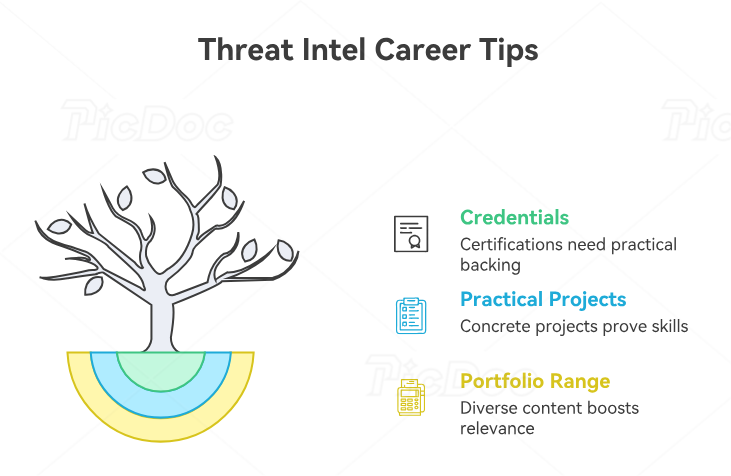
Threat intelligence careers reward proof more than theory. Certifications can help, but they only become powerful when they sit on top of visible analysis. For many candidates, a baseline credential from a broader top cybersecurity certifications directory, a practical benchmark from the step-by-step guide to becoming a certified ethical hacker CEH, learning pathways from a directory of free cybersecurity courses and resources, training options from the global directory of cybersecurity training providers, and market awareness from cybersecurity certifications of the future can be helpful. Still, none of them rescues a candidate who cannot analyze a campaign with discipline.
The projects that move you forward are concrete. Build a threat brief on one ransomware family and map it to ATT&CK. Track one threat actor for thirty days and summarize notable changes in infrastructure, targets, and lures. Create a phishing lure taxonomy for a sector such as healthcare or finance. Compare three reports on the same campaign and identify where confidence should remain low. Write a detection-oriented memo showing how one emerging attack technique should influence logging, alerting, and monitoring. These projects prove the exact muscle that employers need: relevance, filtering, structure, and communication.
A strong portfolio should also show range. One report can be strategic, one operational, one technical. Pair that with reading from best cybersecurity blogs and industry news sites, continuous learning from top cybersecurity books essential reads, audio insights from top cybersecurity podcasts for industry professionals, visual learning from best YouTube channels for cybersecurity learning and updates, and community exposure through the best cybersecurity conferences global guide. That mix keeps your thinking current and prevents your analysis from sounding detached from the real threat landscape.
5. A Realistic 12-Month Roadmap From Beginner to Hireable Candidate
Months 1 through 3 should focus on fundamentals. Learn networking, authentication flows, endpoint basics, logs, and common attack paths. Study phishing, ransomware, credential theft, and exploitation trends. Read advisories and force yourself to summarize them in plain language. Tie this stage to how to become a cybersecurity manager clear pathway and certifications, guide to a career as a cybersecurity auditor roles salaries and certifications, complete career roadmap for cybersecurity compliance analyst, NIST cybersecurity framework adoption industry analysis, and cybersecurity compliance trends report original regulatory insights. Even intelligence analysts need to understand how risk and controls frame the meaning of threats.
Months 4 through 6 should become analytical. Start producing artifacts every week. Build short reports, actor snapshots, IOC assessments, and ATT&CK mappings. Practice explaining why one campaign matters more than another. Begin lightweight scripting for enrichment and organize your notes into reusable templates. During this stage, read emerging cybersecurity threats in cloud environments, AI-powered cyberattacks future threats and defenses, deepfake cybersecurity threats upcoming wave insights, top 10 cybersecurity threats predicted to dominate by 2030, and predicting the next big ransomware evolution. These help you think ahead instead of only backward.
Months 7 through 9 should become operational. Translate intelligence into hunts, detection ideas, and sector-specific exposure notes. Build pieces that speak directly to healthcare, finance, retail, or government if those sectors interest you. Use resources like financial sector cybersecurity incidents detailed original analysis, healthcare cybersecurity threat report actionable insights, best cybersecurity companies for retail and e-commerce directory, predictive analysis of cybersecurity in government public sector, and cybersecurity directory for the education sector top solutions and providers. Specialized context makes your work more useful and more marketable.
Months 10 through 12 should become career-facing. Clean your portfolio. Rewrite weak reports. Practice interviews built around case explanations rather than generic answers. Apply to SOC, IR, CTI junior, research, or security analyst roles with a clear narrative: “I built technical foundations, produced analysis consistently, and learned how to make intelligence operational.” Support that narrative with remote cybersecurity careers long-term trends and opportunities, global cybersecurity salary report industry benchmarks and trends, remote vs on-site cybersecurity salaries original insights, cybersecurity freelance and consulting market income data and trends, and predicting cybersecurity job market trends roles that will thrive by 2030. The goal is not just getting in. The goal is entering with momentum.
6. FAQs
-
A SOC background is one of the strongest launchpads, but it is not the only one. What matters is exposure to alerts, investigations, logs, and real attack behavior. Candidates coming from incident response, vulnerability management, fraud analysis, or research-heavy analyst roles can pivot successfully when they can show operational thinking and clear intelligence outputs.
-
Broad cybersecurity certifications help when they prove baseline knowledge, but they are most effective when paired with visible analytical work. Employers care more about how well you assess threats, map tradecraft, explain relevance, and communicate confidence than about a long list of badges with no proof behind them.
-
Include short intelligence briefs, ATT&CK mappings, phishing campaign analyses, actor profiles, IOC validation exercises, and detection-oriented memos. The strongest portfolio pieces solve a real problem: they help a defender prioritize, monitor, investigate, or brief leadership better.
-
Technical enough to understand attack chains, host and network behavior, common logs, indicators, vulnerabilities, and defensive controls. Deep reverse engineering is not required for every role, but shallow technical knowledge creates weak analysis and makes collaboration with SOC, detection, and IR teams much harder.
-
They mistake information consumption for intelligence work. Reading reports all day feels productive, but the role is really about assessing source quality, extracting what matters, connecting it to risk, and producing outputs that change action. That jump from passive reading to structured analysis is where careers start to separate.
-
For focused learners with consistent weekly output, a 9-to-12-month path can build enough foundation and proof to compete for junior CTI or adjacent analyst roles. For others, the smartest move is entering through SOC or incident response first, then pivoting once technical depth and credibility are stronger.
