
The Ultimate Guide to Getting Advanced Cybersecurity & Management Certification in Hong Kong: Everything You Need to Know in 2026–2027
Hong Kong’s cybersecurity market increasingly needs professionals who can connect technical controls with governance, regulatory obligations, incident leadership, and business risk. The strongest candidates understand how a vulnerability becomes financial exposure, how an incident reaches executive attention, and how security investment supports operational resilience.
An advanced cybersecurity and management certification can strengthen that capability when it is matched to the right career target. This guide explains how to select a credential, prepare efficiently, demonstrate practical competence, and use certification to pursue roles covered in the cybersecurity job-market outlook, certification advancement research, security leadership roadmap, and future cybersecurity skills analysis.
1. Why Advanced Cybersecurity and Management Skills Matter in Hong Kong
Hong Kong’s security environment changed significantly when the Protection of Critical Infrastructures (Computer Systems) Ordinance took effect on January 1, 2026. The Office of the Commissioner of Critical Infrastructure was also established in January 2026 to administer and enforce the new regime. Designated critical-infrastructure operators now face statutory computer-system security obligations, creating greater demand for professionals who can translate technical risk into governance, reporting, response planning, vendor oversight, and executive decisions.
That shift creates opportunities beyond traditional monitoring and firewall administration. Employers may need security professionals who can oversee security audit processes, apply NIST, ISO, and COBIT frameworks, assess critical-infrastructure threats, and manage the organisational consequences of an incident. Candidates who understand both security engineering and business accountability can contribute to policy design, board reporting, third-party risk, crisis exercises, compliance assurance, and security-program investment.
Hong Kong’s Personal Data (Privacy) Ordinance also remains central to the handling of personal data. The framework includes six Data Protection Principles, while the Privacy Commissioner encourages organisations to notify the regulator about data breaches through its breach-notification process. A manager therefore needs more than a memorised definition of confidentiality. The role may involve preserving evidence, identifying affected data, coordinating legal and communications teams, evaluating notification decisions, and preventing the same control failure from recurring.
Professionals targeting privacy, risk, or governance work should combine their certification study with the cybersecurity compliance trends report, privacy-regulation outlook, data-breach risk analysis, and cybersecurity compliance officer roadmap. These resources help connect exam concepts with the operational questions an employer may ask during an interview.
The banking sector adds another layer. The Hong Kong Monetary Authority’s Cybersecurity Fortification Initiative includes the Cyber Resilience Assessment Framework, Professional Development Programme, and Cyber Intelligence Sharing Platform. HKMA priorities for 2026 also include cyber-resilience testing, cyber mapping, third-party risk management, cloud-adoption oversight, and preparation for post-quantum cryptography. These developments increase the practical value of risk-based security management, resilience testing, cloud governance, and executive incident readiness.
A professional entering financial services should therefore understand financial-sector cyber incidents, cloud-security threats, incident-response effectiveness, and future finance-sector risks. A certification becomes more credible when the holder can apply its principles to banking operations, outsourced service providers, payment infrastructure, cloud concentration, ransomware, and regulatory reporting.
Hong Kong also serves organisations with business and data relationships across Mainland China and international markets. Security leaders may need awareness of Hong Kong privacy obligations, contractual requirements, sector-specific rules, Mainland China’s Personal Information Protection Law, and international customer expectations. The Privacy Commissioner notes that the Mainland’s PIPL regulates personal-information processing and can have extraterritorial application in specified circumstances.
This makes cross-border risk a useful specialisation. Study the GDPR cybersecurity guide, future compliance landscape, cybersecurity policy career path, and chief privacy officer roadmap if your target role involves regional operations, privacy assessments, vendor contracts, data transfers, or regulatory coordination.
| Certification | Best Career Stage | Primary Capability Proven | Where It Creates Leverage in Hong Kong |
|---|---|---|---|
| Advanced Cybersecurity & Management Certification | Early management to senior level | Integration of technical security, risk, governance, and leadership | Security management, programme oversight, consulting, and leadership-track roles |
| ISC2 Certified in Cybersecurity | Entry level | Foundational security knowledge | Career transition, junior security interviews, and baseline credibility |
| CompTIA Security+ | Entry level | Security operations, threats, identity, and risk fundamentals | Junior analyst, support-security, and operational security positions |
| ISC2 SSCP | Early career | Hands-on administration and security operations | SOC, infrastructure protection, access administration, and operations roles |
| CompTIA CySA+ | Early to mid-career | Detection, analysis, and defensive response | SOC analyst, threat detection, triage, and blue-team advancement |
| CompTIA SecurityX | Mid-career | Advanced enterprise security architecture and operations | Senior practitioner and technical-lead roles without immediate executive focus |
| CISSP | Experienced practitioner | Broad security architecture, operations, risk, and programme knowledge | Security manager, architect, consultant, and senior governance positions |
| CISM | Management track | Governance, programme management, risk, and incident leadership | Security manager, programme owner, risk leader, and management promotion |
| CRISC | Mid to senior career | Enterprise technology-risk identification and response | Banking risk, consulting, controls, third-party risk, and resilience roles |
| CISA | Audit and assurance track | Information-systems audit, controls, and assurance | Internal audit, external assurance, compliance testing, and consulting |
| CGEIT | Senior leadership | Enterprise IT governance | Director, governance head, technology-risk leadership, and executive advisory work |
| CCSP | Experienced cloud-security professional | Cloud architecture, data security, operations, and compliance | Cloud transformation, financial services, SaaS governance, and consulting |
| AWS Certified Security – Specialty | Cloud practitioner | AWS-specific security design and operations | AWS engineering, cloud migration, DevSecOps, and managed-service roles |
| Microsoft Cybersecurity Architect Expert | Mid to senior cloud career | Microsoft security architecture and Zero Trust design | Microsoft-heavy enterprises, identity projects, and security architecture |
| Google Professional Cloud Security Engineer | Cloud specialist | Google Cloud security configuration and architecture | GCP environments, data platforms, cloud engineering, and consulting |
| ISO/IEC 27001 Lead Implementer | Governance and implementation track | Information-security management system implementation | ISO programmes, policy development, control ownership, and consulting |
| ISO/IEC 27001 Lead Auditor | Assurance track | ISMS auditing and conformity assessment | Audit firms, supplier reviews, certification preparation, and assurance |
| CEH | Early offensive-security track | Broad ethical-hacking terminology and techniques | Security assessment, junior consulting, and structured offensive learning |
| OSCP+ | Hands-on offensive practitioner | Practical penetration testing and reporting | Penetration testing, red-team entry, security consulting, and technical proof |
| OSEP | Advanced offensive practitioner | Evasion, Active Directory attacks, and advanced penetration testing | Red-team operations, senior testing, and specialised consulting |
| OSWE | Advanced application-security practitioner | White-box web-application exploitation | Application security, product security, secure development, and research |
| GIAC GSEC | Early to mid-career | Applied security administration and defence | Operational security, incident support, and enterprise technical roles |
| GIAC GCIH | Incident-response track | Incident handling and attacker techniques | IR teams, SOC escalation, investigations, and resilience programmes |
| GIAC GCIA | Network-defence specialist | Traffic analysis and intrusion detection | Network monitoring, SOC engineering, and advanced detection roles |
| GIAC GPEN | Penetration-testing track | Structured enterprise penetration testing | Consulting, vulnerability assessment, and authorised security testing |
| CDPSE | Privacy-engineering track | Privacy governance, architecture, and data lifecycle controls | Privacy operations, data governance, regional compliance, and consulting |
| CSSLP | Software-security professional | Secure software lifecycle and application risk | AppSec, DevSecOps, product security, and software-governance roles |
2. How to Choose the Right Certification for Your Hong Kong Career
Start with the job you need the certification to unlock. A vague goal such as “move forward in cybersecurity” usually produces an expensive collection of overlapping credentials. A stronger goal names the function, seniority, sector, and evidence gap. For example, “move from SOC analyst to incident-response lead in financial services” immediately points toward detection, investigation, reporting, and coordination skills. The SOC analyst advancement guide, incident-responder career path, senior analyst roadmap, and analyst-to-engineer pathway can help you define that target.
For management-track candidates, the strongest certification should help explain governance, risk appetite, programme design, business cases, metrics, staffing, incident escalation, and third-party exposure. CISM is highly aligned with security management, while CISSP provides broader coverage across architecture, operations, testing, risk, and software security. CRISC is useful when the target position emphasises enterprise technology risk, controls, resilience, or regulated operations. CISA offers stronger alignment with assurance and audit. Compare these choices against the cybersecurity manager pathway, security-manager-to-director roadmap, director of information security guide, and VP of cybersecurity pathway.
Technical specialists should avoid abandoning hands-on credibility too early. A cloud-security engineer may gain more immediate value from CCSP and a platform-specific certification than from a governance-heavy credential. An application-security professional may benefit from CSSLP, OSWE, threat modelling, secure-code review, and CI/CD control experience. An offensive practitioner may need OSCP+ before pursuing a management credential. Review the cloud-security engineer guide, future cloud-security analysis, application-security tools directory, and offensive security engineer roadmap before committing.
The same principle applies to defensive professionals. A candidate responsible for alerts, endpoint visibility, email attacks, network telemetry, or SIEM tuning needs practical depth in the systems they operate. Management knowledge becomes more persuasive when it rests on operational understanding. Use the SIEM solutions comparison, endpoint detection and response guide, enterprise email-security directory, and network-monitoring tools directory to identify the technologies you should understand alongside the certification syllabus.
Sector choice should influence the study plan. Financial-services candidates should practise risk ownership, cyber-resilience testing, third-party oversight, privileged access, cloud concentration, and executive reporting. Healthcare candidates should understand sensitive-data protection, service continuity, legacy technology, and supplier exposure. Retail candidates should focus on payments, identity, fraud, e-commerce availability, and third-party platforms. Relevant preparation resources include the financial-services security directory, healthcare cybersecurity firms directory, retail cybersecurity outlook, and manufacturing cybersecurity solutions guide.
Use three filters before enrolling. First, verify that the credential matches the job descriptions you plan to pursue. Second, confirm that you satisfy the experience requirements or can use an associate pathway. Third, identify what practical evidence will accompany the certificate. A hiring manager receives limited value from a badge alone. A risk register, incident playbook, security architecture, audit plan, executive briefing, or lab report shows that the knowledge can be applied. The cybersecurity portfolio-oriented career guide, threat-intelligence analyst roadmap, red-team specialist pathway, and chief security architect guide provide role-specific direction.
3. Eligibility, Costs, Examination Requirements, and Renewal Planning
Experience requirements can derail a certification plan when they are checked after the exam. CISSP candidates currently need five years of cumulative full-time experience across at least two of the eight CISSP domains. A qualifying degree or approved credential may satisfy up to one year of that requirement. Candidates who pass before meeting the experience threshold can use the Associate of ISC2 pathway while accumulating the required experience.
CISM requires five years of professional information-security management experience across at least three of its four domains. CISA requires five years of relevant auditing, control, assurance, or security experience, while CRISC requires at least three years across at least two CRISC domains. ISACA allows candidates to sit the examinations before satisfying the full experience requirement, although the experience must be verified before full certification is awarded.
This distinction matters when building a promotion timeline. Passing an exam may strengthen your résumé, yet claiming the full designation before the certification body approves it can damage credibility. Record your work against the official domains while studying. Projects involving vulnerability assessment, access-control models, security audits, and incident response may support an application when the work is legitimate, documented, and verifiable.
Build a complete budget rather than looking only at the examination price. Your cost model should include the exam, official or third-party learning materials, practice questions, laboratory access, retake risk, membership fees, application charges, continuing-education expenses, and time away from work. Advanced practical credentials can carry significant training costs. OffSec, for example, describes PEN-200 as a hands-on course preparing candidates for OSCP and OSCP+, while its current OSCP+ examination simulates a live private network and provides 23 hours and 45 minutes for completion.
Candidates considering offensive security should test their readiness through the penetration-testing tools comparison, vulnerability-scanner directory, ethical-hacker transition guide, and penetration-testing consultant roadmap. Paying for a demanding practical exam before building Linux, Windows, Active Directory, networking, scripting, and reporting competence increases the risk of an expensive failure.
Renewal obligations deserve the same attention. ISACA currently requires CISM, CISA, and CRISC holders to earn at least 20 continuing professional education hours annually and 120 hours over a three-year reporting period. Renewal may also involve annual maintenance fees, ethics obligations, and possible audits of reported learning.
Create a CPE plan before passing. Activities can include conferences, webinars, formal courses, security research, teaching, writing, professional volunteering, and role-relevant projects when accepted by the certification body. Hong Kong professionals can build a useful learning pipeline through the global training-provider directory, free cybersecurity courses directory, cybersecurity conferences guide, and cybersecurity research organisations directory.
Employer sponsorship can reduce personal cost, although your request needs a business case. Explain the operational problem the training will help solve, the capability the team currently lacks, the expected deliverables, the study schedule, and how knowledge will be shared. A strong proposal might commit to updating an incident playbook, leading a tabletop exercise, improving a risk register, reviewing privileged access, or training junior analysts. The PAM solutions guide, security-awareness platforms directory, endpoint-security effectiveness report, and insider-threat report can help identify credible improvement projects.
Avoid stacking certifications that test similar knowledge without creating a new capability. A better sequence may combine one broad credential, one specialisation, and one portfolio project. A security manager could pair CISM with cloud-risk work. An architect could combine CISSP with CCSP and an architecture review. An auditor could combine CISA with ISO 27001 auditing and a control-testing portfolio. A red-team professional could combine OSCP+ with reporting, stakeholder communication, and the penetration-testing manager pathway. The purpose of the sequence is to close distinct evidence gaps.
Choose the obstacle creating the most friction. Your answer will reveal where your certification plan needs greater precision.
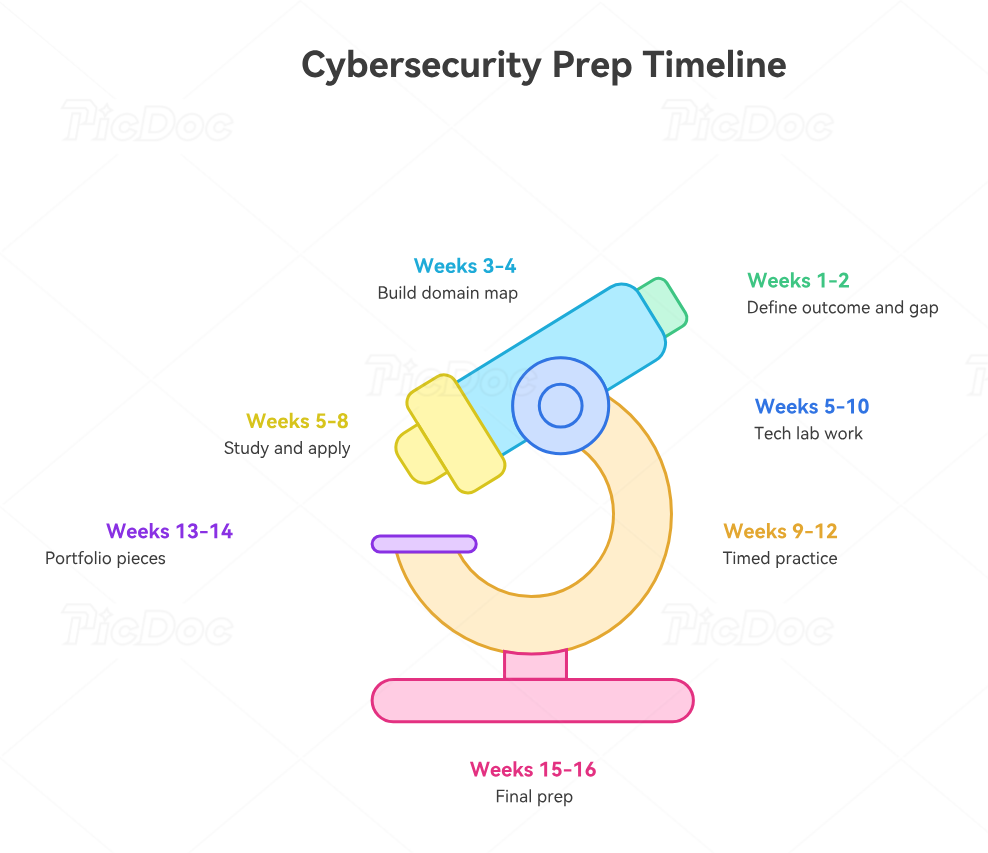
4. A Practical 16-Week Certification Preparation Plan
The first two weeks should be spent defining the outcome and measuring the gap. Collect 15 to 25 Hong Kong job descriptions for your intended role. Separate recurring requirements into technical skills, governance knowledge, communication capability, sector experience, and credentials. Then compare those requirements with the syllabus of your proposed certification. This prevents you from studying a prestigious credential that solves the wrong problem. Use the cybersecurity certification directory, specialised-role demand forecast, remote cybersecurity career outlook, and workforce-shortage study during this analysis.
During weeks three and four, build a domain map. Break the examination outline into small topics, mark your confidence from one to five, and attach evidence to each score. Experience with a tool does not automatically equal mastery of the underlying principle. Someone who has used a SIEM may still struggle to design detection coverage, evaluate telemetry gaps, or explain the relationship between alerts and business impact. Strengthen weak areas with the next-generation SIEM outlook, endpoint-security provider directory, DLP software comparison, and cloud-security tools directory.
Weeks five through eight should combine structured study with application. Use a study cycle of concept review, closed-book recall, scenario questions, practical application, and error analysis. After studying risk treatment, create a sample risk register. After studying incident management, design an escalation matrix. After studying supplier risk, build a vendor questionnaire and evidence checklist. After studying access control, produce a privileged-access review. The access-control model guide, PAM solutions directory, ransomware threat analysis, and phishing-prevention report provide realistic contexts.
Management-focused candidates should practise answering scenario questions from the perspective of accountability. Examinations often reward the response that follows governance, risk ownership, business priorities, approved processes, and proportional control. The technically fastest action may conflict with the organisation’s authority structure, legal obligations, evidence requirements, or continuity needs. Build fluency through the cybersecurity programme manager guide, security leadership transition roadmap, security-manager-to-director guide, and CISO pathway.
Technical candidates should devote weeks five through ten to repeated lab work. One successful walkthrough offers weak evidence because it may depend on copied steps. Repeat the task from a clean environment, change variables, document failed approaches, and write a report that a different professional could follow. Offensive candidates can use the penetration-testing company reviews to understand commercial service expectations, the red-team operator roadmap for role progression, the vulnerability-researcher guide for research discipline, and the ethical-hacking consultant pathway for client-facing development.
During weeks nine through twelve, introduce timed practice and decision journals. For every incorrect answer, record the domain, concept, reason for the error, misleading option, governing principle, and corrective action. Classify mistakes as knowledge gaps, misreading, overthinking, technical bias, poor time management, or weak governance reasoning. A rising practice score can conceal repeated weaknesses when the same question bank is reused. Rotate sources and explain answers without looking at the options.
Use this period to connect emerging risks with established principles. AI-enabled attacks still require identity governance, monitoring, validation, incident handling, and risk ownership. Deepfakes still create authentication, fraud, communications, and business-process exposure. Quantum computing changes cryptographic planning, asset discovery, and migration governance. Study the AI-powered cyberattack forecast, deepfake security analysis, quantum cybersecurity report, and future zero-trust outlook.
Weeks thirteen and fourteen should focus on two portfolio pieces aligned with Hong Kong employment needs. A governance candidate could prepare a critical-system risk register and a board-level incident briefing. A cloud candidate could create an architecture review and shared-responsibility control matrix. An auditor could develop an audit programme and evidence request list. An incident responder could produce a ransomware playbook and post-incident report. Relevant references include the NIST adoption analysis, cloud-security trends report, ransomware evolution forecast, and cybersecurity audit future.
During weeks fifteen and sixteen, reduce new content and increase retrieval practice. Complete timed mock examinations, revisit the error journal, rehearse your test-day routine, and confirm identification, scheduling, system, or testing-centre requirements. Sleep, pacing, and controlled decision-making protect months of preparation. The final goal is stable performance across domains rather than one unusually high mock score.
5. How to Convert Certification Into Career Advancement
A certification creates leverage when it changes how employers evaluate your ability. Update your résumé around outcomes, scope, and decisions. “Monitored security alerts” provides limited evidence. “Investigated high-priority alerts across endpoint and identity telemetry, documented escalation criteria, and improved case consistency through a triage checklist” communicates greater ownership. Use the SOC analyst career guide, SOC manager progression roadmap, IT-support transition guide, and security analyst advancement guide to identify role-specific achievements.
Place the certification beside supporting evidence. For every major domain, prepare one interview story showing the context, risk, options considered, decision, stakeholders, action, and measurable result. A CISM candidate should have stories about governance, programme priorities, incident leadership, and risk communication. A CISSP candidate should cover architecture, operations, IAM, assessment, and risk. A CRISC candidate should demonstrate risk identification, ownership, response, monitoring, and reporting. A CISA candidate should explain audit planning, evidence, findings, business impact, and remediation validation.
Your portfolio should include sanitised work that demonstrates decision quality without exposing employer information. Suitable artefacts include a security strategy, maturity assessment, policy set, control matrix, data-flow review, incident playbook, tabletop scenario, threat model, architecture diagram, audit programme, executive dashboard, or penetration-testing report. Strengthen the portfolio with the cybersecurity frameworks guide, application-security directory, IoT-security company guide, and endpoint-security innovation forecast.
For internal promotion, begin before the examination. Ask your manager which responsibilities separate your current position from the next level. Volunteer for one controlled stretch assignment, such as coordinating a review, mentoring a junior colleague, presenting risk to a business owner, improving an incident procedure, or tracking remediation. Certification study then reinforces active responsibility rather than acting as a substitute for it. The specialist-to-CISO guide, senior analyst-to-VP pathway, chief security architect roadmap, and cybersecurity product manager guide can help define suitable next-level responsibilities.
For an external job search, create a targeted campaign. Divide employers into banking and finance, professional services, technology, telecommunications, logistics, healthcare, retail, public services, and critical infrastructure. Adjust your examples to each sector’s risk profile. A bank may prioritise resilience, third-party risk, cloud governance, and regulatory evidence. A logistics organisation may prioritise availability, operational technology, supplier access, and incident recovery. Review the transportation cybersecurity directory, energy and utilities provider guide, healthcare threat report, and government cybersecurity forecast.
Avoid relying on the certification name during salary negotiations. Build the case around expanded scope, scarce capability, business impact, leadership responsibility, and market alignment. Demonstrate that you can reduce incident exposure, strengthen assurance, improve audit readiness, accelerate secure projects, or communicate risk effectively. Use the certification salary-growth analysis, entry-level-to-CISO progression report, remote versus on-site salary analysis, and cybersecurity freelance income report to frame the conversation.
Networking should also become role-specific. Attend events with a clear learning or relationship goal, ask practitioners about current control challenges, and follow up with useful material rather than a generic connection request. Publishing a concise risk analysis, technical walkthrough, or regulatory explainer can make your expertise visible. The cybersecurity podcast directory, cybersecurity YouTube directory, industry news-site guide, and cybersecurity content-creator roadmap can support continuous visibility.
Track results for 90 days after certification. Measure targeted applications, referrals, recruiter responses, interviews, technical assessments, promotion discussions, expanded responsibilities, and offer quality. Low interview volume usually signals positioning or targeting problems. Interviews without offers may expose weak examples, limited technical depth, unclear communication, or a role mismatch. Treat the certification as one component of a career system that includes experience, evidence, visibility, relationships, and disciplined applications.
6. Frequently Asked Questions About Cybersecurity Certification in Hong Kong
-
CISM is strongly aligned with security governance, programme management, risk management, and incident leadership. CISSP offers broader technical and managerial coverage, while CRISC is valuable for enterprise technology-risk roles. CISA is more suitable for audit and assurance. Compare your target duties with the cybersecurity manager roadmap, security leadership transition guide, cybersecurity auditor pathway, and CISO career roadmap.
-
Yes. ISC2 permits candidates who pass an advanced examination without the required experience to follow its Associate pathway. ISACA also allows candidates to sit the CISM examination before satisfying the full experience requirement, although verified experience remains necessary for the full designation. Use the correct status on your résumé and avoid claiming a certification that has not been formally awarded.
-
Practical credentials can provide strong evidence for penetration-testing, red-team, vulnerability-assessment, and security-consulting roles. Their value increases when accompanied by clear reporting, remediation advice, professional scoping, and legal awareness. Review the OSCP penetration-testing pathway, red-team career guide, penetration-testing manager roadmap, and ethical-hacker-to-consultant guide.
-
A credential can improve screening credibility, yet employers still need evidence that you can perform the role. Build practical projects, quantified work examples, sector knowledge, interview stories, and a targeted application strategy. Career changers should use the IT-support-to-security transition guide, network-administrator-to-ethical-hacker roadmap, SOC analyst pathway, and global cybersecurity training directory.
-
CISM, CISSP, CRISC, CISA, and CCSP can all be useful depending on the function. CRISC suits technology-risk and control roles. CISA supports audit and assurance. CISM supports programme leadership. CISSP suits broad senior security work. CCSP supports cloud-governance positions. Supplement the credential with the financial-sector incident report, financial-services provider directory, cloud-threat analysis, and finance cybersecurity forecast.
-
Cloud certification is valuable when your target roles involve architecture, identity, SaaS, platform engineering, DevSecOps, data protection, or cloud-risk oversight. A broad credential such as CCSP can be combined with AWS, Microsoft, or Google Cloud certification. Study the cloud-security career guide, cloud-tools directory, future cloud-security trends, and AI-driven security-tools forecast.
