
The Ultimate Guide to Getting Advanced Cybersecurity & Management Certification in Oklahoma: Everything You Need to Know in 2026-2027
Oklahoma cybersecurity careers are changing because employers need people who can protect systems, explain risk, handle incidents, and help leaders make better security decisions. A certificate only helps when it proves role-readiness, so Oklahoma candidates should connect training to practical outcomes: SOC performance, cloud defense, compliance execution, incident response, vendor risk, and leadership credibility. This guide shows how to choose an advanced cybersecurity and management certification path that fits Oklahoma’s energy, healthcare, government, finance, education, and small-business security needs.
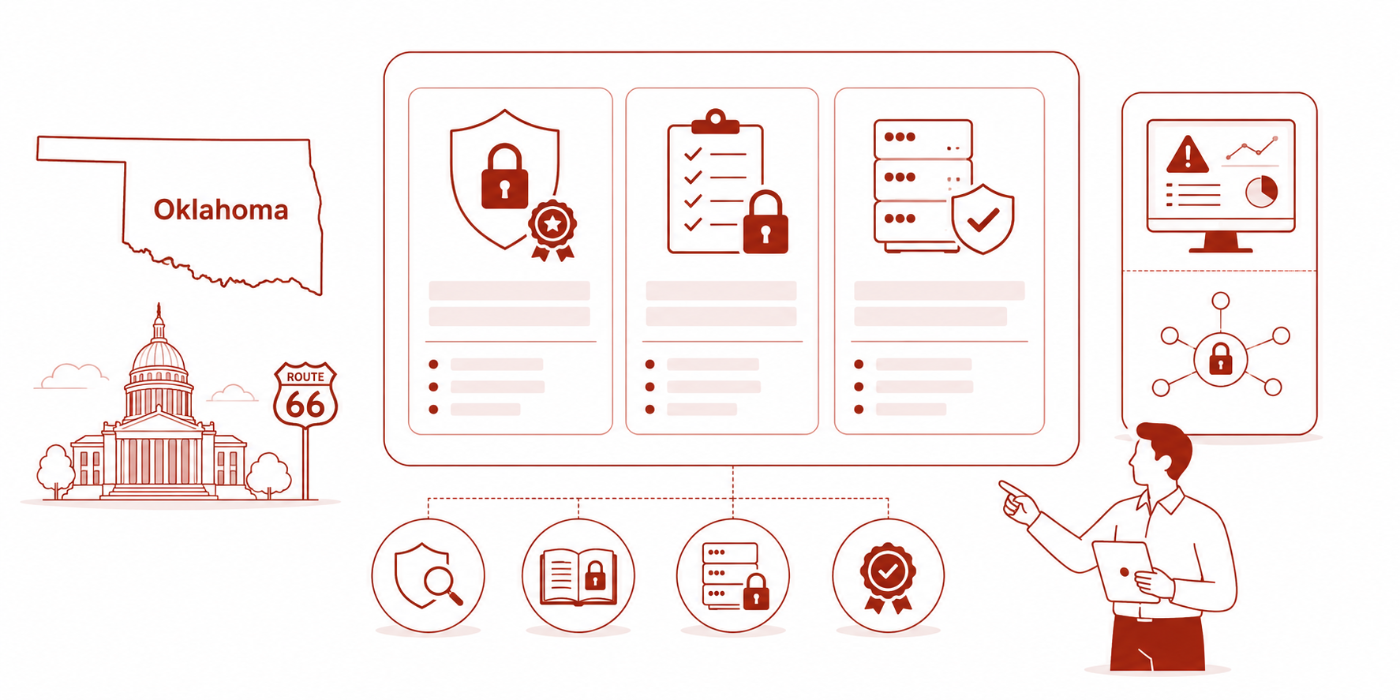
1. Why Advanced Cybersecurity & Management Certification Matters in Oklahoma in 2026-2027
Oklahoma professionals face a specific career problem: many can operate tools, close tickets, and pass exams, yet still struggle to prove they can own security outcomes. That gap becomes painful when a hiring manager wants incident judgment, executive communication, and structured risk thinking. If your background is IT support, start by connecting your experience to the IT support to cybersecurity analyst pathway, then strengthen your resume with a practical SOC analyst career guide, a focused security analyst advancement roadmap, and a realistic view of cybersecurity job market trends.
The strongest certification strategy in Oklahoma depends on where you want leverage. Oklahoma City and Tulsa employers often need defenders who understand cloud systems, endpoint protection, email security, compliance, and incident response across lean teams. That means your credential should support a clear role story, whether you are targeting cloud security engineer roles, cybersecurity compliance analyst work, incident responder positions, or cybersecurity manager roles. The right path reduces doubt before the interview begins.
The biggest mistake is treating certification as a title upgrade by itself. A Security+, CySA+, CISM, CISSP, SecurityX, or advanced management credential can help, yet employers still ask what you can actually do when ransomware hits a file server, a privileged account behaves strangely, a vendor fails a security review, or executives demand a risk answer by noon. That is why ACSMI readers should pair certification planning with ransomware threat analysis, incident response effectiveness research, privileged access management solutions, and cybersecurity compliance trends.
| Certification / Skill Path | Best Oklahoma Career Stage | Most Likely Advancement Effect | Where It Creates Real Leverage |
|---|---|---|---|
| ISC2 Certified in Cybersecurity (CC) | Entry level | Reduces beginner-risk perception | First cybersecurity role, help desk transition, junior security screening |
| CompTIA Security+ | Entry level to early career | Strengthens baseline employability | SOC, analyst, defense contracting, support-to-security movement |
| CompTIA CySA+ | Early career | Improves blue-team credibility | Alert triage, SIEM review, detection, vulnerability coordination |
| CompTIA PenTest+ | Early to mid career | Builds offensive-security positioning | Assessment teams, internal testing, red-team-adjacent projects |
| CompTIA SecurityX | Advanced practitioner | Signals architecture-level security depth | Senior engineer, security architect, enterprise design responsibility |
| CISSP | Mid to senior career | Improves leadership and governance trust | Security management, enterprise risk, director-track credibility |
| CISM | Managerial track | Supports security leadership readiness | Governance, risk ownership, program leadership, executive reporting |
| CEH | Early offensive track | Helps frame ethical hacking fundamentals | Junior pentesting, security testing, vulnerability validation |
| OSCP | Hands-on offensive track | Proves practical exploitation discipline | Penetration testing, red team, consulting, offensive engineering |
| GRC / Compliance Certification Path | IT, audit, risk, legal-adjacent professionals | Creates non-SOC cybersecurity entry leverage | Policy, audits, HIPAA, NIST, vendor risk, compliance operations |
| Cloud Security Certification Path | Network, systems, DevOps professionals | Moves your profile toward modern infrastructure security | AWS, Azure, IAM, cloud monitoring, cloud misconfiguration risk |
| Incident Response Certification Path | SOC and analyst professionals | Shows calm decision-making under breach pressure | Containment, escalation, evidence handling, post-incident reporting |
| Threat Intelligence Certification Path | Analyst to specialist | Improves research-led security value | Actor tracking, phishing analysis, ransomware trends, executive briefings |
| Cybersecurity Auditor Path | Audit, compliance, risk professionals | Builds assurance and control-testing authority | Internal audits, control mapping, compliance evidence, board reporting |
| Cybersecurity Manager Certification Path | Team lead to manager | Converts technical experience into leadership credibility | Roadmaps, staffing, metrics, risk prioritization, security budgeting |
| CISO Roadmap Path | Senior manager to executive | Builds executive security language | Enterprise risk, board communication, resilience, governance ownership |
| Endpoint Security Specialist Path | SOC and infrastructure defenders | Improves workstation and server defense value | EDR, policy tuning, malware containment, device hardening |
| SIEM Specialist Path | SOC analyst to detection engineer | Strengthens monitoring and investigation impact | Log analysis, detections, correlation rules, alert quality improvement |
| Email Security Specialist Path | IT security and SOC teams | Builds phishing-defense credibility | Email gateways, phishing response, DMARC alignment, awareness support |
| Application Security Path | Developers, QA, DevOps, security engineers | Creates high-value specialization | Secure SDLC, code review, SAST/DAST, API security, AppSec governance |
| IoT / OT Security Path | Manufacturing, utilities, infrastructure professionals | Builds niche defensibility | Industrial networks, device risk, segmentation, asset discovery |
| Healthcare Cybersecurity Path | Healthcare IT and compliance professionals | Connects security to patient-data risk | HIPAA, EHR protection, ransomware readiness, vendor risk |
| Financial Services Security Path | Banking, fintech, audit, fraud teams | Improves regulated-industry credibility | Fraud controls, identity, logging, incident evidence, risk reporting |
| Government / Public Sector Security Path | Public agencies and contractors | Strengthens policy and compliance readiness | Framework alignment, access control, auditability, resilience planning |
| Security Awareness Training Path | Analysts, trainers, HR-adjacent security staff | Shows ability to reduce human-risk exposure | Phishing education, reporting culture, employee behavior change |
| Cybersecurity Instructor Path | Experienced practitioners | Turns expertise into teaching authority | Bootcamps, corporate training, labs, curriculum design |
| Cybersecurity Product Manager Path | Security plus business professionals | Moves security experience into product strategy | Security tools, feature planning, customer risk, roadmap decisions |
| Advanced Cybersecurity & Management Certification | Mid-career to leadership-track professionals | Combines technical judgment with management proof | Promotion cases, team leadership, program ownership, cross-functional security authority |
2. How to Choose the Right Advanced Cybersecurity & Management Certification Track in Oklahoma
Start with the role you want, because certifications serve different hiring signals. A candidate aiming for SOC work needs detection, triage, logs, and alert judgment, so the SOC analyst roadmap, SIEM solutions directory, vulnerability scanner guide, and endpoint detection and response tools matter more than a random prestige credential. A candidate aiming for management needs evidence of prioritization, reporting, controls, and stakeholder handling.
Use a three-layer decision filter: role fit, proof strength, and Oklahoma market fit. Role fit asks whether the certification supports the job title you want. Proof strength asks whether you can back the credential with labs, reports, projects, and examples. Oklahoma market fit asks whether the certificate helps in the sectors around you, including energy and utilities cybersecurity, healthcare cybersecurity services, financial services security firms, and government cybersecurity providers.
For beginners in Oklahoma, the smart path is usually foundational proof plus one practical specialty. ISC2 CC or Security+ can help establish baseline security language, then CySA+, cloud security, compliance, or incident response can make the profile specific. A stronger beginner does not say, “I want cybersecurity.” They can explain how they would investigate phishing, validate a vulnerability, document access-control risk, and escalate suspicious endpoint activity. Build that language through free cybersecurity courses, cybersecurity bootcamps and academies, cybersecurity books, and cybersecurity blogs and news sites.
For mid-career professionals, the credential should solve a promotion problem. Maybe your manager trusts your technical work but hesitates to give you ownership of people, budget, audits, vendors, or incident communication. That is where advanced cybersecurity and management certification becomes valuable. Pair it with the security manager career pathway, security manager to director roadmap, cybersecurity program manager guide, and CISO step-by-step roadmap. Your goal is to prove you can convert technical findings into decisions leaders can fund.
3. Oklahoma Career Roadmap: From Security Learner to Cybersecurity Leader
The Oklahoma roadmap begins with credibility, then specialization, then ownership. In the credibility stage, your job is to remove doubt: show that you understand networks, access control, incident basics, vulnerability management, and common attack paths. Study with a role target instead of collecting random badges. A candidate moving from IT support can use the network administrator to ethical hacker transition guide, security audits best practices, access control models guide, and cybersecurity frameworks explainer to speak with more precision in interviews.
The specialization stage should be tied to actual business pain. Oklahoma employers do not need vague “cyber people”; they need someone who can reduce phishing risk, detect ransomware movement, protect cloud systems, document HIPAA-related controls, harden endpoints, or support audits. Choose a lane that creates measurable outcomes. Blue-team candidates should study the CySA-style analyst path, email security solutions directory, DLP software directory, and network monitoring tools guide. Offensive candidates should build around testing quality, documentation, and risk explanation.
The ownership stage is where advanced cybersecurity and management certification becomes powerful. At this level, employers judge whether you can lead work that affects compliance, uptime, vendor accountability, user behavior, and executive risk tolerance. A promotion case should include before-and-after proof: reduced alert noise, improved patch reporting, faster incident escalation, stronger MFA rollout, better audit evidence, or clearer security metrics. Build that case with cybersecurity compliance officer guidance, cybersecurity auditor roles and certifications, senior security analyst pathway, and senior analyst to VP of security guidance.
Pick the obstacle that feels most expensive, because the right certification strategy changes with the bottleneck.
4. How to Turn Certification Into Interviews, Promotions, and Salary Leverage
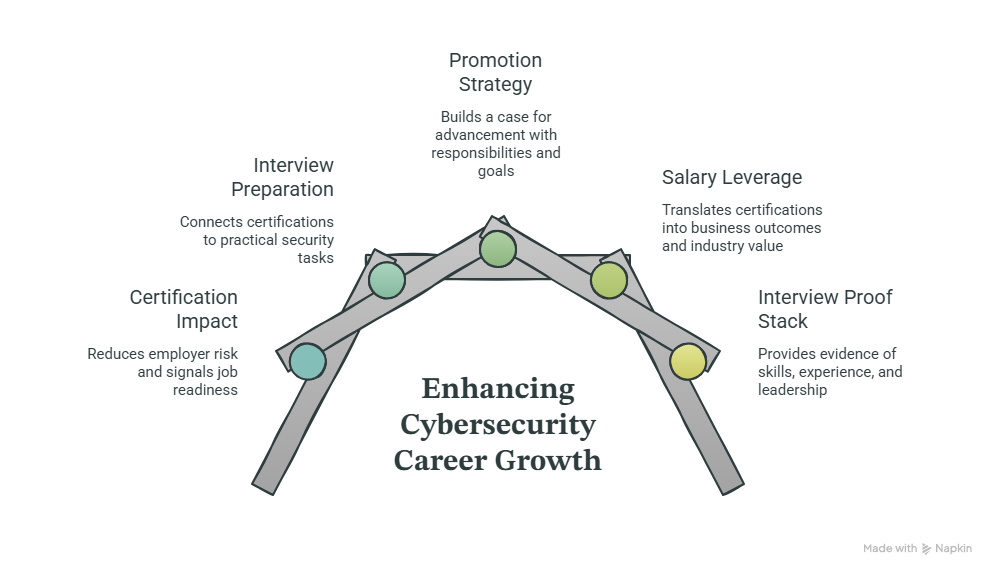
Certification helps when it changes the employer’s risk calculation. For interviews, your resume should connect the certificate to practical security work: alert triage, access reviews, vulnerability reports, incident timelines, control mapping, phishing response, or cloud hardening. A recruiter scanning Oklahoma candidates should see a job-ready direction in seconds. Strengthen that signal with the top cybersecurity certifications directory, salary growth analysis for CISSP, CEH, and Security+, cybersecurity salary progression analysis, and remote versus on-site salary insights.
For promotions, prepare a one-page advancement brief before your annual review. Include your current responsibilities, the security risks you already reduce, the advanced certification you are pursuing, and the next ownership area you can handle. Strong examples include managing vulnerability remediation metrics, improving endpoint coverage, leading phishing-response workflow, creating access review evidence, or building incident-response tabletop exercises. Build your case through vulnerability assessment techniques, state of endpoint security research, phishing prevention strategies, and NIST framework adoption analysis.
For salary leverage, translate certification into business outcomes. Saying you earned a certificate is weaker than saying you can help reduce breach exposure, improve audit readiness, shorten detection time, protect endpoints, strengthen cloud controls, or support regulated reporting. Oklahoma candidates in healthcare, finance, education, retail, government, energy, and manufacturing should frame their value by industry pain. Use healthcare compliance cybersecurity research, financial sector incident analysis, education-sector cybersecurity solutions, and manufacturing cybersecurity trends to make your compensation argument sharper.
The interview proof stack should include three items: a skills map, two project stories, and one leadership story. The skills map shows which tools, frameworks, and processes you can handle. The project stories prove you can finish security work. The leadership story proves you can communicate under pressure. A candidate targeting management should study cybersecurity leadership to VP guidance, director of information security career planning, chief security architect guidance, and cybersecurity policy director pathway. This turns certification into a career narrative.
5. Mistakes Oklahoma Candidates Should Avoid Before Paying for Any Program
The first mistake is buying the certification that sounds most impressive instead of the one that removes your exact career blocker. A help desk professional trying to enter cybersecurity may need Security+, CC, labs, and SOC vocabulary before chasing a senior management credential. A working analyst may need CySA+, incident response, cloud security, or SIEM depth before chasing broad leadership language. Avoid confusion by comparing the SOC analyst to SOC manager path, threat intelligence analyst roadmap, cloud security career guide, and cybersecurity compliance officer roadmap.
The second mistake is ignoring proof. Oklahoma employers want evidence that you can handle messy work: unclear logs, incomplete asset lists, vague user reports, patch delays, vendor excuses, and leadership pressure. A certificate cannot carry all that by itself. Build proof through mini-projects: write a phishing investigation report, map NIST controls for a small business, compare EDR tools, design a basic incident-response playbook, or create a vulnerability remediation tracker. Use the EDR tools guide, penetration testing tools comparison, application security tools directory, and cloud security tools directory to make those projects realistic.
The third mistake is skipping management language until you already have the title. Management readiness begins before management authority. Document risks clearly, explain trade-offs, write short executive summaries, track decisions, and learn how compliance, budget, staffing, vendor risk, and business continuity affect security priorities. Those habits matter in Oklahoma organizations where one person may support security across multiple systems, locations, vendors, or departments. Build that foundation with future cybersecurity compliance predictions, privacy regulations and cybersecurity trends, future audit practices, and small-business cybersecurity legislation analysis.
The fourth mistake is choosing a provider without checking curriculum fit. Before enrolling, ask whether the program teaches real scenarios, management judgment, reporting, compliance context, incident response, and career positioning. Look for structured outcomes: what you will be able to explain, document, investigate, assess, lead, or improve after completion. Compare options through the global cybersecurity training provider directory, cybersecurity bootcamp directory, cybersecurity instructor career guide, and curriculum developer pathway. A good program should make your next role easier to defend in writing and conversation.
6. FAQs About Advanced Cybersecurity & Management Certification in Oklahoma
-
The best path depends on your target role. Entry-level candidates should usually build baseline credibility first, then specialize. Analysts should add defensive, incident-response, cloud, or GRC proof. Mid-career professionals should choose credentials that support ownership, leadership, and executive communication. For Oklahoma, strong paths often connect to energy, healthcare, public sector, education, finance, and SMB security needs. Compare the cybersecurity certifications directory, cybersecurity manager pathway, CISO roadmap, and future certifications employers may value.
-
Yes, when it helps you cross from technical support into security ownership. IT experience is valuable because you already understand users, systems, outages, permissions, and operational pressure. The missing layer is security framing: risk, evidence, controls, threat behavior, response workflow, and management communication. Use certification to turn your IT history into a credible security story. Start with the IT support to cybersecurity analyst guide, network administrator to ethical hacker path, security analyst to engineer roadmap, and cybersecurity workforce shortage study.
-
CISSP is broad and leadership-friendly, CISM is strong for governance and security management, SecurityX supports advanced architecture and senior engineering credibility, and an advanced cybersecurity management program can help connect technical security to leadership execution. Choose based on your promotion gap. If you need governance language, study CISM-style topics. If you need architecture credibility, build senior technical proof. If you need team, risk, budget, and program ownership language, focus on management training. Compare the security manager to director roadmap, chief security architect guide, program manager career guide, and VP of cybersecurity roadmap.
-
Attach it to proof. Build two or three practical artifacts: an incident timeline, a vulnerability remediation tracker, a cloud risk checklist, an access review template, a phishing response report, or a security roadmap for a small organization. Then explain what problem the artifact solves, who would use it, and how it reduces risk. This makes the certification more concrete than a badge. Use the incident responder career path, vulnerability researcher starter guide, cloud threat analysis, and annual insider threat report to build stronger project ideas.
-
Certification can help, especially when paired with labs, projects, networking, and clear role targeting. Many candidates weaken their chances by applying broadly to every cybersecurity title. Pick one entry point first: SOC analyst, junior GRC analyst, vulnerability coordinator, security support, cloud security associate, or compliance support. Then build proof around that lane. Strengthen your plan with free cybersecurity courses and resources, global training providers, best YouTube channels for cybersecurity learning, and cybersecurity podcasts.
-
Turn it into career movement immediately. Update your resume with role-specific outcomes, publish or organize your project artifacts, prepare interview stories, and ask for responsibility at work that matches the credential. Good next steps include leading a small security improvement, documenting a control gap, improving a response workflow, helping with vendor review, or building a risk summary for leadership. Keep learning through cybersecurity conferences, cybersecurity research organizations, AI in cybersecurity adoption research, and future cybersecurity skills guidance.
