
Advanced Career Guide: From Ethical Hacker to Cybersecurity Consultant
A lot of ethical hackers hit the same ceiling. They can enumerate, exploit, validate, and write technical findings, but they struggle to turn that work into larger influence, better compensation, stronger client trust, and broader career control. That is the difference between being good at offensive execution and becoming valuable as a cybersecurity consultant.
This guide shows how to make that jump professionally. You will learn what changes when you move from hacker to advisor, which skills actually create consulting leverage, how to position your experience, and how to build the proof that convinces clients and hiring managers you can solve business problems, not just find technical flaws.
1. Understand the Real Career Shift: You Are Not Leaving Ethical Hacking Behind, You Are Expanding Its Value
Moving from ethical hacker to cybersecurity consultant is not a cosmetic title change. It is a shift from “I can find issues” to “I can help an organization understand exposure, prioritize risk, improve decisions, and justify action.” That means offensive skill remains valuable, but it stops being the whole story. Someone who followed a strong ethical hacking career roadmap, built credibility through the CEH pathway, or aimed for an OSCP-style penetration testing path already has a strong technical base. What they often lack is consulting-layer judgment.
A consultant must understand why a vulnerability matters to a retailer differently than it matters to a hospital, a bank, a school, or a manufacturer. That is why offensive specialists who study the financial services cybersecurity landscape, healthcare-specific cybersecurity tools and services, education-sector cybersecurity solutions, and manufacturing security trends start sounding more valuable in client conversations. They stop describing weaknesses in isolation and start explaining operational consequences.
This is also why consulting favors people who can connect technical work to business frameworks. If your thinking is still limited to payloads, shells, and post-exploitation tricks, you will underperform against people who also understand security audits and best practices, NIST, ISO, and COBIT frameworks, compliance trend analysis, and incident response planning. Clients do not pay premium fees for interesting technical trivia. They pay for clearer decisions, lower risk, stronger readiness, and faster prioritization.
The smartest way to think about this transition is not “How do I stop being an ethical hacker?” It is “How do I make my offensive perspective useful to leadership, auditors, operations teams, cloud owners, and budget holders?” People who studied the path from junior penetration tester to senior security consultant, the route to cybersecurity auditor roles, the move toward a cybersecurity compliance officer career, and the progression to cybersecurity manager usually recognize this sooner. The consultant wins because they can translate, prioritize, and influence.
Ethical Hacker to Cybersecurity Consultant: 26-Capability Advancement Matrix
Use this matrix to identify what changes when offensive execution has to turn into consulting leverage, client trust, and larger career upside.
| Capability | Ethical Hacker Focus | Consultant-Level Upgrade | ACSMI Resource |
|---|---|---|---|
| Recon | Gather attack surface data | Tie exposure to business assets and likely loss paths | Penetration testing tools |
| Vulnerability validation | Prove a weakness exists | Show priority, exploitability, and remediation order | Vulnerability scanners |
| Reporting | Document technical findings | Write for engineers, managers, and executives at once | Security audits guide |
| Scoping | Follow rules of engagement | Help shape realistic, defensible engagement scope | Cybersecurity auditor guide |
| Business impact | State technical severity | Explain operational, regulatory, and financial consequences | Compliance trends |
| Framework alignment | Know security concepts | Map findings to control frameworks and assurance language | Frameworks guide |
| Identity risk | Abuse credentials or privilege paths | Recommend durable access-governance improvements | Access control models |
| Cloud exposure | Find misconfigurations | Advise on architecture, IAM, and monitoring changes | Cloud security engineer path |
| Application risk | Exploit web flaws | Connect flaws to SDLC, AppSec, and governance gaps | Application security tools |
| Endpoint tradecraft | Understand detection surfaces | Recommend control tuning and telemetry improvements | EDR tools guide |
| Monitoring context | Avoid noisy actions | Show where alerts, triage, and logging failed | SIEM solutions |
| Incident readiness | Simulate attack behavior | Use findings to improve readiness and response workflows | Incident response planning |
| Sector understanding | Test environments generically | Adapt advice to sector-specific threat pressure | Healthcare threat report |
| Finance exposure | Know high-value targets exist | Understand transaction risk and fraud-adjacent pressure | Financial sector analysis |
| Critical infrastructure context | Recognize uptime matters | Frame risk around resilience, safety, and continuity | Critical infrastructure report |
| Threat intelligence | Reference attacker techniques | Shape testing priorities around relevant adversaries | Threat intelligence guide |
| Architecture awareness | Navigate systems | Advise on design weaknesses that keep recreating risk | Firewall technologies |
| Encryption and trust | Notice crypto issues | Explain trust, key management, and design implications | Encryption standards |
| PKI understanding | Use certificates as part of attack paths | Advise on certificate hygiene and trust-chain exposure | PKI guide |
| Communication | Explain technical steps | Lead clear conversations with nontechnical stakeholders | Cybersecurity manager path |
| Career positioning | Sell hands-on expertise | Sell outcomes, trust, and advisory value | Career advancement report |
| Compensation leverage | Be paid for execution | Be paid for judgment, specialization, and client confidence | Certification salary growth |
| Market awareness | Apply broadly | Target high-growth consulting opportunities strategically | Job market trends |
| Personal brand | List tools and labs | Publish insight, clarity, and problem-solving maturity | Cybersecurity blogs directory |
| Learning system | Collect new exploits | Build ongoing expertise through structured sources | Training providers |
| Advisory maturity | Report what broke | Help clients choose what to fix first and why | Cybersecurity consulting firms |
2. Close the Gaps That Keep Ethical Hackers From Being Trusted as Consultants
The first gap is usually communication, but not in the superficial sense. Many ethical hackers can talk a lot about tools, techniques, and lab wins, yet still fail to communicate what leaders need: what is exposed, why it matters now, how fast it needs attention, and what action creates the best reduction in risk. That is why studying the tone and structure behind cybersecurity audit work, compliance officer responsibilities, SOC-to-manager progression, and the path toward director-level cybersecurity leadership is so useful. Those roles force cleaner communication because their value depends on influence, not just execution.
The second gap is prioritization. A good ethical hacker may find ten weaknesses. A good consultant explains which two deserve executive urgency, which four belong in near-term remediation, which issues are symptoms of deeper design failure, and which items only look scary on paper. That level of thinking improves when you study data breach patterns by industry, phishing trends and prevention strategy, ransomware evolution, and deepfake-related cyber threats. Exposure is never evaluated in a vacuum. It is evaluated against business reality, attacker relevance, and likely downstream damage.
The third gap is architecture understanding. Consultants get stronger when they stop seeing findings as isolated defects and start seeing them as predictable outcomes of weak design, weak governance, weak visibility, or weak ownership. Reading through cloud security trend analysis, endpoint security effectiveness data, SIEM overviews, and intrusion detection deployment guidance helps you understand how environments fail at the systems level. That perspective is what turns one engagement into recurring advisory work.
The fourth gap is stakeholder empathy. Consultants need to understand why a cloud team resists a control, why an engineering team delays remediation, why legal cares about one issue more than another, and why executives sometimes need risk summarized differently than practitioners do. Exposure to privacy regulation trends, GDPR evolution discussions, healthcare compliance realities, and government-sector cybersecurity needs sharpens that empathy. Consultants who understand friction become more persuasive because their recommendations feel implementable, not detached.
3. Build Consultant-Level Skills: Advisory Thinking, Executive Writing, Specialization, and Commercial Awareness
If you want consulting-level compensation, you need consulting-level deliverables. That means your reports must improve. A consultant-grade report is not merely a list of findings with screenshots. It is a decision document. It tells the client what was tested, what patterns matter, how exposures relate to business processes, which weaknesses cluster around identity or architecture, and what sequence of action creates the most practical reduction in risk. This is where people who study security audits, incident response execution, DLP strategy, and insider threat prevention often become stronger writers faster. They learn to frame issues around consequence.
You also need specialization. Generalist consulting can work early, but higher trust and better rates usually come from being known for something sharper. That could be offensive testing in cloud-heavy environments, application security advisory, ransomware resilience reviews, identity-focused attack-path analysis, sector-specific risk assessments, or consulting for heavily regulated organizations. You can shape that focus by combining your ethical hacking base with internal ACSMI resources on cloud security tools, application security tools, financial-sector security providers, healthcare security firms, and SMB cybersecurity needs. Clients rarely say, “We want a smart person.” They usually want “someone who understands our type of mess.”
Commercial awareness matters too. Consultants who never learn how services are packaged, sold, and retained stay stuck as technical labor. Study the market through cybersecurity consulting firm rankings, MSSP guides, top cybersecurity companies worldwide, and the freelance and consulting income report. That kind of reading teaches you how demand is framed in the market: readiness, resilience, compliance pressure, cloud risk, identity sprawl, third-party exposure, and board-level visibility. The more your language matches those buying triggers, the more consultative you sound.
Finally, build a learning system that supports advisory depth, not just technical novelty. Use training providers, cybersecurity books, research organizations, industry conferences, and curated podcasts for professionals to keep deepening context. A consultant who only studies tools becomes stale. A consultant who studies the market, the threat landscape, sector pressures, and the control environment becomes hard to replace.
Quick Poll: What Is Really Blocking Your Move From Ethical Hacker to Consultant?
Pick the obstacle that feels most true. The right next move depends on the bottleneck, not the title you want.
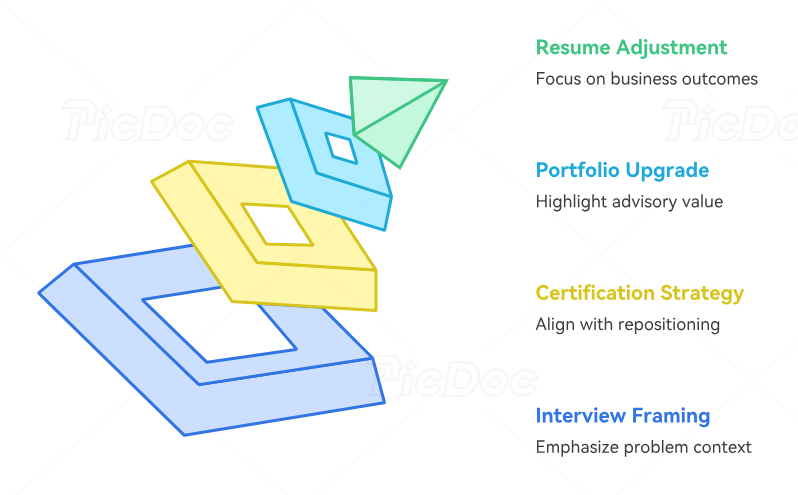
4. Reposition Yourself in the Market: Résumé, Portfolio, Certifications, and Interview Strategy
Your résumé must stop sounding like a lab diary. Hiring managers and clients need to see business-facing outcomes. Instead of “performed penetration testing,” show that you assessed attack paths, documented business impact, prioritized remediation, and improved stakeholder clarity. That kind of language aligns better with resources like the career guide for cybersecurity instructors and trainers, the path to cybersecurity curriculum development, and the journey toward director-level cybersecurity leadership. Why? Because those roles demand the ability to create understanding, not just perform tasks.
Your portfolio should prove that your ethical hacking skill has matured into advisory value. Include sanitized assessment excerpts, executive summaries, risk prioritization memos, architecture observations, and remediation roadmaps. If you can show how a finding related to endpoint security effectiveness, AI adoption in cybersecurity, cloud threat patterns, or insider threat prevention, you signal context, not just competence.
Certifications can help, but they need to support your repositioning strategy. Use the top cybersecurity certifications directory, the future cybersecurity certifications analysis, the career advancement report on certifications, and the salary growth analysis for major security certifications to choose intelligently. An offensive credential may prove technical credibility, while a governance- or architecture-aligned credential may help consulting trust. The point is not to collect badges. The point is to reduce doubt in the exact places where your profile still looks narrow.
In interviews, your edge comes from how you frame problems. A weak candidate explains tools. A strong consultant candidate explains tradeoffs: what you would test, why that matters to this business, what you would tell leadership first, and what remediation path balances urgency with realism. Build answers that sound informed by security frameworks, cloud security evolution, zero-trust direction, and future workforce demands. Interviewers remember candidates who think beyond the test.
5. Build a Practical 12- to 24-Month Roadmap Toward Consultant-Level Authority
In the first phase, focus on converting technical work into better artifacts. Every lab, engagement, or internal assessment should produce three outputs: a technical note, a client-ready summary, and a remediation sequence. During this stage, strengthen your market awareness with the global cybersecurity salary report, the entry-level to CISO salary progression analysis, remote versus on-site salary insights, and the cybersecurity job market trends report. You need to know where leverage is actually growing.
In the second phase, choose one consulting lane and go deep. Maybe that is cloud attack-path analysis, regulatory-focused advisory, sector-specific risk consulting, offensive-led control validation, or breach-readiness assessments. Use ACSMI resources like the cloud security engineer guide, the cybersecurity compliance analyst roadmap, the incident responder career pathway, the threat intelligence analyst guide, and the security analyst to engineer roadmap to deepen adjacent strengths that consulting buyers value.
In the third phase, build visibility and authority. Publish sharper insight, contribute stronger write-ups, speak with precision on recurring client problems, and show a repeatable perspective. This does not mean pretending to be a thought leader. It means sounding like someone who has seen patterns across environments. Learn from top cybersecurity blogs, YouTube learning channels, industry conferences, and research institutes, but make your perspective grounded in actual practice.
The last phase is leverage. Once you can combine offensive depth, business framing, sector context, clear deliverables, and repeatable communication, you stop competing only for “ethical hacker” openings. You become relevant for consulting firms, advisory-heavy internal roles, specialized security assessments, readiness programs, and higher-trust client-facing work. That is when the move becomes financially meaningful, especially when combined with insights from the freelance and consulting market report, the workforce shortage study, specialized role demand predictions, and the outlook on remote cybersecurity career trends. The market pays more when you reduce uncertainty, not just when you produce technical evidence.
6. FAQs
-
Not by itself. Ethical hacking gives you strong technical credibility, especially if you built your skills through the ethical hacking roadmap, the CEH guide, or the OSCP-focused penetration testing path. But consulting requires more: client communication, prioritization, framework awareness, remediation judgment, and business-context thinking.
-
They assume technical depth alone will create trust. In reality, trust grows when you can connect findings to security audits, compliance trends, incident response readiness, and framework-driven decision making. Clients want advice they can act on, not just evidence that you are clever.
-
Usually yes. Broad capability helps, but specialization makes you easier to trust and easier to buy. A strong lane could be cloud, AppSec, ransomware readiness, sector-specific consulting, or offensive-led risk assessment. ACSMI resources on cloud security tools, application security tools, financial-sector cybersecurity, and healthcare threat realities can help you choose a lane with real demand.
-
Show better artifacts. Build sanitized executive summaries, prioritized remediation roadmaps, scoping notes, and architecture observations. Support that growth with the language of audits, compliance officer work, manager-level cybersecurity communication, and consulting-market expectations. When your work helps others decide, you start sounding consultative.
-
The most useful certifications are the ones that close trust gaps in your profile. Start by comparing options in the cybersecurity certifications directory, then weigh the market signal through the career advancement report, the salary growth analysis, and the article on future-valued certifications. Choose for positioning, not vanity.
-
Yes, and it can be a strong route. People coming from SOC analyst roles, incident response pathways, compliance analyst roles, or cloud security engineering often bring valuable operational context. The key is turning that context into advisory proof and stronger communication.
-
It depends less on time and more on evidence. Once you can show technical depth, sector understanding, stronger writing, confident prioritization, and repeatable client-facing thinking, you stop looking like an aspiring consultant and start looking like a safer hire. The market context in the job trends report, salary progression data, and future skills analysis can help you benchmark where to push next.
