
The Ultimate Guide to Getting Advanced Cybersecurity & Management Certification in Utah: Everything You Need to Know in 2026-2027
Utah cybersecurity careers are getting more competitive because employers want proof that a candidate can secure systems, manage risk, explain threats, and lead teams under pressure. A certification can help, yet the wrong certification wastes money, time, and momentum.
This guide gives Utah professionals a practical certification roadmap for 2026-2027, especially if you are moving from analyst work into management, from IT into security, or from technical execution into leadership. Use it alongside ACSMI’s cybersecurity certifications directory, cybersecurity salary benchmarks, cybersecurity workforce shortage study, and cybersecurity job market trends to choose a credential that creates real career leverage.
1. Why Advanced Cybersecurity & Management Certification Matters in Utah in 2026-2027
Utah’s cybersecurity market rewards people who can connect hands-on security knowledge with business judgment. A hiring manager in Salt Lake City, Provo, Lehi, Ogden, or St. George may value technical depth, yet leadership roles usually demand broader proof: risk ownership, policy awareness, incident response maturity, audit readiness, cloud governance, vendor control, and board-level communication. That is where an advanced cybersecurity and management certification becomes useful.
The mistake many professionals make is treating certification as a decoration. A credential only helps when it matches the role you are chasing. If you want SOC leadership, compare your plan with ACSMI’s SOC analyst career guide, SOC manager roadmap, incident responder pathway, and cybersecurity incident response report. If you want governance or compliance leadership, use ACSMI’s cybersecurity compliance officer roadmap, cybersecurity auditor guide, cybersecurity compliance trends report, and NIST framework adoption analysis.
Utah candidates often face a frustrating gap: they may have experience, yet their résumé fails to signal scope. A security analyst may have handled alerts for years while looking invisible next to someone who can show leadership vocabulary, frameworks, audits, cloud controls, and risk decisions. The right credential helps translate hidden experience into recognizable hiring language.
For management-focused roles, certifications matter most when they prove three things: you understand security deeply enough to lead technical teams, you understand risk well enough to brief executives, and you understand compliance well enough to protect the organization from preventable exposure. ACSMI’s CISO roadmap, security manager pathway, director of cybersecurity roadmap, and VP of cybersecurity guide give you the leadership ladder behind the credential decision.
| Certification / Credential Track | Best Utah Career Stage | Most Likely Advancement Effect | Where It Creates Real Leverage |
|---|---|---|---|
| CISSP | Mid to senior career | Signals broad security leadership maturity | Security manager, architect, GRC lead, CISO-track roles |
| CISM | Mid to senior career | Strengthens management, governance, and risk credibility | Cybersecurity manager, IT risk leader, security program owner |
| CRISC | Mid career | Proves risk-control thinking beyond tool execution | Enterprise risk, audit, compliance, and control ownership |
| CISA | Early to senior career | Improves audit and assurance positioning | Security auditor, compliance analyst, control validation roles |
| CCSP | Mid career | Builds cloud security leadership trust | Cloud security engineer, cloud architect, SaaS security governance |
| CASP+ | Mid career | Shows advanced practitioner depth | Senior analyst, security engineer, technical lead roles |
| CompTIA Security+ | Entry to early career | Creates baseline employability signal | IT-to-security transition, junior analyst, support-to-security moves |
| CompTIA CySA+ | Early to mid career | Supports defensive specialization | SOC, detection, triage, vulnerability management |
| CompTIA PenTest+ | Early to mid career | Supports offensive security positioning | Testing, assessment, red-team-adjacent work |
| CEH | Early to mid career | Improves ethical hacking résumé recognition | Junior pentesting, security assessment, consulting entry points |
| OSCP | Mid career | Proves hands-on offensive capability | Penetration testing, red team, offensive security engineering |
| GIAC GCIH | Mid career | Strengthens incident handling credibility | IR analyst, threat hunter, SOC escalation roles |
| GIAC GCIA | Mid career | Deepens network detection authority | Network defense, intrusion analysis, advanced SOC roles |
| GIAC GSEC | Early to mid career | Builds practical security foundation | Technical security operations and analyst credibility |
| AWS Security Specialty | Mid career | Validates cloud-native security knowledge | AWS-heavy employers, cloud operations, DevSecOps teams |
| Azure Security Engineer Associate | Early to mid career | Improves Microsoft security ecosystem credibility | Identity, endpoint, cloud, enterprise Microsoft environments |
| Google Professional Cloud Security Engineer | Mid career | Supports cloud architecture and control design | Cloud security architecture, SaaS security, platform governance |
| Certified Kubernetes Security Specialist | Mid to senior technical career | Shows container and cloud-native depth | DevSecOps, platform engineering, cloud security leadership |
| ISO 27001 Lead Implementer | Mid career | Supports security management system ownership | Governance, consulting, policy, compliance programs |
| ISO 27001 Lead Auditor | Mid career | Improves audit readiness and assessment credibility | Internal audit, third-party assurance, compliance consulting |
| NIST CSF Practitioner Track | Early to senior career | Creates framework fluency for risk conversations | Risk assessment, program maturity, board reporting |
| Privacy / Data Protection Certification | Mid career | Connects cybersecurity with privacy risk | Privacy governance, compliance, data protection programs |
| PMP | Mid to senior career | Strengthens project and program delivery signal | Security program manager, transformation lead, implementation owner |
| ITIL 4 | Early to mid career | Improves service-management communication | SOC operations, IT security management, incident workflow maturity |
| Third-Party Risk Management Track | Mid career | Builds vendor-risk credibility | Supplier security, procurement risk, SaaS security reviews |
| Executive Cybersecurity Leadership Certificate | Senior career | Improves board-facing security leadership language | CISO-track, director, VP security, advisory leadership |
2. How to Choose the Right Advanced Cybersecurity Certification in Utah
The best certification for a Utah professional depends on the role gap you are trying to close. If your current problem is weak résumé recognition, start with broad credentials. If your problem is technical credibility, choose hands-on credentials. If your problem is promotion into leadership, choose management, governance, risk, or cloud-security credentials. ACSMI’s certification impact survey report, CISSP, CEH, and Security+ salary growth analysis, entry-level-to-CISO salary progression analysis, and future cybersecurity certifications guide help you compare credentials by outcome instead of hype.
For Utah’s technology corridor, cloud security deserves serious attention. Employers running SaaS platforms, fintech systems, healthcare systems, e-commerce environments, education platforms, and public-sector services need people who can secure identity, APIs, workloads, endpoints, logs, configurations, and third-party integrations. A cloud-focused candidate should study ACSMI’s cloud security engineer guide, best cloud security tools directory, future of cloud security analysis, and emerging cloud threats report.
For management-track professionals, the highest-value credentials usually sit around CISSP, CISM, CRISC, CISA, CCSP, ISO 27001, PMP, and framework-based training. These help you speak the language of budgets, business risk, audit scope, vendor exposure, insurance questions, security roadmaps, and incident accountability. Technical managers who only discuss tools can get trapped below director level. Leaders who connect controls to business outcomes can compete for larger mandates.
The most damaging certification mistake is stacking credentials without building a career story. A Utah hiring manager should immediately understand why each credential exists on your résumé. Security+ can explain your foundation, CySA+ can explain defensive depth, CISSP can explain architecture and management readiness, CISM can explain governance, CRISC can explain risk ownership, and CCSP can explain cloud strategy. ACSMI’s security analyst-to-engineer roadmap, senior cybersecurity analyst pathway, security specialist-to-CISO guide, and chief security architect guide can help you shape that story.
If your target is an offensive role, prioritize proof of skill. CEH may help with recognizability, PenTest+ can support early validation, and OSCP carries stronger hands-on weight for serious pentesting paths. Pair those choices with ACSMI’s ethical hacker roadmap, CEH guide, OSCP roadmap, and red-team specialist guide.
If your target is defensive leadership, prioritize detection, incident response, SIEM, threat intelligence, vulnerability management, and operational maturity. That path should combine CySA+, GCIH, GCIA, CISSP, CISM, and cloud-security certifications depending on the role. Study ACSMI’s SOC analyst step-by-step guide, threat intelligence analyst guide, vulnerability assessment techniques, and best SIEM solutions directory before choosing your training spend.
3. Utah Career Paths Where Advanced Cybersecurity & Management Certification Pays Off Fastest
A certification pays off fastest when it removes a blocker. For an IT support professional in Utah, the blocker may be credibility. For a SOC analyst, the blocker may be specialization. For a security engineer, the blocker may be leadership readiness. For a manager, the blocker may be executive trust. ACSMI’s IT support to cybersecurity analyst guide, network administrator to ethical hacker guide, IT manager to security leadership guide, and security manager to director roadmap show how different blockers require different credentials.
The IT-to-security transition is the first major Utah pathway. Candidates coming from help desk, desktop support, systems administration, network administration, or cloud operations should avoid jumping straight into advanced management credentials without a foundation. Security+, CySA+, Azure Security, AWS Security, and practical lab work usually create a cleaner bridge. Recruiters need evidence that your IT experience transfers into security work. That evidence should include incident tickets, identity controls, endpoint hardening, vulnerability remediation, log review, access reviews, and security documentation.
The analyst-to-manager pathway is different. A SOC analyst who wants leadership must show operational judgment beyond alert handling. That means incident prioritization, escalation design, staffing awareness, playbook improvement, SIEM tuning, control gaps, metrics, and executive summaries. CISSP, CISM, GCIH, CRISC, and ITIL can help when backed by real examples. ACSMI’s SOC analyst to SOC manager guide, incident responder career path, state of ransomware analysis, and phishing trends report can give you the operational language employers expect.
The compliance and audit pathway is powerful in Utah because regulated organizations need evidence, documentation, and repeatable controls. Healthcare, finance, education, government contractors, SaaS vendors, and nonprofits all face pressure from audits, contracts, cyber insurance reviews, and vendor questionnaires. A candidate with CISA, CRISC, ISO 27001, privacy training, and NIST fluency can compete for roles that pure tool operators miss. ACSMI’s healthcare compliance report, GDPR cybersecurity guide, future compliance trends, and privacy regulations forecast can support that direction.
The cloud and product-security pathway is another high-leverage route. Utah’s tech ecosystem includes SaaS, fintech, health technology, education technology, and fast-scaling software teams. These employers need security professionals who understand CI/CD, cloud identities, container risk, secret management, API exposure, logging, access boundaries, and application security. CCSP, AWS Security Specialty, Azure Security, Google Cloud Security, Kubernetes Security, and application-security training can position you better than a generic certification stack. Use ACSMI’s application security tools directory, AI cybersecurity adoption report, AI-driven cybersecurity tools forecast, and future skills guide.
The leadership pathway requires more than passing an exam. A future security manager, director, VP, or CISO must show judgment under ambiguity. Certifications can open the door, yet interviews are won with stories about tradeoffs: which risks you accepted, which controls you prioritized, which vendors you challenged, which metrics you improved, which incidents you contained, and which executives you convinced. ACSMI’s CISO career roadmap, director of information security guide, cybersecurity program manager guide, and cybersecurity policy director pathway are useful for shaping that leadership proof.
Quick Poll: What Is the Real Reason You Want an Advanced Cybersecurity & Management Certification in Utah?
Pick the pressure point that best matches your next career move.
4. Step-by-Step Roadmap to Getting Certified in Utah
Start with a target role, then work backward. A vague goal like “get into cybersecurity management” creates scattered training. A sharp goal like “move from security analyst to SOC manager in Salt Lake City within 12 months” gives you a better certification sequence, better projects, better résumé bullets, and better interview stories. ACSMI’s cybersecurity analyst advancement guide, career path from SOC analyst to SOC manager, cybersecurity specialist to educator guide, and cybersecurity product manager roadmap can help define that target.
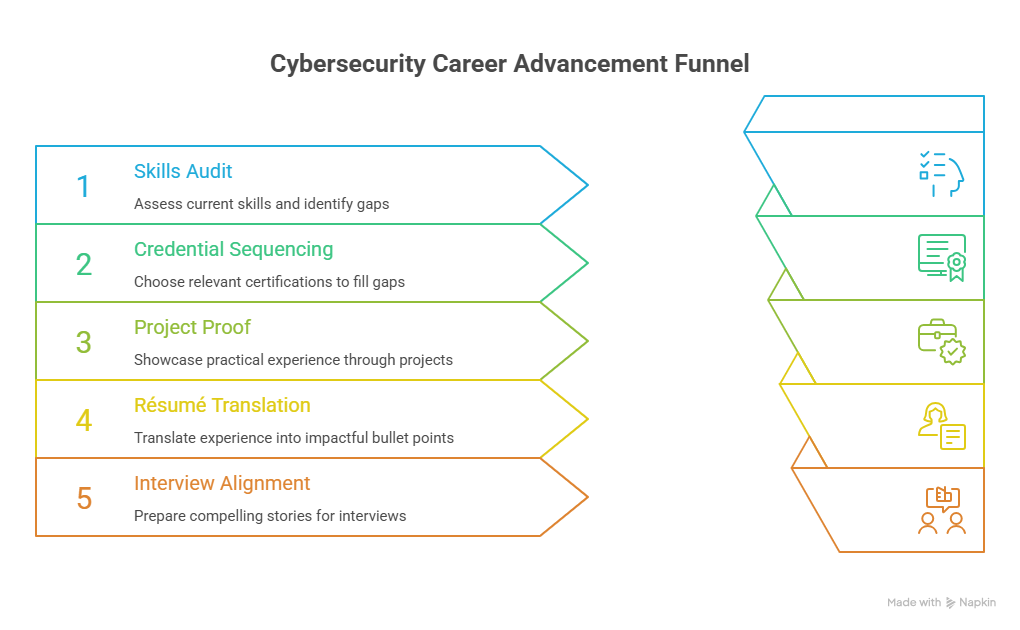
Step one is a skills audit. List your current evidence across security operations, vulnerability management, identity, endpoint, cloud, risk, compliance, incident response, documentation, stakeholder communication, and leadership. Then mark each item as weak, usable, or interview-ready. Your next certification should strengthen the weakest area that blocks your target role. A candidate who lacks cloud experience should avoid hiding behind another broad management credential. A candidate who lacks governance language should avoid stacking another tool certificate.
Step two is credential sequencing. Early-career professionals can build from Security+ to CySA+, PenTest+, Azure Security, AWS Security, or CEH depending on direction. Mid-career professionals can move into CISSP, CISM, CISA, CRISC, CCSP, ISO 27001, or GIAC tracks. Senior professionals should combine leadership credentials with proof of program outcomes. ACSMI’s training provider directory, free cybersecurity courses directory, cybersecurity bootcamps directory, and cybersecurity books directory can help you control cost while building depth.
Step three is project proof. For a management certification to matter, your portfolio should include security roadmaps, risk registers, incident postmortems, policy drafts, vendor security review templates, cloud control diagrams, tabletop exercise notes, vulnerability remediation plans, and executive dashboards. These artifacts show employers how you think. A certification tells them you studied the field. Evidence tells them you can operate inside it.
Step four is résumé translation. Replace vague bullets with proof of scope, risk, action, and outcome. Instead of saying you “monitored security alerts,” say you triaged SIEM alerts, improved escalation logic, documented repeatable playbooks, reduced false-positive noise, or supported incident containment. Instead of saying you “worked on compliance,” describe control mapping, evidence collection, audit readiness, policy updates, vendor questionnaires, or framework alignment. ACSMI’s security audits best practices, access control models guide, cybersecurity frameworks guide, and best DLP software directory give you stronger language for technical and governance proof.
Step five is interview alignment. Before applying, prepare five stories: one incident story, one risk tradeoff story, one leadership story, one compliance or audit story, and one technical troubleshooting story. Each story should show pressure, decision-making, communication, and measurable value. Utah employers want people who can operate calmly when systems fail, vendors delay, alerts spike, auditors ask hard questions, or executives demand clarity.
5. Costs, Timelines, Salary Leverage, and Common Mistakes to Avoid
The cost of certification includes more than exam fees. It includes study time, training materials, retakes, labs, renewal fees, continuing education, and opportunity cost. A cheap credential can become expensive if it fails to move you closer to the role you want. A costly credential can be worth it when it directly supports promotion, higher salary, or stronger hiring access. Use ACSMI’s global salary report, remote vs on-site cybersecurity salary analysis, freelance and consulting income report, and specialized role demand forecast before choosing.
A realistic timeline depends on background. A strong IT professional may prepare for Security+ or Azure Security in a few focused months. A working analyst may need several months for CySA+, CISM, CISA, or AWS Security. CISSP, OSCP, CCSP, CRISC, and GIAC-level credentials often require deeper preparation because they test judgment, breadth, or hands-on discipline. The right question is how quickly the credential can become usable proof in your career story.
Salary leverage improves when certification aligns with a role change. A credential alone rarely forces a raise. It becomes powerful when paired with new responsibilities, measurable achievements, a promotion case, or a stronger external job search. If you want management-level pay, show management-level work. That means budget awareness, project delivery, metrics, risk prioritization, stakeholder communication, and ownership of repeatable processes. ACSMI’s salary growth analysis for CISSP, CEH, and Security+, gender pay gap analysis, remote cybersecurity careers forecast, and automation and workforce forecast help place certification inside broader career economics.
The first common mistake is choosing a certification because it is famous. Fame helps only when the credential fits the hiring signal you need. The second mistake is over-certifying before applying. Some candidates keep studying because interviews feel uncomfortable. At a certain point, job-market feedback becomes the best teacher. The third mistake is ignoring local employer patterns. Utah roles can lean toward cloud, SaaS, public sector, healthcare, financial services, education, and infrastructure security, so your certification stack should match the environments you are likely to support.
The fourth mistake is forgetting soft leadership proof. Advanced cybersecurity management requires writing, prioritization, conflict handling, vendor pressure, cross-functional coordination, and executive communication. Technical brilliance can stall when a candidate cannot explain risk without jargon. A manager must make security understandable to people who control budget, contracts, operations, and deadlines. ACSMI’s cybersecurity leadership to VP guide, chief privacy officer roadmap, cybersecurity content creator guide, and cybersecurity instructor guide can help build communication authority.
The fifth mistake is treating certification renewal as an afterthought. Many advanced credentials require continuing education. That can become a career advantage when you use it strategically. Attend security events, complete cloud labs, write internal guidance, join professional groups, study new threats, review ACSMI’s top cybersecurity blogs directory, cybersecurity podcasts directory, YouTube cybersecurity learning directory, and cybersecurity conferences directory, then turn that learning into résumé-ready evidence.
6. FAQs About Getting Advanced Cybersecurity & Management Certification in Utah
-
For management roles, CISSP and CISM are usually the strongest starting points because they signal broad security understanding and leadership readiness. CRISC helps if your target role involves enterprise risk, CISA helps if audit and assurance matter, and CCSP helps if the employer runs cloud-heavy systems. Use ACSMI’s cybersecurity manager pathway, CISO roadmap, director of information security guide, and chief security architect guide to match the certification to the leadership level you want.
-
Certifications can help you get noticed, yet management jobs require evidence of ownership. Employers want examples of incident handling, control improvement, risk decisions, vendor coordination, reporting, policy work, and team influence. If your résumé has credentials without outcomes, it will feel thin. Pair your certification with projects, measurable achievements, and leadership stories. ACSMI’s cybersecurity program manager guide, security analyst advancement guide, incident response effectiveness report, and security audits guide can help build that proof.
-
Start with a foundation credential such as Security+, then add a role-specific credential like CySA+ for SOC work, Azure Security for Microsoft-heavy environments, AWS Security for cloud roles, or PenTest+ for offensive security direction. Build practical projects around identity, endpoint hardening, vulnerability remediation, log review, and incident documentation. ACSMI’s IT support to cybersecurity analyst guide, SOC analyst guide, vulnerability scanner guide, and endpoint detection and response tools guide are strong companions.
-
CISSP is worth considering when you already have enough security experience to benefit from a broad, leadership-oriented credential. It is especially useful for security managers, architects, consultants, senior analysts, GRC professionals, and CISO-track candidates. It should be paired with proof of real responsibility, because employers still want examples of risk decisions, control design, incident response, and communication. Compare it with ACSMI’s certification salary growth analysis, certification impact report, cybersecurity certifications directory, and future certification trends.
-
For cloud security, choose based on the ecosystem you want to support. AWS Security Specialty helps with AWS-heavy teams, Azure Security Engineer Associate helps with Microsoft environments, Google Cloud Security Engineer helps with GCP roles, and CCSP gives broader cloud governance credibility. Kubernetes security training helps if your target employers use containers and cloud-native architecture. ACSMI’s cloud security engineer guide, cloud security tools directory, future cloud security report, and emerging cloud threats analysis can help you compare.
-
A focused candidate may prepare for some intermediate certifications within a few months, while advanced credentials such as CISSP, CISM, CRISC, CCSP, OSCP, and GIAC tracks often require longer preparation. Timeline depends on your background, study hours, lab access, and exam familiarity. The better strategy is to set a deadline, build a weekly study system, complete practice projects, and apply the material at work immediately. ACSMI’s training provider directory, free cybersecurity courses directory, bootcamps directory, and books directory can support planning.
