
The Ultimate Guide to Getting Advanced Cybersecurity & Management Certification in New York: Everything You Need to Know in 2026-2027
New York rewards cybersecurity professionals who can protect systems, explain risk, and lead under pressure. A strong credential strategy can help you move from scattered applications to targeted roles across finance, healthcare, government, cloud, compliance, and security operations. Use this guide with ACSMI’s cybersecurity certifications directory, cybersecurity salary benchmarks, workforce shortage research, and certification career-impact analysis to build a career plan that earns attention.
1. Why Advanced Cybersecurity & Management Certification Matters in New York
New York’s cybersecurity market is demanding because the state concentrates high-risk industries: financial services, healthcare networks, legal firms, SaaS teams, retail platforms, universities, insurance companies, nonprofits, public-sector agencies, and cloud-heavy startups. A candidate who only says “I know security” sounds replaceable. A candidate who can map controls to business risk, investigate incidents, support audits, brief executives, and improve detection maturity becomes far more useful. That is why pairing an advanced cybersecurity and management credential with a focused pathway such as SOC analyst development, cloud security engineering, cybersecurity compliance, security auditing, and CISO leadership matters.
The biggest pain point for New York applicants is signal quality. Recruiters see plenty of résumés with vague “security tools,” “risk management,” and “incident response” language. Hiring teams need proof that you can operate in regulated environments, understand controls, prioritize threats, communicate tradeoffs, and protect revenue-critical systems. A certification becomes powerful when it connects to a role-specific story: a help desk analyst moving into SOC work through IT support to cybersecurity analyst training, a network administrator moving toward ethical hacking, a security analyst moving into cybersecurity engineering, or a manager advancing through security leadership.
| Certification / Credential Direction | Best Career Stage | New York Career Leverage | Proof to Build Before Applying |
|---|---|---|---|
| ISC2 Certified in Cybersecurity | Entry transition | Helps career switchers show baseline security commitment. | Home lab notes, basic risk writeups, phishing analysis samples. |
| CompTIA Security+ | Entry to early career | Supports analyst, support-security, and junior defense roles. | Ticket triage examples, access-control notes, vulnerability summaries. |
| CompTIA CySA+ | Early blue team | Builds credibility for SOC, detection, and monitoring roles. | SIEM searches, incident timeline, alert-priority decision log. |
| CompTIA PenTest+ | Early offensive track | Helps prove testing knowledge before deeper red-team specialization. | Scope document, safe lab report, remediation-focused finding. |
| OSCP | Hands-on offensive career | Strong signal for penetration testing and offensive security roles. | Methodology notes, exploit path, clean executive summary. |
| CEH | Ethical hacking foundation | Useful when paired with tools, reports, and business-safe testing context. | Recon checklist, vulnerability validation, risk-rated finding sample. |
| CISSP | Experienced practitioner | Excellent for senior analyst, architect, consultant, and leadership credibility. | Security program examples, control mapping, risk-treatment memo. |
| CISM | Management track | Strong fit for security managers, governance leads, and risk owners. | Policy review, KPI dashboard, board-friendly cyber risk brief. |
| CISA | Audit and assurance | Useful for financial services, insurance, healthcare, and compliance-heavy teams. | Audit checklist, evidence request list, control-gap tracker. |
| CRISC | Risk leadership | Helps candidates move from technical control work into enterprise risk. | Risk register, likelihood-impact model, treatment recommendation. |
| CCSP | Cloud security | Strong for SaaS, fintech, healthcare cloud, and hybrid enterprise roles. | Cloud IAM review, storage-risk assessment, shared responsibility memo. |
| AWS Security Specialty | Cloud engineer track | Shows platform-specific depth for AWS-heavy New York employers. | IAM policy review, CloudTrail detection, encryption configuration notes. |
| Azure Security Engineer | Microsoft cloud teams | Useful for enterprise identity, Defender, Entra ID, and hybrid environments. | Conditional access plan, privileged access review, alert triage notes. |
| Application Security Certifications | AppSec and product security | Valuable for fintech, SaaS, e-commerce, and dev-heavy security teams. | Threat model, secure code review notes, API-risk findings. |
| NIST / ISO Framework Training | Governance and controls | Helps translate security work into control maturity and audit language. | Control map, gap analysis, executive remediation roadmap. |
| Privacy and Compliance Credentials | Regulated industries | Strong fit for finance, healthcare, legal, insurance, and SaaS vendors. | Data-flow map, vendor-risk checklist, compliance evidence folder. |
| Incident Response Training | Blue team specialization | Shows readiness for breach response, containment, and post-incident review. | Incident timeline, containment plan, lessons-learned report. |
| Threat Intelligence Credentials | Intel and defense | Useful for financial fraud, ransomware defense, and executive risk briefings. | Threat profile, IOC context, actor-technique mapping. |
| Insider Threat Training | Enterprise defense | Valuable for organizations protecting sensitive customer and employee data. | Behavioral indicator matrix, least-privilege review, escalation workflow. |
| PAM / Identity Security Training | IAM and infrastructure security | Strong leverage in financial services, healthcare, and enterprise IT. | Privileged account inventory, rotation plan, access review sample. |
| EDR / Endpoint Security Training | Security operations | Useful for SOC, endpoint defense, ransomware prevention, and response teams. | EDR alert analysis, endpoint-hardening checklist, containment playbook. |
| SIEM Training | SOC and detection | Helps prove you can turn logs into defensible investigation outcomes. | Detection query, false-positive tuning note, dashboard screenshot. |
| Vulnerability Management Training | Analyst to engineer | Supports infrastructure, consulting, compliance, and security engineering roles. | Risk-ranked remediation plan, owner matrix, patch-priority memo. |
| Email Security Training | Security operations | Useful because phishing remains a daily operational risk for New York firms. | Phishing triage example, header analysis, awareness feedback loop. |
| AI Security Training | Future-facing security | Helps candidates address AI misuse, data leakage, and automated attacks. | AI risk register, prompt-abuse scenario, model-access control notes. |
| Advanced Cybersecurity & Management Certification | Mid-career to leadership | Best for professionals who need technical credibility plus management language. | Strategic security roadmap, metrics pack, stakeholder-ready risk narrative. |
2. How to Choose the Right Certification Track for Your New York Cybersecurity Goal
Start with the job you want, then choose the certification that makes that job easier to justify. A SOC applicant in Queens, Brooklyn, Albany, Buffalo, or Manhattan needs hands-on triage proof, SIEM fluency, endpoint investigation, and alert judgment, so SOC analyst roadmaps, SIEM solution knowledge, EDR tool familiarity, and incident response preparation create a cleaner story than collecting random acronyms. A compliance applicant needs control evidence, audit discipline, policy understanding, and risk communication, so compliance officer guidance, cybersecurity audit guidance, NIST framework knowledge, and privacy regulation trends matter more.
For New York finance, the highest-value track usually blends security governance, third-party risk, incident response, cloud controls, and executive reporting. Candidates targeting banks, fintechs, insurance companies, investment firms, and payment platforms should study financial-services cybersecurity firms, cybersecurity compliance trends, incident response effectiveness, cloud threat analysis, and salary growth by certification. The credential should help you speak in board-level risk terms while still explaining a vulnerability, detection rule, access review, or vendor issue without sounding theoretical.
For offensive security, choose a path that proves discipline. Hiring teams fear testers who find issues without understanding business impact, scope, reporting, remediation, or stakeholder friction. A stronger route combines ethical hacking roadmaps, penetration testing company comparisons, penetration testing tool knowledge, red-team career planning, and vulnerability assessment methods. Your portfolio should read like a professional engagement: objective, scope, evidence, severity, business risk, remediation, retest logic, and executive summary.
3. The New York Skill Stack Employers Actually Reward
New York employers reward security professionals who reduce uncertainty. That means your certification plan should build five stacked capabilities: technical depth, regulatory awareness, cloud fluency, communication, and operational judgment. Technical depth helps you analyze endpoints, logs, identity events, phishing reports, vulnerabilities, and suspicious activity. Regulatory awareness helps you understand why a weak control can become a legal, financial, customer-trust, or board-governance problem. Cloud fluency helps you secure identity, storage, workloads, APIs, SaaS integrations, and remote access. Communication helps you turn noise into decisions. Use ACSMI’s endpoint security report, email security directory, cloud security tools guide, access control models guide, and risk-focused compliance research as supporting study material.
The skill gap that hurts many candidates is translation. They may know a tool, yet they struggle to explain why the alert matters, which asset is exposed, which control failed, which team owns the fix, and what business consequence follows. A New York hiring manager wants evidence that you can handle stakeholder pressure without hiding behind buzzwords. Build a proof pack around ransomware analysis, phishing prevention, data breach mitigation, insider threat prevention, and third-party security thinking. That proof pack gives interviews more substance than a résumé stuffed with disconnected tools.
Pick the obstacle that feels most urgent, because your certification strategy should solve the real career problem.
4. Step-by-Step Certification Plan for 2026-2027
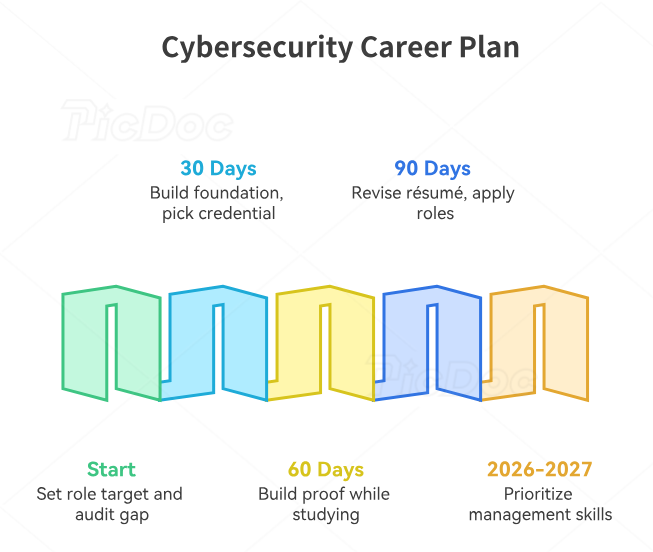
The smartest plan starts with a role target, a gap audit, and a proof timeline. First, choose one primary direction: SOC, cloud security, GRC, audit, AppSec, incident response, offensive security, or leadership. Then audit your current evidence. Do you have a résumé bullet tied to measurable security work? Do you have a project that shows investigation, control improvement, risk reduction, secure configuration, or stakeholder communication? Do you understand the language used in cybersecurity job market trends, future skills research, specialized role demand, remote cybersecurity careers, and entry-to-CISO progression? That audit prevents wasted effort.
For the first 30 days, build foundation and choose the credential. Use free cybersecurity courses, cybersecurity bootcamps, training provider directories, cybersecurity books, and cybersecurity podcasts to support the learning plan. For days 31-60, build proof while studying: a SOC case study, a cloud IAM review, a vulnerability management report, a compliance evidence binder, or an executive cyber-risk memo. For days 61-90, revise your résumé around outcomes, apply to aligned roles, and rehearse interview stories using challenge, action, evidence, and business result.
By 2026-2027, management capability will matter even for technical professionals. The strongest New York candidates will understand automation, AI risks, vendor ecosystems, data protection, cloud misconfigurations, identity attacks, and business continuity. That makes ACSMI’s AI-powered attack predictions, future zero-trust analysis, next-gen SIEM guide, endpoint security innovation forecast, and automation workforce analysis useful alongside certification study. The goal is to become the candidate who can explain where the threat landscape is going and what the organization should do next.
5. How to Turn the Certification Into Interviews, Promotions, and Salary Leverage
A credential creates leverage when it changes how people perceive your readiness. To make that happen, rewrite your résumé around the problems New York employers are already trying to solve: ransomware readiness, vendor risk, cloud access, endpoint containment, vulnerability prioritization, executive reporting, compliance evidence, and business continuity. Replace thin lines like “studied cybersecurity” with stronger proof such as “built a risk-ranked vulnerability remediation tracker for cloud and endpoint assets” or “created a mock incident timeline with containment, evidence, and stakeholder update notes.” Support those bullets with ACSMI references on ransomware evolution, critical infrastructure cybersecurity, cloud security threats, DLP software, and network monitoring tools.
For interviews, prepare three stories: one technical story, one risk story, and one communication story. The technical story proves you can investigate, secure, test, or improve a system. The risk story proves you can prioritize business impact. The communication story proves you can brief a manager, auditor, developer, vendor, or executive without losing clarity. A certification may earn a screen, yet stories win trust. Use career advancement research, analyst advancement guidance, senior analyst pathways, security manager to director guidance, and VP security career guidance to shape those stories.
For salary leverage, connect the credential to scope. Employers pay more when your work protects higher-value systems, reduces regulatory exposure, improves resilience, manages teams, guides vendors, or lowers breach probability. A certified professional who can own cloud controls, map audit evidence, lead incident response, improve security tooling, or brief leadership can argue for a stronger title with cleaner logic. Benchmark your target using remote versus on-site salary data, global salary research, freelance cybersecurity income data, CISSP and CEH salary growth, and future job market predictions. Then negotiate around responsibility, measurable impact, and market demand.
6. FAQs
-
Yes, especially for professionals targeting regulated employers, leadership pathways, security operations, consulting, audit, cloud security, or risk management. New York organizations need people who can connect technical security with governance pressure, customer trust, vendor oversight, and executive decision-making. The best result comes from pairing certification with practical proof, such as a SIEM investigation, cloud IAM review, vulnerability remediation plan, or compliance evidence sample. Use ACSMI’s certification directory, career advancement survey, workforce shortage study, and salary benchmarks before choosing your path.
-
A beginner should choose based on the first target role. For SOC roles, combine Security+ or an equivalent baseline with SOC analyst training, SIEM learning, and endpoint security knowledge. For compliance roles, focus on cybersecurity frameworks, security audits, and compliance analyst career planning. For offensive security, start with ethical hacking roadmaps and documented lab reports.
-
A focused professional can build a strong 90-day preparation plan, although advanced credentials tied to experience, management, cloud security, audit, or offensive skills may require longer. The timeline should include study, practice, portfolio proof, résumé rewriting, and interview preparation. Spend the first month learning the exam domains and job requirements, the second month building proof, and the third month applying the knowledge to role-specific scenarios. Support the process with ACSMI’s free course directory, bootcamp directory, training provider list, and cybersecurity books directory.
-
Management-focused certification helps security managers, GRC analysts, auditors, SOC leads, incident response leads, cloud security leads, consultants, and aspiring CISOs. The biggest benefit appears when the role requires prioritization, stakeholder communication, vendor oversight, compliance evidence, budget reasoning, or board-level reporting. Candidates moving from hands-on work into leadership should study cybersecurity manager pathways, director of information security careers, CISO roadmaps, and chief security architect guidance.
-
Stand out by showing applied judgment. Create a portfolio with three artifacts: a technical artifact, a risk artifact, and a communication artifact. The technical artifact could be a detection rule, hardening checklist, vulnerability report, cloud access review, or phishing investigation. The risk artifact could be a control gap analysis, vendor-risk scorecard, or remediation roadmap. The communication artifact could be a one-page executive brief. Pair those assets with ACSMI research on phishing trends, data breaches, IoT breaches, and AI in cybersecurity.
-
The biggest mistake is choosing a credential without a role strategy. A certification should answer one career question: “Why should this employer trust me for this specific responsibility?” A SOC candidate needs detection and triage proof. A cloud candidate needs identity and configuration proof. A compliance candidate needs evidence and control proof. A leadership candidate needs risk and communication proof. Before paying for training, compare ACSMI’s future certifications analysis, specialized role demand forecast, job market trends, and career path guides.
