
The Ultimate Guide to Getting Advanced Cybersecurity & Management Certification in Wisconsin: Everything You Need to Know in 2026-2027
Wisconsin cybersecurity careers are becoming more serious, more regulated, and more management-driven. A certification can help, yet the real advantage comes from choosing a credential that matches your target role, your current evidence, and the kind of problems Wisconsin employers are paying people to solve. This guide breaks down the smartest certification path, the career signals hiring managers look for, and the practical steps that turn training into promotion leverage.
1. Why Advanced Cybersecurity & Management Certification Matters in Wisconsin in 2026-2027
Wisconsin has a practical cybersecurity market: employers care about people who can protect hospitals, banks, manufacturers, schools, public agencies, retailers, utilities, and growing cloud environments without creating operational chaos. That means a serious certification plan should connect technical depth with business judgment. A learner who understands cybersecurity workforce shortage pressure, cybersecurity job market trends, salary progression from entry level to CISO, and certification impact on career advancement can make a cleaner decision than someone collecting random badges.
The pain point is simple: many Wisconsin professionals have IT experience, tool exposure, and security interest, yet their résumé still reads like “support person who wants cyber.” Advanced cybersecurity and management certification helps close that perception gap when it is paired with proof: risk assessments, incident reports, cloud control mapping, policy reviews, tabletop exercises, vulnerability prioritization, and measurable improvement. That is why the best path should link your certification to a role such as SOC analyst, cybersecurity compliance officer, cloud security engineer, or cybersecurity manager.
The broader market supports this urgency. The U.S. Bureau of Labor Statistics projects information security analyst employment to grow 29% from 2024 to 2034, with about 16,000 openings per year, and it reports a 2024 median annual wage of $124,910 for the role. Wisconsin’s public-sector environment also shows real governance pressure: the State of Wisconsin’s Division of Enterprise Technology maintains statewide IT security policies and standards, with its IT Security Policy Handbook and IT Security Standards Handbook revised in 2026 and derived from NIST SP 800-53. For learners, that means NIST cybersecurity framework adoption, cybersecurity compliance trends, security audit best practices, and cybersecurity frameworks belong in the same career plan as exam prep.
| Wisconsin Career Target | Best Certification Priority | What It Must Prove | ACSMI Deepening Path |
|---|---|---|---|
| IT support to cybersecurity analyst | Security fundamentals + analyst workflow | You can move from tickets to triage, risk notes, access review, and alert handling. | Use the IT support to cybersecurity analyst roadmap with the free cybersecurity courses directory. |
| Junior SOC analyst | Security+ style foundation + SOC labs | You can read alerts, enrich evidence, escalate cleanly, and avoid noisy false-positive habits. | Study the SOC analyst step-by-step guide and compare SIEM solutions. |
| SOC analyst to SOC manager | Incident response + team leadership | You can improve queue quality, metrics, escalation rules, and analyst coaching. | Pair the SOC analyst to SOC manager guide with the SOC salary and certification pathway. |
| Cybersecurity compliance analyst | GRC, audit, control mapping | You can translate requirements into evidence, owners, timelines, and executive-ready gaps. | Build with the compliance analyst roadmap and compliance trends report. |
| Cybersecurity auditor | Audit controls + evidence review | You can test control operation, document exceptions, and separate risk from paperwork. | Read the cybersecurity auditor guide and security audit process guide. |
| Cloud security engineer | Cloud controls + identity + logging | You can secure IAM, cloud workloads, misconfigurations, secrets, and detection coverage. | Use the cloud security engineer guide and cloud security tools directory. |
| Cybersecurity manager | Risk management + program ownership | You can manage budget, vendors, reporting, policy, incidents, and cross-functional accountability. | Follow the cybersecurity manager pathway and the manager to director roadmap. |
| Incident responder | Detection, containment, recovery | You can run a timeline, isolate affected assets, preserve evidence, and brief leadership. | Study the incident responder pathway and incident response effectiveness report. |
| Threat intelligence analyst | Threat research + intelligence writing | You can convert threat data into usable warnings for executives, SOC teams, and system owners. | Use the threat intelligence analyst guide and detailed threat intel roadmap. |
| Penetration tester | Hands-on offensive assessment | You can scope engagements, test safely, validate findings, and write reports leaders understand. | Start with the ethical hacker roadmap and the OSCP penetration tester guide. |
| Senior security consultant | Assessment + client communication | You can diagnose risk, prioritize fixes, defend recommendations, and manage stakeholder friction. | Study the junior pentester to consultant path and consulting firm rankings. |
| Red-team specialist | Adversary emulation + reporting discipline | You can test realistic attack paths and give defenders specific detection improvements. | Use the red-team specialist guide and red-team operator career path. |
| Vulnerability management lead | Scanner mastery + risk prioritization | You can separate urgent exposure from backlog noise and tie remediation to business impact. | Compare vulnerability scanners and learn vulnerability assessment techniques. |
| Application security analyst | Secure SDLC + testing workflow | You can work with developers, prioritize exploitable flaws, and improve release safety. | Use the application security tools directory and future cybersecurity skills guide. |
| Endpoint security specialist | EDR, hardening, response workflow | You can tune endpoint detection, reduce alert fatigue, and contain workstation/server attacks. | Review EDR tools and endpoint security effectiveness data. |
| Email security owner | Phishing defense + user-risk controls | You can reduce account compromise risk with filtering, awareness, reporting, and response loops. | Study email security solutions and phishing prevention trends. |
| IAM or access control specialist | Identity governance + least privilege | You can clean access sprawl, map roles, and reduce privilege risk without blocking operations. | Use access control models with PAM solution reviews. |
| Healthcare cybersecurity professional | HIPAA-aware security governance | You can protect patient data, medical workflows, vendors, and downtime-sensitive systems. | Read the healthcare compliance report and healthcare cyber firm directory. |
| Financial-sector cybersecurity analyst | Risk, fraud, incident, and compliance alignment | You can connect security controls to fraud exposure, regulatory risk, and executive reporting. | Use the financial incidents analysis and financial cyber firm guide. |
| Manufacturing cybersecurity lead | OT, IoT, segmentation, resilience | You can protect uptime, suppliers, connected devices, and plant-floor risk conversations. | Study manufacturing cybersecurity solutions and IoT security companies. |
| Education-sector security professional | Awareness, identity, data protection | You can protect students, faculty, learning platforms, research data, and limited-budget environments. | Use the education cybersecurity directory and education threat predictions. |
| Government or public-sector cybersecurity | Policy, controls, risk reporting | You can document controls, coordinate agencies, and communicate risk through governance language. | Read the public-sector cyber firm guide and government cyber predictions. |
| SMB cybersecurity consultant | Practical security program design | You can build affordable roadmaps for backups, access, awareness, endpoints, and vendor risk. | Use the SMB cybersecurity company guide and SMB legislation impact guide. |
| Cybersecurity architect | Enterprise architecture + risk governance | You can design control patterns, evaluate tradeoffs, and guide technical strategy. | Follow the chief security architect roadmap and security architect guide. |
| CISO track professional | Executive risk, board communication, budget ownership | You can own enterprise risk, security strategy, metrics, legal coordination, and resilience. | Use the CISO roadmap with the specialist to CISO guide. |
| Cybersecurity program manager | Program delivery + stakeholder control | You can run projects across security, IT, legal, vendors, business units, and leadership. | Study the cybersecurity program manager guide and cybersecurity product manager roadmap. |
| Security awareness leader | Human risk + behavior metrics | You can reduce phishing, credential misuse, reporting delays, and training fatigue. | Compare security awareness platforms and insider threat prevention data. |
| Cybersecurity instructor or trainer | Teaching + curriculum + lab design | You can turn security knowledge into structured learning, labs, assessments, and workforce outcomes. | Use the cybersecurity instructor guide and curriculum developer roadmap. |
| Freelance cybersecurity consultant | Specialized niche + trust-building proof | You can sell scoped services, price risk work, and deliver defensible recommendations. | Read the freelance cybersecurity income report and cybersecurity content creator guide. |
2. Choosing the Right Advanced Cybersecurity & Management Certification Path in Wisconsin
A strong certification path begins with the job you want after the credential, then works backward into skill evidence. A Wisconsin IT support professional aiming for analyst work should connect Security+ style baseline learning, SOC analyst training, SIEM tool familiarity, and endpoint detection and response knowledge. A mid-career professional targeting leadership should focus on governance, risk, incident reporting, vendor oversight, and measurable control improvement through resources like the cybersecurity manager pathway, director of cybersecurity roadmap, security manager to director guide, and VP of cybersecurity leadership guide.
The most common mistake is choosing a credential because it looks prestigious while your evidence points somewhere else. A penetration-testing certification helps when your portfolio includes reports, scope language, vulnerability validation, and remediation recommendations. A GRC certification helps when your work samples show policy mapping, audit evidence, risk register updates, and control-owner communication. A cloud security credential helps when you can explain IAM boundaries, logging gaps, secrets exposure, and workload hardening. Use the ethical hacking roadmap, OSCP penetration tester guide, cloud security career guide, and cybersecurity compliance analyst roadmap as separate lanes.
For 2026-2027, management-aligned cybersecurity training should include NIST CSF 2.0 language because employers increasingly want security people who can explain governance, risk, response, and recovery in business terms. NIST CSF 2.0 organizes outcomes through GOVERN, IDENTIFY, PROTECT, DETECT, RESPOND, and RECOVER, with GOVERN covering risk strategy, expectations, policy, roles, responsibilities, and oversight. That makes NIST framework adoption, cybersecurity frameworks, future cybersecurity compliance, and cybersecurity legislation for SMBs more useful than generic exam cramming.
For beginners, foundational credentials still matter when used correctly. ISC2’s Certified in Cybersecurity is positioned for entry-level or junior-level cybersecurity roles, requires no work experience, and has a new exam outline effective September 1, 2026. For experienced professionals, ISC2 lists credentials by career stage and highlights paths covering foundational, risk management, operational, specialist, manager, and executive roles. In practical terms, Wisconsin learners should treat foundational credentials as the starting signal, then build toward advanced certification salary growth, specialized cybersecurity roles, future employer-valued certifications, and long-term cybersecurity career advancement.
3. How to Turn Certification Into Real Wisconsin Career Proof
A certificate can open the door, yet proof keeps the interview alive. Build a portfolio that shows how you think under pressure. For SOC roles, write a sanitized alert triage report using sample logs: what triggered, what enriched the finding, what false-positive checks were performed, what escalation criteria applied, and what containment step would follow. That single artifact supports SOC analyst applications, incident responder roles, SIEM solution fluency, and incident response performance discussions.
For GRC and management roles, create a one-page risk register with five risks: ransomware exposure, weak MFA coverage, third-party access, unpatched internet-facing assets, and backup recovery uncertainty. Add owner, likelihood, impact, control gap, remediation cost category, and executive summary. That artifact shows you can communicate across business functions, which is essential for cybersecurity compliance officer roles, cybersecurity auditor roles, CISO progression, and privacy regulation readiness.
For technical leadership, create a “control improvement memo.” Pick an environment type common in Wisconsin, such as a clinic network, manufacturer, insurance office, school district, or regional retailer. Explain the current risk, the business consequence, the control recommendation, the implementation sequence, and the metric that proves improvement. This gives hiring managers something more useful than a list of exam domains. It also helps connect healthcare cybersecurity threats, financial cybersecurity incidents, manufacturing sector cybersecurity, and retail e-commerce cybersecurity to your career story.
The NICE Framework is useful here because it gives employers, educators, and learners a shared language for cybersecurity work, knowledge, and skills across career discovery, hiring, training, workforce planning, and role-based development. In Wisconsin, that means you should map your proof to specific tasks: detection, response, risk assessment, policy implementation, vulnerability validation, vendor review, identity governance, or awareness improvement. Keep your evidence tied to future cybersecurity skills, automation and workforce change, AI-powered cyberattacks, and AI in cybersecurity adoption.
Quick Poll: What Wisconsin Cybersecurity Career Problem Are You Trying to Solve First?
Pick the blocker that feels most expensive right now. Your certification strategy should match the pressure point.
4. A 90-Day Study and Portfolio Plan for Wisconsin Cybersecurity Certification Candidates
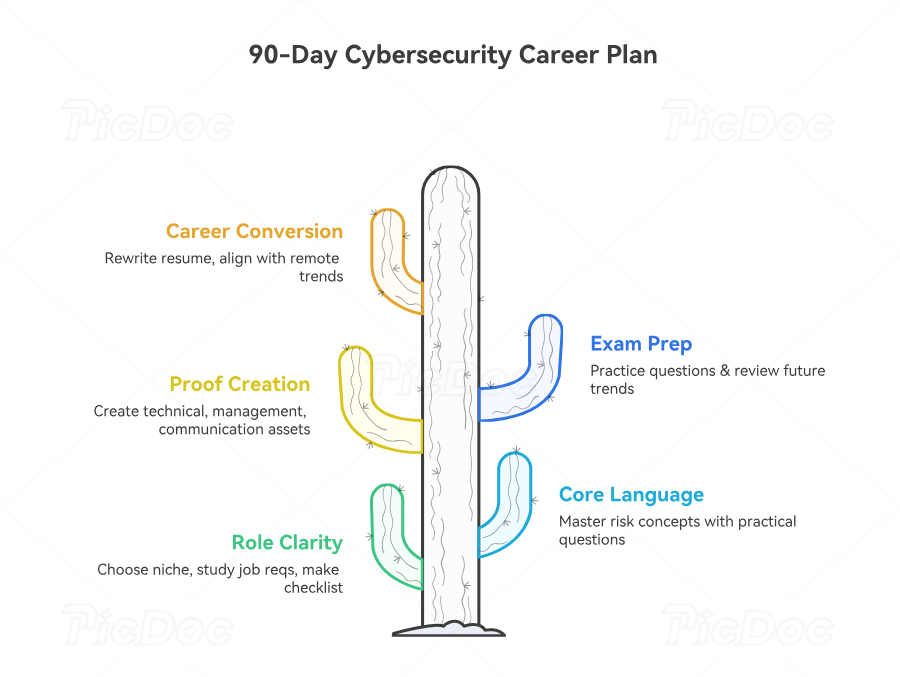
Days 1-15 should be about role clarity, because scattered preparation burns time. Choose one primary lane: SOC, GRC, cloud security, penetration testing, incident response, or management. Read job descriptions in Milwaukee, Madison, Green Bay, Appleton, Kenosha, and remote Wisconsin-friendly roles, then highlight repeated requirements. Turn those requirements into a checklist using ACSMI’s cybersecurity certification directory, global cybersecurity training providers, cybersecurity bootcamps directory, and cybersecurity books directory.
Days 16-35 should build core language. For management and advanced certification, learn how risk, controls, incidents, assets, vendors, identities, backups, logs, and recovery fit together. Study ransomware impact, data breach mitigation, cloud threat analysis, and insider threat prevention with one question in mind: “What would I recommend on Monday morning if I owned this risk?”
Days 36-60 should create proof. Build one technical artifact, one management artifact, and one communication artifact. A technical artifact could be a vulnerability prioritization worksheet. A management artifact could be a control roadmap. A communication artifact could be a two-paragraph executive incident brief. These assets strengthen applications for senior cybersecurity analyst roles, security analyst to engineer progression, offensive security engineering, and cybersecurity vulnerability researcher roles.
Days 61-75 should be exam consolidation. Use practice questions to find weak domains, then write short explanations for every missed concept. For advanced management certification, do this with scenario judgment: what would you escalate, what would you document, what would you measure, and what would you defer? A serious learner should also review zero trust predictions, future cloud security trends, next-gen SIEM technology, and endpoint security innovations.
Days 76-90 should be career conversion. Rewrite your résumé around outcomes, not tools. Replace “used vulnerability scanner” with “prioritized critical external exposure by asset value, exploitability, and business owner.” Replace “monitored alerts” with “triaged suspicious authentication activity, enriched evidence, and escalated confirmed anomalies.” Then align your LinkedIn, portfolio, and applications to remote cybersecurity career trends, remote versus on-site salaries, cybersecurity salary benchmarks, and certification salary growth.
5. Career Outcomes: How Wisconsin Professionals Can Use Certification for Interviews, Promotions, and Salary Growth
Certification works best when it changes how decision-makers classify you. For interviews, it should move you from “interested candidate” to “lower-risk hire.” For promotions, it should move you from “helpful technical employee” to “person who can own outcomes.” For salary growth, it should move you from “tool user” to “risk reducer.” That shift requires language from career advancement survey data, CISSP, CEH, and Security+ salary analysis, cybersecurity freelance income data, and gender pay gap analysis so you can speak with evidence instead of wishful thinking.
For interviews, prepare five stories: one incident story, one risk story, one conflict story, one learning story, and one measurable improvement story. A Wisconsin healthcare employer may care about downtime and patient data. A manufacturer may care about uptime, segmentation, vendors, and legacy systems. A financial employer may care about fraud, identity, logging, audits, and third-party exposure. A school or public agency may care about limited budgets, user awareness, and policy evidence. Use ACSMI’s healthcare cybersecurity report, manufacturing cybersecurity guide, financial cybersecurity incident analysis, and education-sector cybersecurity directory to shape role-specific answers.
For promotions, build a one-page internal business case. Open with the risk you currently help reduce, then show the work you already perform, the certification you completed or are pursuing, the responsibilities you can absorb, and the metric leadership can use to judge performance. A promotion case becomes stronger when it references security leadership progression, director of information security pathways, policy director careers, and chief privacy officer career paths.
Wisconsin’s cyber ecosystem also rewards people who participate. The Wisconsin Governor’s Cybersecurity Summit agenda for 2026 emphasizes long-term talent pipelines, education-workforce partnerships, human risk management, AI, operational technology, local government support, and workforce development. UW–Madison also highlights the Wisconsin Information Security Center as a group focused on growing a high-tech, knowledge-based workforce for secure cyber and national security-related solutions. That means networking, local events, cyber centers, public-sector awareness, and employer partnerships can compound your certification. Pair that with cybersecurity conferences, cybersecurity podcasts, cybersecurity YouTube channels, and cybersecurity research organizations.
6. FAQs About Advanced Cybersecurity & Management Certification in Wisconsin
-
The best path depends on your target role. For SOC and analyst work, prioritize security fundamentals, detection, incident response, SIEM, endpoint security, and a portfolio of triage reports. For management, prioritize governance, risk, compliance, policy, metrics, vendor oversight, and incident leadership. For cloud security, prioritize IAM, logging, workload protection, configuration review, and cloud incident scenarios. Use ACSMI’s top cybersecurity certifications directory, future certification value guide, cloud security guide, and cybersecurity manager pathway to choose the lane.
-
Yes. Many professionals enter through IT support, networking, systems administration, help desk, compliance, audit, military, education technology, or healthcare IT. The key is showing security-specific evidence. Build a risk register, an alert triage report, a vulnerability prioritization worksheet, and a short executive incident brief. Those assets make your career transition clearer when paired with the IT support to cybersecurity analyst guide, network administrator to ethical hacker pathway, cybersecurity analyst advancement guide, and free cybersecurity learning resources.
-
Healthcare, finance, manufacturing, education, public sector, retail, utilities, transportation, and SMB consulting all value cybersecurity credentials when the credential connects to actual risk. Healthcare needs patient-data protection and downtime resilience. Manufacturing needs OT/IoT awareness and vendor risk control. Finance needs fraud, identity, audit, and incident discipline. Public agencies need policy evidence and governance maturity. Use the healthcare cybersecurity tools directory, financial services cyber firm guide, manufacturing cybersecurity solutions guide, and energy utilities cybersecurity guide.
-
A focused 90-day plan works for many working professionals when the goal is disciplined progress rather than passive reading. Spend the first 15 days defining the role, the next 20 days building core concepts, the next 25 days creating proof assets, the next 15 days drilling weak areas, and the final 15 days converting your learning into résumé, LinkedIn, and interview language. Support that plan with the cybersecurity books directory, cybersecurity bootcamp directory, training provider directory, and future skills guide.
-
Your résumé should show outcomes, context, and evidence. Instead of listing only tools, describe what you protected, detected, improved, documented, or escalated. Strong bullets mention asset value, risk severity, business owner communication, remediation priority, incident timeline, compliance evidence, or control improvement. Align your résumé with the security analyst to engineer roadmap, senior cybersecurity analyst pathway, incident responder career guide, and cybersecurity consultant advancement path.
-
It can be useful when it helps you qualify for higher-responsibility work: lead analyst, security engineer, compliance lead, incident response lead, security manager, program manager, architect, director, or CISO-track roles. Salary growth usually follows ownership of larger risks, stronger communication, and measurable business impact. Pair certification with evidence from the global cybersecurity salary report, entry-level to CISO salary progression analysis, remote cybersecurity salary report, and certification salary growth analysis.
