
The Ultimate Guide to Getting Advanced Cybersecurity & Management Certification in Oman: Everything You Need to Know in 2026-2027
Oman’s cybersecurity market is moving from basic protection work into regulated, skills-driven, management-heavy cyber maturity. For professionals comparing cybersecurity certifications, cybersecurity salary growth, cybersecurity career advancement, and future cybersecurity job trends, advanced cybersecurity and management certification can create a cleaner path toward leadership, cloud security, GRC, incident response, consulting, and regulated-sector roles. The real decision is choosing a credential strategy that proves you can manage cyber risk, communicate with leadership, and execute security work under pressure.
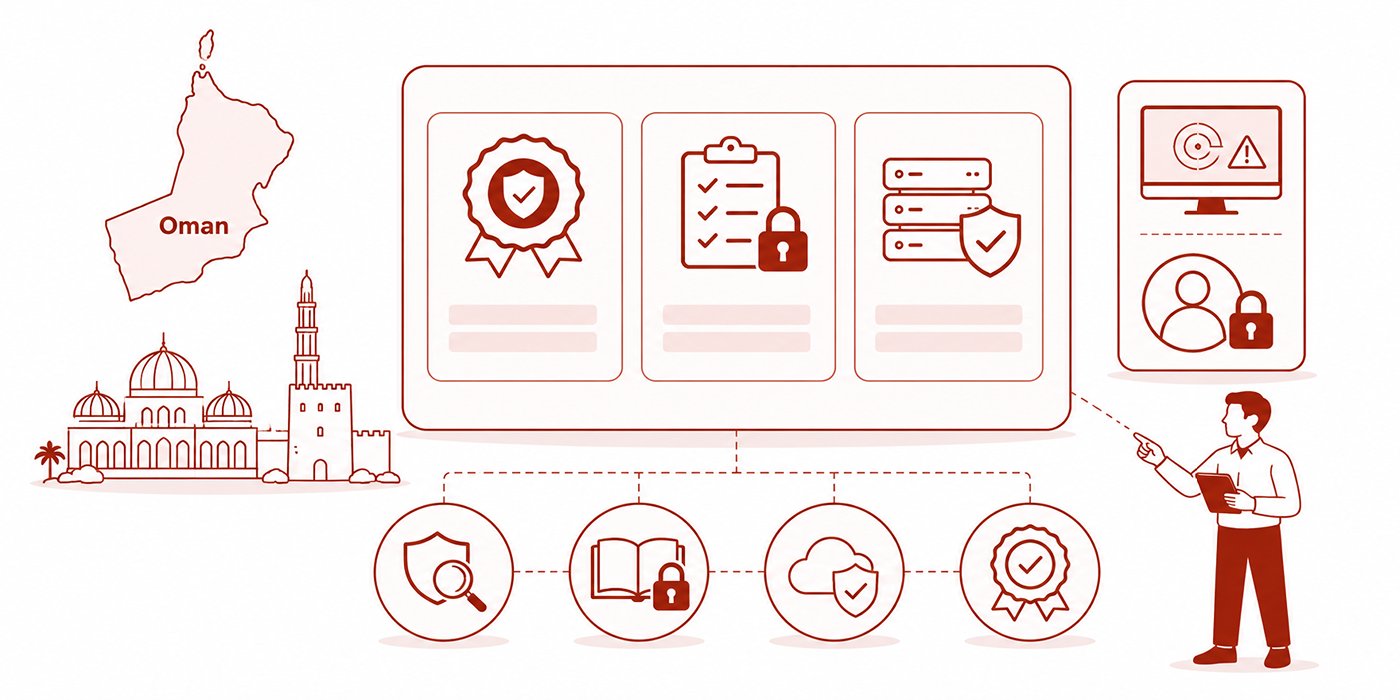
1. Why Advanced Cybersecurity & Management Certification Matters in Oman in 2026-2027
Oman is building cybersecurity as a national capability, a business protection layer, and an economic growth area. MTCIT describes the Hadatha Cybersecurity Industry Development program as focused on specialized cybersecurity industry development, human capital, innovation, excellence, Oman Vision 2040 alignment, national ecosystem growth, specialized capabilities, startups, SMEs, and international promotion for local cybersecurity companies. That makes advanced certification valuable for professionals who want to move beyond tool operation into cybersecurity management, cybersecurity compliance, SOC leadership, cloud security engineering, and security architecture.
The biggest career mistake in Oman’s 2026-2027 cyber market is treating certification as decoration. Hiring teams need evidence that a professional can reduce risk, organize controls, support audits, respond to incidents, protect cloud environments, and explain security priorities to business stakeholders. A certificate with no role strategy can feel random. A certificate connected to cybersecurity frameworks, security audits, vulnerability assessment, incident response, and cybersecurity workforce trends becomes a career asset.
Oman’s public digital ecosystem also creates strong demand for professionals who understand governance and privacy. MTCIT says Oman’s Personal Data Protection Law was issued under Royal Decree No. 6/2022 and aims to protect individuals’ personal data by establishing controls. For career planning, that means GRC, audit, privacy engineering, data protection, awareness, supplier risk, and evidence management are serious career lanes. Professionals who combine privacy regulation knowledge, GDPR cybersecurity lessons, cybersecurity compliance trends, healthcare cybersecurity compliance, and cybersecurity audit careers can speak to real employer pressure.
Certification matters most when it solves a painful market problem. Junior professionals need credibility. Analysts need specialization. Engineers need architecture judgment. Compliance professionals need control fluency. Managers need risk communication. Consultants need trust. Leaders need board-level language. Oman’s market rewards candidates who can connect technical execution with policy, people, metrics, and business continuity.
Cybersecurity Certifications and Career Impact in Oman: 30-Credential Advancement Matrix
| Certification | Best Career Stage | Most Likely Advancement Effect | Where It Creates Real Leverage in Oman | Best ACSMI Resource to Pair With It |
|---|---|---|---|---|
| ACSMI Advanced Cybersecurity & Management Certification | Mid to senior career | Builds leadership, governance, risk, and cyber management credibility | Security manager, GRC lead, cyber program owner, senior consultant | Cybersecurity manager pathway |
| CISSP | Mid to senior career | Signals broad security leadership depth | Security architecture, governance, senior analyst, consulting, leadership screening | CISSP salary growth |
| CISM | Mid to senior career | Strengthens security management and governance positioning | Security manager, risk owner, control program lead, cyber leadership | Security manager to director |
| CRISC | Mid career | Improves enterprise cyber risk credibility | Risk registers, executive reporting, audit remediation, control ownership | Compliance officer roadmap |
| CISA | Early to mid career | Builds audit and assurance authority | Internal audit, control testing, supplier reviews, evidence preparation | Cybersecurity auditor guide |
| ISO/IEC 27001 Lead Implementer | Mid career | Supports information security management system implementation | Policy design, ISMS operation, gap closure, management review preparation | NIST, ISO, and COBIT frameworks |
| ISO/IEC 27001 Lead Auditor | Mid career | Improves audit readiness and control validation | Compliance assurance, internal audits, external audit preparation | Security audit best practices |
| CompTIA Security+ | Entry level | Strengthens baseline cybersecurity employability | IT-to-cyber transition, junior analyst roles, cyber support positions | IT support to cybersecurity analyst |
| CompTIA CySA+ | Early career | Builds defensive analysis credibility | SOC analyst, alert triage, threat detection, blue-team growth | SOC analyst career guide |
| CompTIA PenTest+ | Early to mid career | Supports offensive-security positioning | Vulnerability testing, assessment teams, controlled exploitation, consulting | Penetration testing tools |
| CompTIA CASP+ | Mid career | Signals advanced technical practitioner depth | Security engineering, technical leadership, architecture support | Analyst to engineer roadmap |
| CEH | Early to mid career | Creates ethical hacking vocabulary and screening value | Junior penetration testing, security testing, vulnerability validation | CEH career guide |
| OSCP | Mid career | Provides hands-on offensive proof | Penetration testing, red team operations, security consulting | OSCP penetration tester guide |
| GPEN | Mid career | Strengthens structured penetration testing credibility | Consulting, client reporting, external assessments, technical remediation advice | Junior tester to senior consultant |
| GCIH | Early to mid career | Improves incident handling and response credibility | SOC escalation, incident playbooks, containment, response coordination | Incident responder career path |
| GCIA | Mid career | Deepens network detection and traffic analysis skill | Network monitoring, SOC engineering, detection improvement | Network monitoring tools |
| GCFA | Mid to senior career | Builds forensic investigation credibility | Breach investigation, evidence handling, advanced response leadership | Incident response effectiveness |
| CCSP | Mid career | Strengthens cloud security leadership profile | Cloud migration, tenant controls, architecture review, data protection | Cloud security tools |
| CCSK | Early to mid career | Builds cloud security foundation | Shared responsibility, SaaS risk, control mapping, cloud governance | Future of cloud security |
| AWS Certified Security Specialty | Mid career | Improves cloud-platform security proof | IAM, logging, encryption, workload protection, cloud monitoring | Cloud security engineer guide |
| Microsoft Cybersecurity Architect Expert | Mid to senior career | Supports enterprise security architecture credibility | Identity security, Microsoft Defender, Zero Trust, architecture reviews | PAM solutions guide |
| Certified Data Privacy Solutions Engineer | Mid career | Connects cybersecurity with privacy engineering | Personal data controls, privacy-by-design, DLP, regulated data workflows | Privacy regulation trends |
| PMP | Mid to senior career | Improves cyber program delivery credibility | Transformation programs, vendor delivery, timelines, stakeholder control | Cybersecurity program manager |
| SABSA Foundation | Senior technical career | Builds business-driven architecture discipline | Enterprise security design, board alignment, architecture governance | Chief security architect roadmap |
| TOGAF | Senior technical career | Improves enterprise architecture fluency | Transformation programs, architecture boards, cross-domain design | Chief security architect guide |
| OT Security Certification | Mid career | Creates industrial and critical-infrastructure relevance | Energy, utilities, ports, manufacturing, OT risk, segmentation | Critical infrastructure threat report |
| IoT Security Certification | Early to mid career | Supports connected-device security specialization | Smart infrastructure, industrial IoT, asset visibility, device risk | IoT security specialist roadmap |
| Security Awareness Training Specialist | Early to mid career | Builds human-risk reduction credibility | Phishing reduction, employee training, policy adoption, behavior change | Security awareness platforms |
| Cyber Threat Intelligence Certification | Mid career | Improves threat reporting and adversary-context value | Threat briefings, sector intelligence, executive reporting, SOC enrichment | Threat intelligence analyst roadmap |
| CISO Leadership Certification | Senior career | Signals executive cyber ownership and strategic readiness | CISO track, director roles, cyber budgets, board reporting | CISO roadmap |
2. Best Certification Path by Cybersecurity Role in Oman
The strongest certification route depends on the role you want in Oman. A SOC analyst needs detection, triage, escalation, SIEM fluency, endpoint knowledge, and incident discipline. A GRC professional needs control mapping, policy interpretation, audit evidence, privacy awareness, and executive communication. A cloud security engineer needs IAM, logging, encryption, network security, workload protection, and architecture review. A future manager needs risk prioritization, budget discipline, people leadership, and decision-making under uncertainty.
For SOC and blue-team professionals, start with Security+ and CySA+ pathways, then build into SOC analyst execution, SOC manager growth, SIEM solution awareness, and endpoint detection and response. The professional who can reduce false positives, write escalation notes, improve detection logic, and explain business impact will move faster than the analyst who only closes tickets.
For offensive security, CEH can support early screening, while OSCP, GPEN, practical labs, and strong reporting create greater professional weight. Oman’s cybersecurity ecosystem includes startups, SMEs, industrial-sector stakeholders, innovators, investors, and academic partners through Hadatha centers implemented by Oman National CERT at MTCIT. That makes practical testing, local innovation, consulting, and secure product development useful career directions. Build your path around ethical hacking, OSCP preparation, red team specialization, penetration testing tools, and vulnerability scanners.
For GRC, audit, and privacy roles, the strongest stack usually includes ACSMI, CISM, CISA, CRISC, ISO 27001, and privacy-related knowledge. Oman’s PDPL direction means employers need people who can translate data protection obligations into access control, retention, breach response, supplier management, awareness, and evidence. Combine certification with cybersecurity compliance officer planning, cybersecurity auditor skills, security audit best practices, GDPR compliance lessons, and future cybersecurity compliance.
For cloud security, combine CCSP, CCSK, AWS Security Specialty, Microsoft Cybersecurity Architect Expert, and hands-on cloud projects. Cloud roles need evidence across IAM, privileged access, logging, encryption, backup, segmentation, vulnerability management, and SaaS governance. Use cloud security tools, future cloud security trends, privileged access management, data loss prevention, and AI-driven cybersecurity tools to keep your learning tied to real enterprise problems.
3. How to Choose the Right Advanced Cybersecurity & Management Certification in Oman
Begin with the bottleneck hurting your career today. If recruiters ignore your résumé, you need a recognizable foundation plus role-specific keywords. If interviews happen and offers disappear, you need stronger proof. If promotion feels blocked, you need management language and visible outcomes. If you want consulting credibility, you need structured reporting, control knowledge, and client-ready judgment.
A good certification plan has three layers. The first layer is credibility: cybersecurity certification directories, cybersecurity training providers, free cybersecurity courses, cybersecurity bootcamps, and cybersecurity books. The second layer is specialization: SOC, cloud, GRC, audit, offensive security, incident response, privacy, OT, or architecture. The third layer is proof: portfolio artifacts, interview stories, measurable outcomes, and leadership examples.
A management-minded professional should prioritize ACSMI, CISM, CISSP, CRISC, ISO 27001, and PMP-style program discipline. That path supports cybersecurity manager roles, security manager to director progression, director of information security planning, VP of cybersecurity growth, and CISO roadmap development. The pain point is clear: many skilled technical professionals remain invisible to leadership because they discuss tasks while decision-makers discuss risk, cost, resilience, and accountability.
A technical specialist should pick a credential that builds real operating confidence. For blue team, choose CySA+, GCIH, GCIA, SIEM work, EDR practice, and incident response simulations. For red team, choose OSCP, GPEN, labs, reporting, and vulnerability validation. For cloud, choose CCSP, CCSK, AWS, Azure, IAM, DLP, and architecture projects. Support the track with incident responder guidance, threat intelligence careers, cloud threat analysis, application security tools, and network monitoring tools.
Quick Poll: What Career Result Are You Chasing With Advanced Cybersecurity & Management Certification in Oman?
Pick the result that would remove the biggest pressure from your career right now.
4. A 12-Month Roadmap to Get Certified and Become Oman-Ready
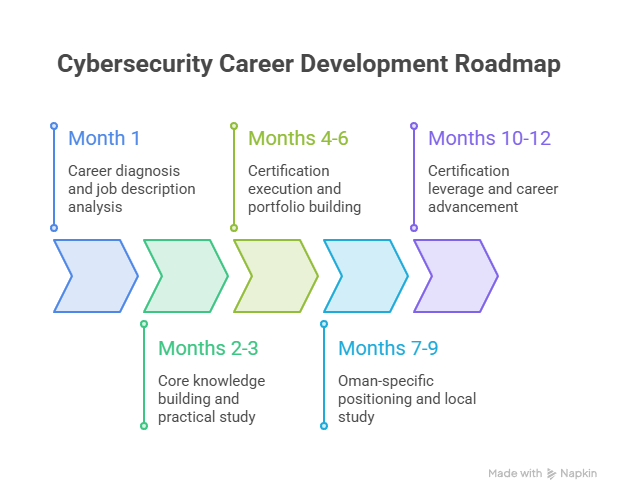
Month 1 should be career diagnosis. Choose one target role and collect five Omani or GCC cybersecurity job descriptions. Highlight repeated requirements around risk, SOC, cloud, compliance, incident response, IAM, audits, privacy, or leadership. Then compare those requirements with cybersecurity analyst advancement, security analyst to engineer growth, IT support to cybersecurity transition, cloud security career planning, and cybersecurity compliance analyst roadmaps. This step protects you from studying the wrong credential.
Months 2-3 should build core knowledge. Study governance, risk, access control, incident response, asset management, vulnerability management, cloud controls, privacy, third-party risk, and security metrics. Use access control models, vulnerability assessment techniques, endpoint security effectiveness, email security solutions, and phishing attack prevention to keep the study practical. The goal is simple: explain a control, identify failure points, assign ownership, and show how the evidence would be reviewed.
Months 4-6 should become certification execution and portfolio-building months. Prepare for the chosen exam, then produce artifacts that hiring managers can understand quickly. Build a sample risk register, incident report, control mapping, cloud security checklist, vulnerability prioritization memo, supplier questionnaire, and executive summary. Connect those artifacts with ransomware risk analysis, data breach mitigation, insider threat prevention, cybersecurity incident response, and future cyber skills.
Months 7-9 should focus on Oman-specific positioning. Study MTCIT’s cybersecurity direction, Hadatha’s industry development goals, privacy requirements, data governance, cloud adoption, critical infrastructure risk, and local innovation opportunities. MTCIT highlights a Global Cybersecurity Index 2024 score of 97.02 on its site, alongside broader digital resilience messaging. That signal supports a market where cybersecurity professionals should understand both technical controls and national digital confidence. Strengthen your profile with critical infrastructure cybersecurity, energy and utilities cybersecurity, manufacturing cybersecurity trends, financial-sector cyber incidents, and healthcare cybersecurity threats.
Months 10-12 should turn certification into visible career leverage. Rewrite your résumé around outcomes: improved audit readiness, reduced alert noise, strengthened access controls, documented incident response, closed critical vulnerabilities, improved phishing resilience, mapped privacy controls, supported cloud reviews, or led security awareness. Prepare interview stories with problem, action, evidence, result, and business impact. Use global cybersecurity salary benchmarks, entry-level to CISO salary progression, remote cybersecurity salary analysis, freelance cybersecurity market trends, and specialized cybersecurity role demand to support compensation conversations with evidence.
5. How to Convert Certification Into Salary Growth, Promotion, and Leadership Credibility
Certification becomes valuable when employers can see what changed after you earned it. A stronger credential should make your résumé clearer, your interview answers sharper, your technical decisions more defensible, and your leadership conversations more mature. The professional who says “I passed an exam” sounds ordinary. The professional who says “I used the certification framework to redesign our risk register, improve incident reporting, and map controls to business-critical systems” sounds promotion-ready.
For salary growth, connect certification to expensive problems. Employers worry about ransomware, cloud misconfiguration, supplier exposure, insider risk, privacy failures, phishing, weak access control, tool sprawl, audit gaps, and skills shortages. Build your talking points around ransomware evolution, AI-powered cyberattacks, deepfake cybersecurity threats, cloud environment threats, and IoT security breaches. Salary leverage improves when your value is tied to loss avoidance, resilience, compliance, and business continuity.
For promotion, translate technical work into management language. “Configured alerts” becomes “improved detection coverage for high-risk scenarios.” “Closed vulnerabilities” becomes “reduced exploitable exposure across priority assets.” “Completed audit evidence” becomes “strengthened control ownership and reduced compliance friction.” “Delivered training” becomes “reduced human-risk exposure through targeted awareness.” This leadership language aligns with cybersecurity program management, cybersecurity director growth, security policy leadership, chief security architect planning, and CISO career progression.
For long-term credibility, become the person who can compare tools, explain tradeoffs, and recommend practical action under constraints. Study endpoint security providers, EDR tools, SIEM solutions, application security tools, and PAM solutions. The strongest certified professionals can discuss capability, cost, staffing, integration, alert fatigue, compliance evidence, and operational fit.
Oman’s 2026-2027 opportunity belongs to professionals who combine certification with practical proof. That proof can be a cleaner résumé, a focused portfolio, a sharper LinkedIn profile, a better interview story, or stronger internal promotion evidence. Your credential should tell employers one thing clearly: you can protect systems, manage risk, support compliance, communicate with leaders, and help the organization make better cybersecurity decisions.
6. FAQs About Advanced Cybersecurity & Management Certification in Oman
-
The best certification depends on your target role. ACSMI advanced cybersecurity and management certification is strong for professionals seeking leadership, GRC, risk, compliance, program ownership, and management credibility. CISSP suits broad senior security roles, CISM suits management, CISA suits audit, CRISC suits risk, CCSP suits cloud, and OSCP suits offensive security. Pair your choice with certification rankings, career advancement research, salary growth analysis, and future certification demand.
-
Yes, especially when the credential supports a focused role story. Entry-level candidates need foundations and projects. Mid-career professionals need specialization. Senior professionals need leadership proof. Oman’s cyber market rewards professionals who can connect security operations, compliance, privacy, cloud, audit, and business risk. Build around SOC analyst guidance, cloud security engineering, compliance analyst careers, and cybersecurity manager pathways.
-
A strong management path usually includes ACSMI, CISM, CISSP, CRISC, ISO 27001, and project delivery knowledge. Add CISA for audit-heavy roles, CCSP for cloud-heavy leadership, and PMP for cyber transformation programs. Strengthen this path with security manager advancement, IT management to security leadership, senior security analyst to VP, and CISO roadmap planning.
-
Most experienced professionals need 8-16 weeks for focused preparation. Career changers may need 4-8 months because they must build technical vocabulary, hands-on confidence, and role-specific proof. Management certifications require governance, risk, communication, and control ownership. Technical certifications require labs, tooling, repetition, and reporting. Use free cybersecurity courses, cybersecurity books, cybersecurity podcasts, and cybersecurity YouTube channels to build a stronger study base.
-
CCSP, CCSK, AWS Security Specialty, and Microsoft Cybersecurity Architect Expert are strong options, depending on the cloud stack used by the employer. Cloud security candidates should prove IAM, logging, encryption, tenant security, SaaS risk, vulnerability management, backup, and incident response knowledge. Pair certification with cloud security tools, future cloud security, AI-driven cyber tools, and DLP software reviews.
-
Turn the credential into proof. Create a sample risk register, audit evidence pack, cloud control checklist, incident report, vulnerability prioritization memo, and board-style cyber risk summary. Rewrite your résumé around outcomes instead of duties. Build interview stories that show ownership, decision-making, and measurable improvement. Strengthen your positioning with cybersecurity workforce trends, future cyber roles, specialized role demand, and future skills for cybersecurity professionals.
