
The Ultimate Guide to Getting Advanced Cybersecurity & Management Certification in Turkey: Everything You Need to Know in 2026-2027
Turkey’s cybersecurity professionals increasingly need a blend of technical depth, regulatory awareness, operational judgment, and management capability. A credential becomes valuable when it helps you investigate threats, explain business exposure, build defensible controls, and lead security decisions under pressure. Use this guide alongside ACSMI’s cybersecurity certification directory, career-advancement research, salary growth analysis, and future skills forecast to build a focused 2026-2027 certification plan.
1. Why Advanced Cybersecurity & Management Certification Matters in Turkey
Turkey’s cybersecurity market spans banking, financial technology, telecommunications, e-commerce, manufacturing, logistics, healthcare, aviation, defense, energy, software development, government services, and internationally connected businesses. These environments need professionals who can move beyond basic alert handling and understand how endpoint security, cloud security, incident response, security compliance, and executive decision-making fit together.
The painful reality for many applicants is that an ordinary résumé full of tool names creates weak differentiation. Saying that you have used firewalls, vulnerability scanners, SIEM platforms, or Linux tells an employer very little about the quality of your judgment. Strong candidates can explain how they prioritized a vulnerability, validated an alert, preserved evidence, coordinated remediation, or converted a technical weakness into a business-risk narrative. ACSMI’s analyst advancement guide, incident responder roadmap, compliance analyst pathway, and security leadership guide show how role-specific evidence creates a more credible career story.
Turkey’s Personal Data Protection Law No. 6698 establishes obligations and procedures for organizations processing personal data. Updated rules concerning international data transfers also make privacy governance, data mapping, vendor oversight, retention, and control documentation highly relevant for security professionals supporting cross-border operations. A candidate who understands GDPR and cybersecurity, security audit processes, access-control models, and cybersecurity frameworks can contribute more effectively to regulated and internationally connected employers.
Advanced Cybersecurity & Management Certification is particularly useful when your target position crosses departmental boundaries. A SOC lead must understand detection quality, staffing, escalation, and reporting. A security manager needs governance, risk, metrics, budgets, and incident-readiness knowledge. A consultant must translate technical findings into recommendations that clients can fund and implement. The strongest strategy therefore combines multi-domain cybersecurity training, practical career planning, specialized role research, and documented proof of applied competence. ACSMI describes its program as a multi-domain curriculum spanning governance, risk, cloud, SOC operations, incident response, threat hunting, ethical hacking, malware analysis, and security management.
Advanced Cybersecurity & Management Certification in Turkey: 26-Credential Career Strategy Matrix
| Certification | Best Career Stage | Most Likely Advancement Effect | Proof to Build for Turkish Employers |
|---|---|---|---|
| ACSMI Advanced Cybersecurity & Management Certification | Career transition to leadership | Builds multi-domain technical and management credibility | Security roadmap, risk brief, incident plan, metrics dashboard |
| ISC2 Certified in Cybersecurity | Entry level | Establishes baseline security knowledge | Home-lab notes, access review, basic risk assessment |
| CompTIA Security+ | Entry to early career | Supports junior analyst and security-support applications | Phishing analysis, ticket triage, security-control summary |
| CompTIA Network+ | Entry level | Strengthens the networking foundation required for security | Network diagram, packet analysis, segmentation proposal |
| CompTIA CySA+ | Early blue-team career | Supports SOC, monitoring, and detection specialization | SIEM investigation, alert timeline, escalation decision log |
| CompTIA PenTest+ | Early offensive career | Improves vulnerability-testing and assessment positioning | Scoped test plan, lab report, remediation recommendations |
| CompTIA SecurityX | Experienced technical professional | Signals advanced practitioner and architecture capability | Architecture review, threat model, control design document |
| CISSP | Experienced professional | Supports senior, architecture, consulting, and leadership roles | Risk-treatment memo, program plan, control-mapping exercise |
| CCSP | Mid-career cloud track | Builds cloud governance and security credibility | Cloud IAM review, encryption design, shared-responsibility brief |
| SSCP | Early to mid-career | Supports operational security and infrastructure roles | Hardening checklist, identity review, response workflow |
| CISM | Management pathway | Strengthens governance and security-program leadership | KPI dashboard, policy review, executive risk presentation |
| CISA | Audit and assurance track | Improves credibility for control-testing and audit roles | Audit plan, evidence register, control-gap report |
| CRISC | Risk and governance track | Supports enterprise technology-risk responsibilities | Risk register, treatment plan, key-risk-indicator design |
| CGEIT | Senior governance leadership | Supports director-level technology-governance positioning | Governance model, investment case, oversight dashboard |
| CEH | Early offensive-security track | Creates a structured ethical-hacking foundation | Recon workflow, validated finding, executive summary |
| CHFI | Forensics and investigation | Supports evidence-handling and digital-investigation roles | Evidence log, timeline reconstruction, forensic case notes |
| OSCP | Hands-on offensive career | Creates strong technical proof for penetration testing | Attack narrative, clean report, remediation-focused findings |
| OSEP | Advanced offensive career | Supports adversary-simulation and evasion specialization | Attack-chain documentation, detection gaps, mitigation plan |
| GIAC GSEC | Early to mid-career | Builds broad practical security credibility | Defense checklist, investigation worksheet, control review |
| GIAC GCIH | Incident-response specialization | Strengthens detection, containment, and response positioning | Incident timeline, containment decision, lessons-learned report |
| GIAC GCIA | Network defense specialization | Supports network monitoring and intrusion-analysis roles | Packet investigation, traffic baseline, detection logic |
| GIAC GREM | Advanced malware track | Builds credibility for malware and reverse-engineering work | Behavior report, indicator set, detection recommendation |
| AWS Certified Security – Specialty | Cloud-security professional | Signals AWS-specific security depth | IAM review, logging design, encryption-control assessment |
| Microsoft Azure Security Engineer Associate | Cloud engineer track | Supports Azure security and identity responsibilities | Identity configuration, policy review, monitoring workflow |
| Google Professional Cloud Security Engineer | Cloud specialist | Builds Google Cloud security credibility | Access design, data-protection model, monitoring plan |
| ISO/IEC 27001 Lead Implementer or Lead Auditor | GRC, audit, and management | Supports ISMS implementation, assurance, and consulting | Scope statement, risk register, audit checklist, corrective plan |
2. How to Choose the Right Certification Track for Your Career Goal
Begin with a target responsibility rather than a fashionable credential. Someone seeking a first SOC role in Istanbul, Ankara, Izmir, Bursa, Antalya, or a remote international team should prioritize alert interpretation, Windows and Linux fundamentals, network traffic, identity events, endpoint telemetry, and incident documentation. Combine a recognized baseline with a SOC analyst career guide, SIEM solutions directory, EDR tools guide, and network security tools comparison. The credential provides structure, while investigation samples prove that you can use what you learned.
Professionals targeting governance, risk, privacy, or audit roles need a different stack. Their strongest evidence includes control mapping, risk registers, audit workpapers, data inventories, third-party assessments, policy reviews, and remediation tracking. Study NIST adoption patterns, ISO and COBIT frameworks, future audit practices, and privacy regulation trends. Turkey’s data-protection framework makes the ability to connect security controls with personal-data obligations especially useful for organizations handling customer, employee, financial, or health information.
For offensive security, select training that forces you to document scope, evidence, exploitability, business impact, and remediation. Running automated tools without understanding authorization or validation can damage your credibility. A stronger pathway combines an ethical-hacker roadmap, penetration-testing career path, vulnerability-assessment techniques, and penetration-testing tool comparison. Your portfolio should show disciplined methodology and recommendations that infrastructure teams can act on.
Cloud-security candidates should learn identity, key management, workload protection, logging, container exposure, storage permissions, network controls, configuration assurance, and incident response in cloud environments. Pair certification study with ACSMI’s cloud security engineer roadmap, cloud threat analysis, cloud security tool directory, and future cloud security forecast. The clearest portfolio artifact is a cloud-control review showing the exposed resource, threat path, affected data, corrective action, owner, and verification method.
Management-focused applicants should choose a program that develops prioritization, governance, incident leadership, policy design, stakeholder communication, vendor management, performance measurement, and security-program planning. ACSMI’s Advanced Cybersecurity & Management Certification is delivered online and designed for international learners, with written, video, audio, interactive, and scenario-based components. ACSMI states that the program can be accessed internationally without in-person attendance, making it practical for professionals studying around full-time work in Turkey.
3. The Technical, Regulatory, and Management Skills You Need in Turkey
A valuable certification should improve the way you handle uncertainty. Technical competence means investigating the right evidence, distinguishing suspicious activity from normal behavior, recognizing incomplete telemetry, and escalating with context. Build this through phishing attack analysis, ransomware research, endpoint security analysis, and data-breach mitigation guidance. Employers gain more value from someone who can reduce investigation time and improve response decisions than from someone who merely recognizes security vocabulary.
Regulatory competence requires the ability to identify which data is processed, where it flows, who can access it, how long it is retained, which suppliers touch it, and how security events could affect individuals or the organization. Turkey’s data-protection requirements cover the principles and obligations associated with personal-data processing, while related rules address deletion, anonymization, controller registration, information duties, and international transfers. Build practical understanding through cybersecurity compliance research, GDPR compliance guidance, audit best practices, and the cybersecurity compliance officer roadmap.
Management competence becomes visible through decisions. Can you rank competing risks? Can you explain why one control receives funding before another? Can you define a useful security metric? Can you lead an incident without losing evidence, accountability, or communication discipline? Can you explain exposure to a nontechnical executive? Strengthen these capabilities with the cybersecurity manager pathway, program manager career guide, director of information security roadmap, and CISO advancement guide.
You should also understand internationally recognized information-security management principles. ISO/IEC 27001 defines requirements for an information security management system, while ISO/IEC 27002 provides control guidance across areas such as access control, cryptography, personnel security, and incident response. This knowledge supports Turkish professionals working in consulting, audit, software exports, financial services, managed services, and multinational supply chains. Pair framework knowledge with access-control design, security auditing, and compliance career development.
Quick Poll: What Is Blocking Your Cybersecurity Career Growth in Turkey?
Choose the obstacle creating the most pressure, because your certification plan should solve a real career problem.
4. Step-by-Step Plan to Earn Certification in 2026-2027
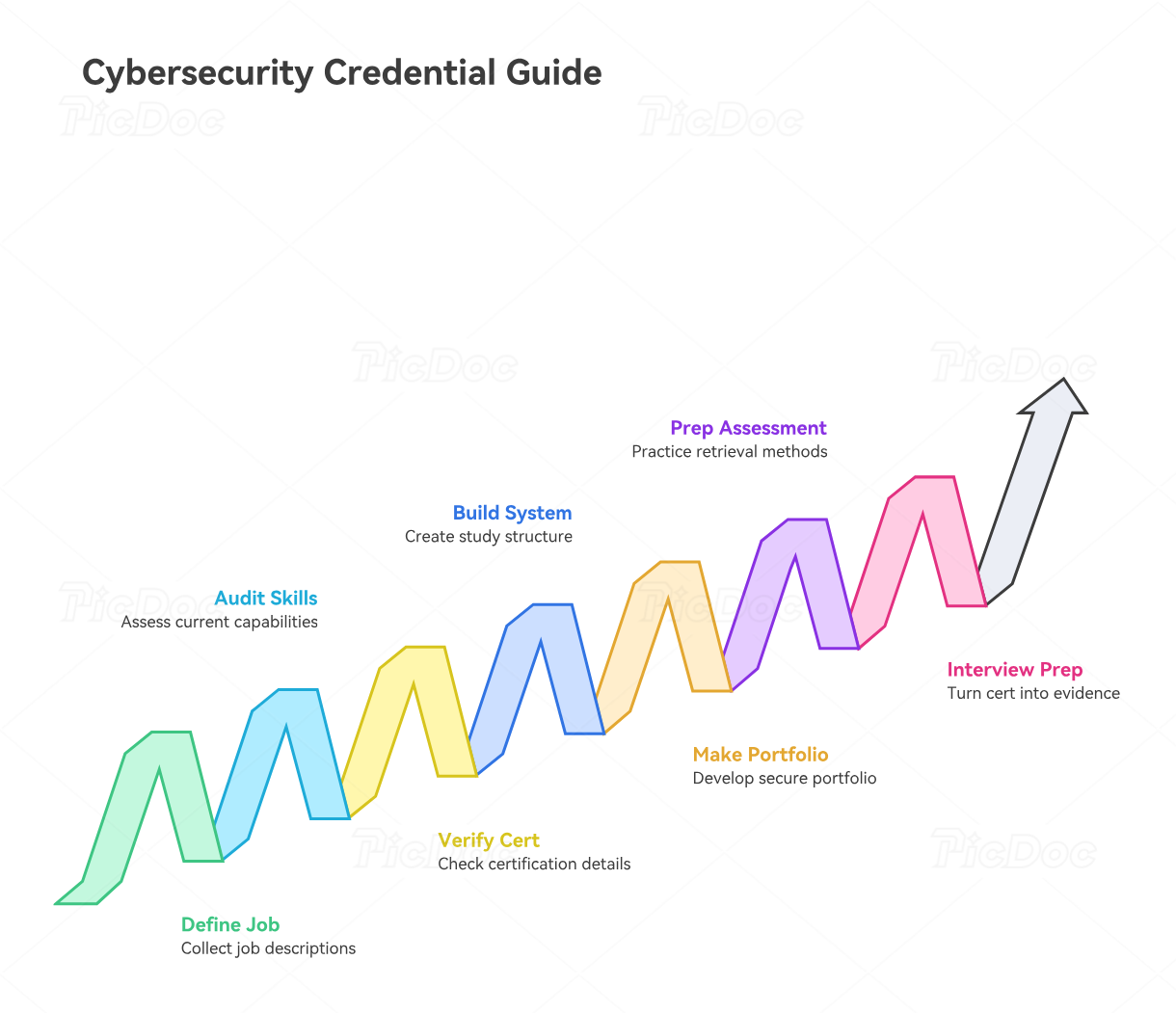
Step 1: Define the job you want before selecting the credential
Collect 20 to 30 relevant job descriptions from Turkish and international employers. Record recurring requirements under technical skills, frameworks, tools, languages, years of experience, communication responsibilities, and industry knowledge. A future SOC analyst may see repeated demand for log analysis and endpoint investigations, while an aspiring compliance analyst may see control assessment and policy documentation. Use the cybersecurity job-market forecast, specialized role-demand analysis, remote-career forecast, and workforce shortage study to interpret broader career direction.
Step 2: Audit your existing capability honestly
Create four columns titled “understand,” “can perform with guidance,” “can perform independently,” and “can explain or lead.” Place every target skill in one column. This exposes the gap between familiarity and employable competence. Someone may understand incident response while lacking the ability to construct a timeline, assign severity, document containment, or communicate business impact. Close those gaps with a security analyst roadmap, incident-response pathway, threat intelligence guide, and cloud security roadmap.
Step 3: Verify the certification before paying
Review the curriculum, assessment approach, training hours, instructor or institutional credibility, delivery format, refund policy, support system, renewal requirements, and relevance to your target job. Avoid paying solely because a certificate has an impressive title. ACSMI describes its Advanced Cybersecurity & Management Certification as a structured online program with hundreds of lessons covering technical and management domains. Its international-student information also identifies CPD-accredited hours and an ACE credit recommendation during the stated evaluation period. Review the official Advanced Cybersecurity Certification, international learner information, student testimonials, and cybersecurity certification options before deciding whether the scope matches your goal.
Step 4: Build a study system that produces usable evidence
Divide your week into concept learning, guided practice, independent practice, documentation, and review. Every major topic should create an artifact. A vulnerability-management module can produce a risk-ranked remediation tracker. An incident-response module can produce a timeline and post-incident review. A governance module can produce a policy-gap analysis. Reinforce your program with the free cybersecurity course directory, cybersecurity books directory, YouTube learning directory, and cybersecurity podcast directory.
Step 5: Create a portfolio that protects confidential information
Use fictional organizations, public datasets, legal labs, sanitized scenarios, and your own cloud environment. Never publish employer data, credentials, internal screenshots, customer records, exploit details from unauthorized targets, or sensitive incident evidence. A strong portfolio can contain a SIEM case, cloud IAM review, risk register, policy critique, vulnerability report, executive incident brief, and security metrics dashboard. Use SIEM technology guidance, vulnerability-scanner comparisons, application-security tools, and email-security solutions to choose realistic project contexts.
Step 6: Prepare for the assessment through retrieval and decision practice
Reading the same material repeatedly creates familiarity without reliable recall. Use closed-book summaries, scenario questions, spaced review, timed exercises, and error logs. For each missed question, record the failed concept, why your answer looked attractive, the correct decision rule, and a scenario where the rule applies. Advanced cybersecurity assessments often test prioritization across risk, response, architecture, governance, and business continuity. Strengthen that reasoning through cybersecurity framework study, ransomware evolution analysis, AI-powered attack research, and future cybersecurity standards.
Step 7: Translate certification into interview evidence
Replace weak statements such as “knowledge of cybersecurity frameworks” with evidence-based language. Explain the scenario, asset, threat, decision, action, and measurable result. A strong interview answer might describe how you reviewed cloud permissions, identified unnecessary privilege, ranked the exposure, recommended a least-privilege model, and defined a verification step. Prepare examples using the IT support transition guide, network administrator transition roadmap, senior analyst pathway, and security specialist to CISO guide.
5. How to Turn the Certification Into Better Roles and Career Leverage
A certificate should appear on your résumé as part of a stronger professional identity. Your headline, summary, skills, projects, and experience should all support the same target role. A SOC candidate should emphasize investigation, telemetry, escalation, and response. A GRC candidate should emphasize controls, evidence, risk, and policy. A cloud candidate should emphasize identity, configuration, logging, and data protection. Build your positioning through the SOC manager advancement guide, penetration testing manager roadmap, cybersecurity compliance career guide, and security architect pathway.
Turkish professionals targeting international opportunities should make their evidence easy to evaluate across borders. Use clear English documentation where the target role requires it, define acronyms, explain business impact, and connect local regulatory knowledge with globally familiar frameworks. Present each project through a short problem statement, methodology, findings, recommendation, and limitation section. Study the global cybersecurity salary report, remote versus on-site salary analysis, freelance cybersecurity market, and future job-market predictions before setting expectations.
For promotion, connect certification to responsibilities your organization currently lacks. Offer to improve one controlled area such as incident documentation, vulnerability ownership, security metrics, third-party reviews, access recertification, awareness feedback, or audit evidence. Small improvements create credible leadership examples when they include a baseline, owner, deadline, control objective, and measurable result. Support your plan with the security manager-to-director roadmap, VP of cybersecurity guide, policy director pathway, and cybersecurity product manager roadmap.
For salary negotiation, avoid claiming that the certificate alone deserves a specific increase. Build the case around scope, scarcity, operational impact, and reduced exposure. Show that you can own higher-value systems, coordinate incidents, improve compliance evidence, reduce unresolved vulnerabilities, strengthen cloud controls, or communicate risk to leadership. Use the certification salary-growth analysis, career-impact survey, entry-level to CISO salary progression, and global salary benchmarks to prepare a realistic discussion.
The strongest long-term strategy is to treat certification as the beginning of a documented capability cycle. Learn a domain, apply it, record the evidence, request broader responsibility, measure the outcome, and update your professional story. Continue learning through ACSMI’s research organization directory, cybersecurity conference guide, industry-news directory, and future certification analysis.
6. FAQs
-
It can provide strong value for professionals seeking broader technical capability, management readiness, career transition, or internationally understandable training. The return depends on how closely the curriculum matches your target role and whether you convert learning into practical evidence. Review the Advanced Cybersecurity Certification program, certification career-impact research, cybersecurity workforce study, and certification options guide before enrolling. ACSMI presents the program as a multi-domain course intended to develop technical execution, governance, risk, and security-management capability.
-
ACSMI states that its Advanced Cybersecurity & Management Certification is delivered fully online for international learners and can be accessed using a laptop, tablet, or mobile device with a stable internet connection. The program includes multiple learning formats and does not require residency, a visa, or in-person attendance. Review the official international students page, program overview, student success stories, and global training-provider directory before registration.
-
ACSMI describes an eight-week structured format with self-paced flexibility for international learners, while the broader completion window may vary according to workload, experience, study consistency, and practical-project depth. A professional studying alongside full-time employment should schedule dedicated weekly blocks for lessons, labs, documentation, review, and portfolio development. Use the free course directory, cybersecurity books guide, training-provider directory, and bootcamp comparison to supplement weak areas.
-
The right specialization depends on your background, location, language capability, industry access, and willingness to pursue local, remote, or international work. Strong pathways include SOC operations, cloud security, governance and compliance, application security, incident response, digital forensics, penetration testing, threat intelligence, and security management. Compare the SOC analyst pathway, cloud security engineer guide, threat intelligence roadmap, and red-team specialist pathway against actual job descriptions before choosing.
-
ACSMI describes its program as accessible without prior cybersecurity experience, though beginners should expect to spend additional time on networking, operating systems, command-line use, identity, risk terminology, and security fundamentals. Career changers from IT support, networking, software development, auditing, project management, or compliance can often reuse existing skills. Start with the IT support transition guide, ethical-hacking career roadmap, security analyst development guide, and certification directory.
-
No credential can guarantee employment. Hiring depends on role alignment, practical competence, experience, communication, location, language ability, interview performance, and the quality of your evidence. Certification becomes more persuasive when it supports a clear target and a portfolio containing technical, risk, and communication artifacts. Use the career-advancement survey, job-market analysis, analyst career guide, and future-skills forecast to build realistic expectations.
