
The Ultimate Guide to Getting Advanced Cybersecurity & Management Certification in Egypt: Everything You Need to Know in 2026–2027
Egypt’s cybersecurity market is entering a demanding phase. Digital services, cloud adoption, financial technology, government modernization, outsourcing, and stricter data-protection expectations are increasing the need for professionals who can connect technical threats with business decisions. An Advanced Cybersecurity & Management Certification can help you build that combined capability, especially when supported by practical labs, documented projects, and a clearly defined career target. This guide explains how candidates in Egypt can choose the right pathway, prepare efficiently, prove applied competence, and turn certification into measurable career leverage during 2026–2027.
1. Why Advanced Cybersecurity and Management Skills Are Becoming More Valuable in Egypt
Egypt’s National Cybersecurity Strategy 2023–2027 emphasizes resilience, cyber-capability development, workforce preparation, incident management, governance, and protection of the national digital environment. Egypt has also been classified in Tier 1 of the ITU Global Cybersecurity Index, reflecting progress across legal, technical, organizational, capacity-building, and cooperation measures.
For professionals, this creates a clear message: employers increasingly need people who understand both security operations and organizational accountability. A candidate who can investigate an alert yet struggles to explain business exposure will face a career ceiling. A manager who can discuss policy yet cannot challenge weak technical controls will face the same problem from the opposite direction.
The most valuable development path therefore combines advanced cybersecurity certification, cybersecurity management skills, security framework knowledge, risk-based auditing, and practical vulnerability assessment. This combination allows professionals to participate in technical investigations, interpret risk, communicate with executives, and recommend controls that can survive operational pressure.
Egypt’s ICT sector has maintained strong growth, with ITIDA describing it as the country’s highest-growing sector over the previous eight years, at an annual rate of roughly 14–16%. Public investment plans for 2025–2026 also included programs supporting infrastructure, cybersecurity capability, artificial intelligence, and technology localization.
That growth can create opportunities across banks, telecommunications companies, government contractors, technology providers, consulting firms, healthcare organizations, e-commerce businesses, outsourcing operations, and multinational service centers. Candidates can prepare for these environments by studying Egypt-relevant compliance trends, financial-services cybersecurity, healthcare cybersecurity services, cloud-security threats, and critical-infrastructure security.
Egypt’s data-protection environment adds another layer of urgency. Executive Regulations under the Personal Data Protection Law were issued in late 2025, with the compliance transition expected to run through late 2026. Organizations handling personal information must therefore strengthen governance, licensing readiness, security controls, cross-border transfer processes, incident procedures, and accountability records.
Professionals who understand GDPR and cybersecurity controls, privacy-regulation trends, cybersecurity compliance careers, security audit practices, and NIST framework adoption can contribute far beyond routine monitoring.
The strongest reason to pursue advanced certification is therefore career range. A broad program can help an early-career candidate identify a specialization, an analyst prepare for senior responsibilities, a network professional move into security engineering, and an experienced IT manager develop governance credibility.
| Certification | Best Career Stage | Most Likely Advancement Effect | Where It Creates Real Leverage |
|---|---|---|---|
| ACSMI Advanced Cybersecurity & Management Certification | Entry to management | Builds broad technical and leadership coverage | SOC, ethical hacking, cloud security, governance and security management |
| ISC2 Certified in Cybersecurity | Entry level | Reduces beginner-risk perception | First security role, internal transfer and interview credibility |
| CompTIA Security+ | Entry level | Strengthens baseline employability | Analyst, support, junior security and defense-contracting pathways |
| CompTIA CySA+ | Early career | Supports defensive specialization | Detection, triage, vulnerability management and blue-team credibility |
| CompTIA PenTest+ | Early career | Improves offensive-security positioning | Testing, assessment, consulting and red-team-adjacent growth |
| CompTIA SecurityX | Mid career | Signals advanced practitioner depth | Architecture, enterprise security and technical leadership |
| Certified Ethical Hacker | Early to mid career | Provides recognizable ethical-hacking coverage | Security testing, consulting, training and client-facing assessment |
| EC-Council CHFI | Early to mid career | Builds forensic-investigation vocabulary | Evidence handling, incident review and digital-forensics support |
| ISC2 SSCP | Early career | Validates operational security knowledge | SOC operations, access control, monitoring and administration |
| ISC2 CISSP | Experienced professional | Expands senior and leadership eligibility | Architecture, consulting, management and multinational recruitment |
| ISC2 CCSP | Mid career | Strengthens cloud-governance authority | Cloud architecture, platform assurance and shared-responsibility governance |
| ISACA CISM | Management track | Improves security-program leadership positioning | Governance, risk ownership, incident oversight and executive reporting |
| ISACA CRISC | Mid to senior career | Builds cyber-risk decision credibility | Enterprise risk, control design and compliance transformation |
| ISACA CISA | Audit and assurance track | Supports formal audit responsibilities | Internal audit, third-party assurance and control testing |
| ISACA CGEIT | Senior leadership | Connects technology governance with enterprise priorities | Director, governance head and executive advisory roles |
| ISO/IEC 27001 Lead Implementer | Mid career | Builds security-management-system delivery capability | ISMS implementation, documentation, remediation and certification readiness |
| ISO/IEC 27001 Lead Auditor | Audit and consulting track | Supports structured conformity assessment | Internal audits, supplier assessments and certification preparation |
| GIAC GSEC | Early to mid career | Demonstrates practical defensive breadth | Security operations, administration and technical consulting |
| GIAC GCIH | Incident-response track | Strengthens handling and investigation capability | Containment, attacker analysis and coordinated response |
| GIAC GPEN | Offensive mid career | Improves penetration-testing credibility | Consulting, client assessments and adversarial testing |
| OSCP | Hands-on offensive track | Provides strong practical proof | Penetration testing, red teaming and technical consulting |
| Microsoft AZ-500 | Cloud practitioner | Validates Azure security implementation | Identity, networking, workloads and cloud-security operations |
| Microsoft SC-100 | Cloud architecture track | Supports security-architect progression | Zero trust, governance, identity and enterprise architecture |
| AWS Certified Security – Specialty | Experienced cloud professional | Deepens AWS security credibility | Cloud controls, logging, encryption, identity and incident response |
| Google Professional Cloud Security Engineer | Cloud-security track | Validates Google Cloud protection capability | Workload security, access, monitoring and data protection |
| Certificate of Cloud Security Knowledge | Early to mid cloud career | Builds vendor-neutral cloud foundations | Cloud governance, shared responsibility and control evaluation |
2. How to Choose the Right Certification Path for Your Career Goal
Certification selection should begin with a target role, a realistic skills inventory, and an analysis of the evidence employers will expect. Starting with exam popularity often produces a scattered résumé containing overlapping credentials and no clear professional identity.
An IT support professional aiming for a security-operations role should prioritize networking, operating systems, log analysis, identity, endpoint controls, and incident triage. A useful progression may combine the IT support-to-analyst roadmap, a SOC analyst career guide, SIEM platform knowledge, endpoint detection expertise, and an incident-response pathway.
A network administrator moving toward offensive security should build Linux fluency, scripting, Active Directory knowledge, web-application testing, report writing, and controlled exploitation skills. The most relevant resources include the network-administrator transition guide, ethical-hacking roadmap, penetration-testing company comparison, penetration-testing tool directory, and red-team specialist pathway.
Professionals targeting governance, risk, compliance, or audit should concentrate on control mapping, evidence collection, risk registers, policy design, third-party assessment, privacy governance, and management reporting. Study the cybersecurity auditor career path, compliance officer roadmap, future compliance trends, GDPR evolution, and privacy leadership development.
Cloud-security candidates should avoid collecting provider badges without operational depth. Employers will expect you to understand identity boundaries, secrets management, network segmentation, encryption, centralized logging, container risks, misconfiguration detection, and cloud incident response. Build around the cloud-security engineer pathway, cloud-security tool directory, application-security tools, privileged-access management, and data-loss prevention systems.
The ACSMI Advanced Cybersecurity & Management Certification can serve as a broad foundation or career-acceleration program because its curriculum covers technical security, ethical hacking, cloud protection, threat hunting, governance, and leadership. ACSMI describes the program as containing 379 lessons with completion pathways ranging from approximately eight weeks to six months, depending on pace.
That breadth is useful for candidates who still need to test several disciplines before choosing one. It also helps experienced professionals close the management gap between technical execution and program ownership. Candidates can then add a focused credential aligned with a chosen specialization, supported by future cybersecurity skills, emerging-role forecasts, certification market analysis, and cybersecurity salary benchmarks.
3. Eligibility, Enrollment and a High-Efficiency Study Plan
The ACSMI program is presented as accessible to graduates, career changers, IT professionals, and candidates without previous cybersecurity experience. Accessibility should influence your starting point rather than your study intensity. A beginner may enter the program directly, yet foundational gaps in networking, operating systems, command-line use, cloud concepts, and security terminology should be addressed early.
Before enrollment, perform a written baseline assessment. Rate yourself from one to five across networking, Windows, Linux, cloud computing, scripting, security operations, vulnerability management, risk, compliance, incident response, report writing, and leadership communication. The weakest three areas should receive additional study time.
Use the free cybersecurity course directory, cybersecurity training-provider directory, cybersecurity book guide, YouTube learning directory, and cybersecurity podcast directory to strengthen gaps without purchasing several overlapping courses.
A focused 12-week plan works well for candidates balancing full-time employment:
Weeks 1–2: Core systems and attack surfaces. Review networking, DNS, HTTP, authentication, Linux permissions, Windows services, cloud models, and common vulnerabilities. Complete small exercises using the vulnerability-scanner directory, network-security tool guide, access-control model explanation, and endpoint-security research.
Weeks 3–4: Defensive operations. Practice alert review, log interpretation, phishing investigation, endpoint triage, escalation writing, and incident classification. Use the SIEM solutions directory, email-security platform guide, phishing-trend analysis, endpoint-security provider directory, and incident-response effectiveness report.
Weeks 5–6: Offensive-security fundamentals. Practice reconnaissance, service enumeration, vulnerability validation, web testing, privilege-escalation analysis, and professional reporting within authorized labs. Connect these exercises with the OSCP pathway, red-team operator roadmap, vulnerability researcher guide, and penetration-testing management pathway.
Weeks 7–8: Governance and compliance. Build a sample risk register, control matrix, incident policy, third-party questionnaire, data-classification standard, and audit-evidence list. Reference NIST, ISO and COBIT frameworks, security-audit methods, compliance trend analysis, and future cybersecurity standards.
Weeks 9–10: Management and communication. Convert technical findings into business-impact statements. Practice reporting risk owners, affected assets, probable scenarios, control gaps, remediation cost, residual exposure, and decision deadlines. Study the security-manager advancement roadmap, cybersecurity program manager guide, security product manager pathway, and chief security architect roadmap.
Weeks 11–12: Assessment and portfolio completion. Take timed practice assessments, review weak domains, rebuild failed labs without instructions, and polish three portfolio pieces. Your portfolio could contain a SOC incident report, a vulnerability assessment, and a management-level risk briefing. Candidates targeting governance can substitute a mini-ISMS package, while cloud candidates can present a secure architecture review.
Quick Poll: Which Career Barrier Must Your Certification Solve First?
Choose the obstacle creating the greatest pressure in your current cybersecurity journey.
4. How to Convert Certification Into Career Credibility in Egypt
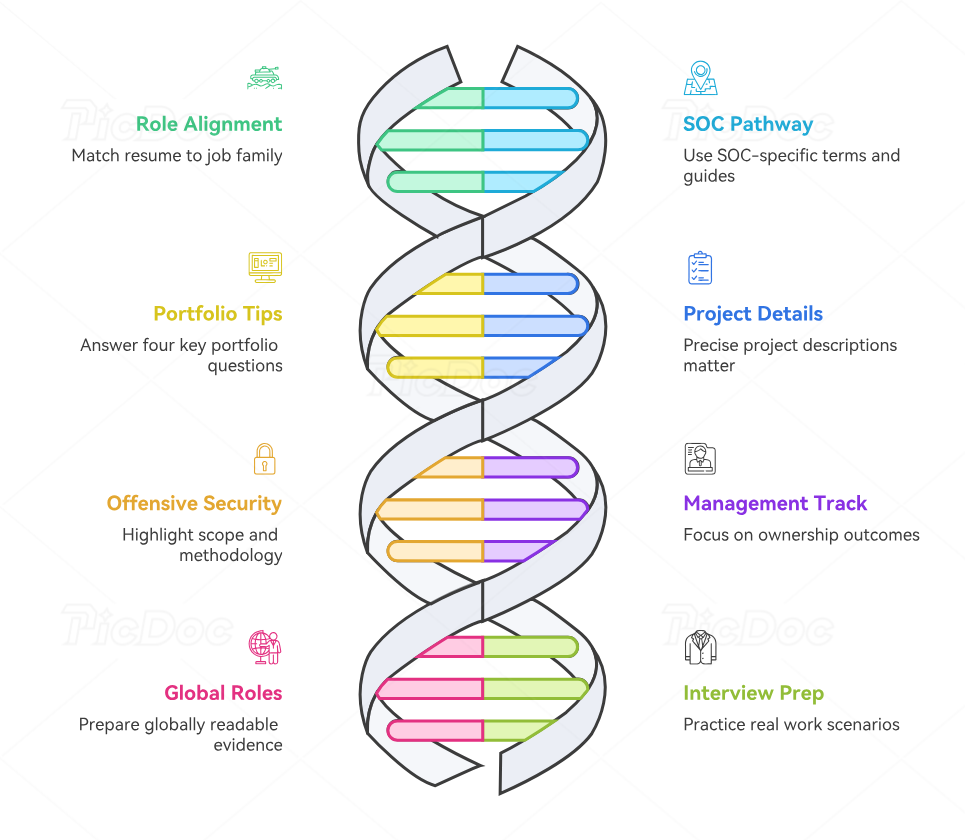
A certificate creates attention when the résumé shows evidence that the candidate can use the knowledge. The practical conversion process begins with role alignment. Choose one primary job family and shape your CV, LinkedIn profile, portfolio, projects, and interview preparation around its recurring responsibilities.
For a SOC pathway, use terms such as alert triage, log correlation, escalation, endpoint investigation, phishing analysis, incident classification, detection engineering, and response documentation. Study the SOC analyst pathway, SOC manager progression guide, threat-intelligence analyst roadmap, incident-responder career guide, and endpoint-security solutions guide.
Your portfolio evidence should answer four questions:
What asset, process, or environment did you examine?
What threat, weakness, or control failure did you identify?
Which tools and methods did you use?
What decision or remediation did your findings support?
A weak project description says, “Used a SIEM to analyze logs.” A stronger version explains that you ingested authentication events, created a detection rule for repeated failed logins followed by successful access, validated false positives, documented escalation criteria, and proposed account-protection controls. This level of precision demonstrates operational thinking.
Offensive-security candidates should present scope awareness, authorization, reproducible methodology, evidence quality, severity reasoning, remediation guidance, and retesting. Use the ethical hacker-to-consultant pathway, penetration-tester progression guide, red-team career roadmap, application-security directory, and vulnerability-assessment techniques.
Management-track candidates need evidence of ownership. Replace vague phrases such as “responsible for cybersecurity” with outcomes involving risk reduction, control completion, incident response time, audit closure, policy adoption, supplier remediation, security-awareness performance, or executive decision support. The cybersecurity director pathway, VP of security roadmap, CISO career guide, security-leadership transition guide, and policy-director pathway can help structure long-term progression.
Candidates pursuing opportunities outside Egypt should prepare globally readable evidence. Write reports in clear professional English, use internationally recognized control terminology, explain your legal assumptions, and avoid relying on organization-specific abbreviations. Remote roles often reward candidates who can work asynchronously, document decisions, communicate across time zones, and demonstrate cloud-based collaboration. Review remote cybersecurity career trends, remote salary analysis, freelance cybersecurity income trends, and future job-market predictions.
Interview preparation should mirror real work. Practice explaining a ransomware incident to an operations manager, presenting a high-risk vulnerability to a technical lead, defending a control recommendation to a finance stakeholder, and briefing senior management after a data breach. Use the ransomware threat analysis, data-breach industry report, insider-threat report, and AI-powered attack forecast to build realistic scenarios.
5. Costs, Timeline, Return on Investment and Your 90-Day Action Plan
The real cost of certification includes tuition, examination fees, retakes, laboratory access, hardware or cloud usage, study resources, internet reliability, and the hours removed from work or family commitments. Candidates should calculate the full investment before starting and select a pace that can survive busy weeks.
A fast eight-week path may suit someone with previous IT or security experience. A 12- to 16-week schedule provides more space for labs and portfolio development. A six-month pathway may suit career changers who need to build foundations while working full time. ACSMI’s published completion range allows candidates to adjust the program to their background and weekly availability.
Use a simple return-on-investment framework:
Career target value: Identify the role, seniority level, sectors, and geographic markets you intend to pursue.
Capability gap: List the skills repeatedly appearing in relevant job descriptions.
Certification coverage: Map each curriculum domain to those skill gaps.
Evidence plan: Decide which labs, reports, architectures, policies, or case studies will prove competence.
Opportunity cost: Calculate study hours, direct spending, and delayed alternatives.
Career conversion plan: Set application, networking, portfolio, and interview targets for the 90 days following completion.
You can strengthen this analysis through the certification career-impact report, certification salary-growth analysis, entry-level-to-CISO salary progression, cybersecurity workforce study, and 2026–2027 job-market report.
Days 1–30: Establish direction and foundations
Select a primary career track, complete the baseline assessment, enroll in the program, block weekly study periods, and create a progress dashboard. Review ten to fifteen relevant job descriptions from Egypt, Gulf markets, multinational employers, or remote organizations. Extract recurring tools, frameworks, certifications, and responsibility verbs.
Build foundations through cybersecurity learning resources, industry blogs, research organizations, professional conferences, and training platforms.
Days 31–60: Build applied evidence
Complete two focused labs every week. Save screenshots, commands, configuration decisions, investigation notes, findings, and remediation reasoning. Convert raw lab work into concise case studies that remove sensitive details while preserving the decision process.
Candidates interested in emerging disciplines can explore AI in cybersecurity, AI-driven security tools, IoT security careers, blockchain-security use cases, and quantum cybersecurity risks.
Days 61–90: Validate knowledge and activate the job strategy
Finish weak-domain review, complete practice assessments, polish three portfolio projects, revise your CV, strengthen LinkedIn positioning, and prepare six interview stories. Each story should demonstrate a problem, your analysis, the action taken, the result, and the lesson applied afterward.
Begin targeted outreach to security professionals, alumni, recruiters, training communities, and industry groups. Seek feedback on your portfolio rather than sending immediate job requests. Candidates interested in education or consulting can also review the cybersecurity instructor pathway, curriculum-developer roadmap, bootcamp-instructor guide, and cybersecurity content-creator pathway.
Certification renewal should also be planned from the beginning. Maintain a record of continuing education, webinars, conferences, professional reading, mentoring, labs, research, and workplace projects. Renewal becomes easier when professional development is captured monthly rather than reconstructed close to expiration.
6. Frequently Asked Questions
-
Yes. ACSMI presents the program as suitable for graduates, career changers, IT professionals, and candidates without previous cybersecurity experience. Beginners should strengthen networking, operating-system, cloud, and command-line fundamentals alongside the main curriculum. The entry-level certification directory, IT support transition guide, SOC analyst roadmap, and free course directory can support that preparation.
-
ACSMI publishes a flexible completion range of approximately eight weeks to six months. Candidates with strong technical foundations may progress quickly, while career changers may benefit from a longer schedule containing extra labs and foundational study. Choose a timeline based on practical competence, assessment readiness, and portfolio quality rather than speed alone.
-
Employment depends on the interaction between certification, technical ability, communication, practical evidence, previous experience, language skills, professional positioning, and employer demand. Increase your conversion rate through a role-specific résumé, documented projects, interview scenarios, and focused applications. The analyst advancement guide, senior analyst pathway, career-impact report, and workforce-market study provide useful planning context.
-
The best specialization depends on your existing capabilities and target employer. Security operations suits candidates who enjoy investigation and monitoring. Offensive security rewards deep technical practice. Cloud security suits professionals with infrastructure or platform experience. GRC fits candidates strong in documentation, analysis, law, controls, and stakeholder management. Management pathways require evidence of ownership across risk, people, budgets, and outcomes.
Review cloud-security careers, threat-intelligence careers, incident-response pathways, ethical-hacking careers, and compliance careers before committing.
-
Yes. Senior technical professionals regularly make decisions involving risk acceptance, project priorities, control ownership, staffing, vendor selection, audit remediation, and executive communication. Management knowledge helps them justify technical recommendations and compete for lead, architect, consultant, manager, director, and CISO-track positions.
The security specialist-to-CISO guide, security leadership roadmap, program manager pathway, and chief security architect guide explain how those responsibilities evolve.
-
The answer depends on your experience and target role. ACSMC can provide broad preparation across technical and management domains. CISSP and CISM are commonly associated with experienced professionals and leadership-oriented pathways. CEH provides broad ethical-hacking coverage, while OSCP demands sustained hands-on offensive-security ability.
Use the certification directory, CISSP and CEH salary analysis, CEH career guide, and OSCP penetration-testing roadmap to compare the likely value of each sequence
