
The Ultimate Guide to Getting Advanced Cybersecurity & Management Certification in Thailand: Everything You Need to Know in 2026-2027
Thailand’s expanding digital economy needs cybersecurity professionals who can investigate technical threats, interpret regulatory obligations, protect cloud environments, and communicate risk to decision-makers. An advanced credential can strengthen that profile when it supports a defined role and produces evidence employers can evaluate. This guide explains how to select, complete, and convert Advanced Cybersecurity & Management Certification into career leverage while using ACSMI’s certification directory, career-impact research, salary analysis, and future-skills forecast.
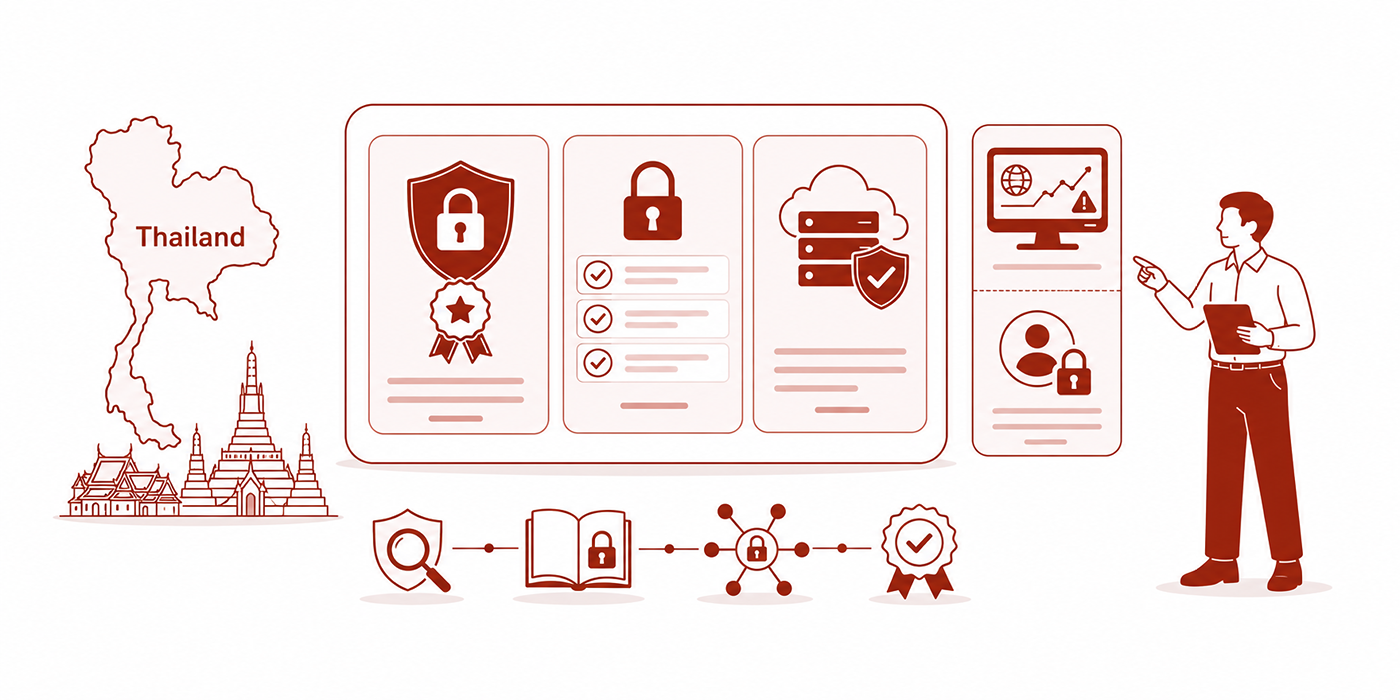
1. Why Advanced Cybersecurity & Management Certification Matters in Thailand
Thailand’s cybersecurity environment connects banking, tourism, e-commerce, healthcare, telecommunications, manufacturing, logistics, government services, digital platforms, and critical infrastructure. Professionals operating in these sectors need more than tool familiarity. They must understand how endpoint protection, cloud security controls, incident response, and enterprise risk management support business continuity.
Thailand’s Cybersecurity Act B.E. 2562 establishes national cybersecurity policies and measures, including provisions relevant to government agencies and private organizations operating critical information infrastructure. Thailand’s National Cyber Security Agency describes the law as a framework for preventing, managing, and reducing cyber-risk exposure.
That environment increases demand for professionals who can coordinate across technical, legal, operational, and executive teams. A security analyst may need to investigate an alert, determine whether regulated information was exposed, preserve evidence, advise incident leadership, and document the response. The SOC analyst pathway, incident responder roadmap, compliance analyst guide, and cybersecurity manager pathway illustrate how different roles contribute to that process.
Thailand’s Personal Data Protection Act also makes privacy-aware security capability important. Professionals supporting personal-data processing should understand lawful data handling, access governance, security safeguards, retention, vendor exposure, incident escalation, and cross-border data flows. The Personal Data Protection Committee operates Thailand’s official regulatory platform, while the government also maintains a dedicated PDPA compliance platform for public agencies.
A candidate who can connect the PDPA with access-control models, security-audit practices, privacy regulation trends, and cybersecurity compliance developments can contribute to projects that extend beyond routine technical support.
The main career problem is often weak proof rather than weak ambition. Applicants may list firewalls, Linux, SIEM, vulnerability scanners, and cloud platforms without demonstrating how they used those capabilities to reduce risk. Hiring managers need evidence that a candidate can distinguish urgent findings from noise, communicate limitations, recommend realistic remediation, and verify whether corrective action worked. The security analyst advancement guide, senior analyst roadmap, cloud engineer career guide, and security leadership pathway help translate knowledge into role-specific evidence.
ACSMI presents its Advanced Cybersecurity & Management Certification as a multi-domain online program containing 379 lessons, practical training, management content, and preparation across several cybersecurity domains. Its international learner structure supports remote participation across schedules and time zones.
Cybersecurity Certifications and Career Impact: 26-Credential Thailand Advancement Matrix
| Certification or Track | Best Career Stage | Primary Career Effect | Evidence Employers Should See |
|---|---|---|---|
| ACSMI Advanced Cybersecurity & Management Certification | Career transition through leadership | Develops cross-domain technical and management capability | Risk register, incident plan, security roadmap, executive brief |
| ISC2 Certified in Cybersecurity | Entry level | Establishes security fundamentals | Access review, security checklist, basic risk assessment |
| CompTIA Security+ | Entry to early career | Supports junior security and analyst applications | Phishing analysis, hardening plan, incident ticket |
| CompTIA CySA+ | Early blue-team career | Strengthens monitoring and investigation positioning | SIEM investigation, escalation note, detection recommendation |
| CompTIA PenTest+ | Early offensive-security career | Builds structured assessment knowledge | Authorized test plan, validated findings, remediation report |
| CompTIA SecurityX | Experienced technical professional | Supports advanced engineering and architecture roles | Threat model, architecture review, control design |
| CISSP | Experienced professional | Supports senior, consulting, architecture, and management roles | Program strategy, risk treatment, control mapping |
| CISM | Management pathway | Strengthens security-governance credibility | KPI dashboard, governance model, executive risk update |
| CISA | Audit and assurance | Supports information-systems audit responsibilities | Audit program, evidence register, findings report |
| CRISC | Risk and governance | Builds enterprise technology-risk capability | Risk register, treatment plan, risk indicators |
| CGEIT | Senior governance leadership | Supports enterprise IT governance positions | Governance framework, investment case, oversight report |
| CCSP | Mid-career cloud track | Develops cloud governance and architecture credibility | Cloud risk review, IAM design, encryption plan |
| CEH | Early offensive track | Provides structured ethical-hacking exposure | Recon methodology, finding validation, client-ready summary |
| OSCP | Hands-on penetration testing | Demonstrates practical offensive-security capability | Attack narrative, technical evidence, remediation guidance |
| OSEP | Advanced offensive security | Supports adversary-simulation responsibilities | Attack-chain report, detection gaps, defensive recommendations |
| GIAC GSEC | Early to mid-career | Builds broad practical security capability | Defense checklist, investigation record, control review |
| GIAC GCIH | Incident-response specialization | Strengthens containment and response credibility | Incident timeline, response decision log, lessons learned |
| GIAC GCIA | Network-defense specialization | Supports intrusion and traffic-analysis roles | Packet analysis, traffic baseline, detection rule |
| Threat Intelligence Certification Track | Analyst specialization | Builds intelligence collection and reporting capability | Threat profile, source evaluation, intelligence briefing |
| Digital Forensics Certification Track | Investigation specialization | Supports evidence and forensic-analysis work | Evidence log, forensic timeline, investigation summary |
| AWS Security Certification Track | Cloud practitioner through specialist | Supports AWS security responsibilities | IAM review, logging architecture, storage assessment |
| Microsoft Cloud Security Track | Cloud and identity career | Develops Azure and identity-security positioning | Conditional-access plan, identity review, monitoring workflow |
| Google Cloud Security Track | Cloud specialist | Supports Google Cloud security responsibilities | Access design, data-security review, monitoring plan |
| ISO/IEC 27001 Lead Implementer | GRC and management | Supports information-security management implementation | ISMS scope, risk assessment, treatment plan, policies |
| ISO/IEC 27001 Lead Auditor | Audit and consulting | Builds management-system audit capability | Audit plan, interview notes, findings, corrective actions |
| Privacy Management Certification Track | Privacy and GRC roles | Connects data protection with security governance | Data inventory, privacy-risk review, breach workflow |
2. How to Choose the Right Certification Path in Thailand
Start with a job outcome. A professional seeking a SOC position in Bangkok, Chiang Mai, Phuket, Chonburi, Rayong, or a remote international team should develop networking, operating-system, identity, log-analysis, endpoint, and incident-escalation capabilities. Pair certification study with the SOC analyst career guide, SIEM comparison directory, EDR technology guide, and network monitoring directory.
Your evidence should include an alert timeline, affected assets, investigative queries, severity rationale, containment recommendation, and escalation note. A screenshot showing a SIEM dashboard proves very little. A documented investigation proves that you can use telemetry to reach a defensible decision.
Cloud-security candidates should concentrate on identity, workload protection, storage permissions, encryption, network controls, secret management, logging, configuration governance, and cloud incident response. Thailand’s NCSA maintains a portal dedicated to cloud cybersecurity standards, reflecting the relevance of structured cloud-control practices.
Build your cloud pathway with the cloud security engineer roadmap, cloud threat report, cloud security tools directory, and future cloud-security analysis. A strong portfolio project can examine an exposed storage resource, excessive permissions, missing logging, attack paths, corrective controls, and post-remediation verification.
Professionals moving toward GRC, privacy, risk, or audit should select training that covers asset inventories, control testing, evidence quality, policy design, risk treatment, third-party security, data governance, and remediation monitoring. Use ACSMI’s compliance officer roadmap, cybersecurity auditor guide, NIST adoption analysis, and future audit-practices forecast.
The painful weakness in many GRC portfolios is generic policy writing. Employers need proof that you can identify the control objective, collect evidence, test operating effectiveness, document exceptions, assign ownership, and monitor corrective action. A polished policy without an implementation mechanism becomes paperwork rather than risk reduction.
Offensive-security candidates need an authorized, evidence-driven methodology. Learning to operate scanning and exploitation tools creates limited value without scope control, finding validation, reporting, and remediation knowledge. Combine the ethical-hacking roadmap, penetration tester pathway, vulnerability assessment guide, and penetration-testing tools comparison.
Management candidates should prioritize risk prioritization, program governance, incident leadership, staffing, budgeting, performance measurement, vendor oversight, and executive communication. The cybersecurity manager guide, program manager pathway, director of information security roadmap, and CISO advancement guide show how technical competence must evolve into organizational decision-making.
3. Skills Thai Employers Should Be Able to See After Certification
A useful certification changes the quality of your decisions. After completing advanced training, you should be able to investigate suspicious activity, identify incomplete evidence, distinguish vulnerability severity from business priority, design realistic controls, and communicate residual risk. Reinforce those skills through phishing trend analysis, ransomware research, data-breach analysis, and endpoint-security effectiveness research.
Technical investigation capability
You should be able to identify relevant telemetry, create a timeline, test competing explanations, document investigative gaps, and recommend the next action. This requires knowledge of next-generation SIEM, endpoint detection, network monitoring, and incident-response improvement.
A weak analyst forwards an alert with copied vendor text. A credible analyst explains what happened, what remains unknown, which assets are exposed, which evidence supports the conclusion, and what should happen next.
Risk and compliance capability
Security professionals working with Thai organizations should understand how technical controls support personal-data protection, contractual requirements, audit readiness, and operational resilience. Develop this through PDPA-relevant privacy trends, GDPR security practices, security audit methodology, and access-control governance.
Your portfolio should demonstrate how you would map assets, data, threats, controls, evidence, owners, and remediation deadlines. That structure shows the ability to turn regulatory language into operational work.
Cloud and application security capability
Modern digital services require professionals who can identify insecure configurations before they become incidents. Study application security tools, cloud security platforms, privileged access management, and data-loss prevention.
Useful evidence includes a threat model, secure architecture diagram, identity review, data-flow assessment, configuration baseline, and remediation tracker. These artifacts allow employers to assess your reasoning without relying entirely on the credential’s title.
Management and communication capability
Advanced professionals need to explain risk in language that finance, legal, operations, product, and executive teams can use. Study the security manager-to-director pathway, VP of cybersecurity roadmap, chief security architect guide, and cybersecurity policy director pathway.
A valuable executive brief states the exposed business process, credible threat, likely impact, current control weakness, recommended treatment, implementation owner, deadline, and residual risk. Technical detail belongs in supporting evidence.
Quick Poll: What Is Blocking Your Cybersecurity Career Growth in Thailand?
Choose the obstacle creating the greatest pressure so your certification plan solves the correct problem.
4. Step-by-Step Certification Plan for 2026-2027
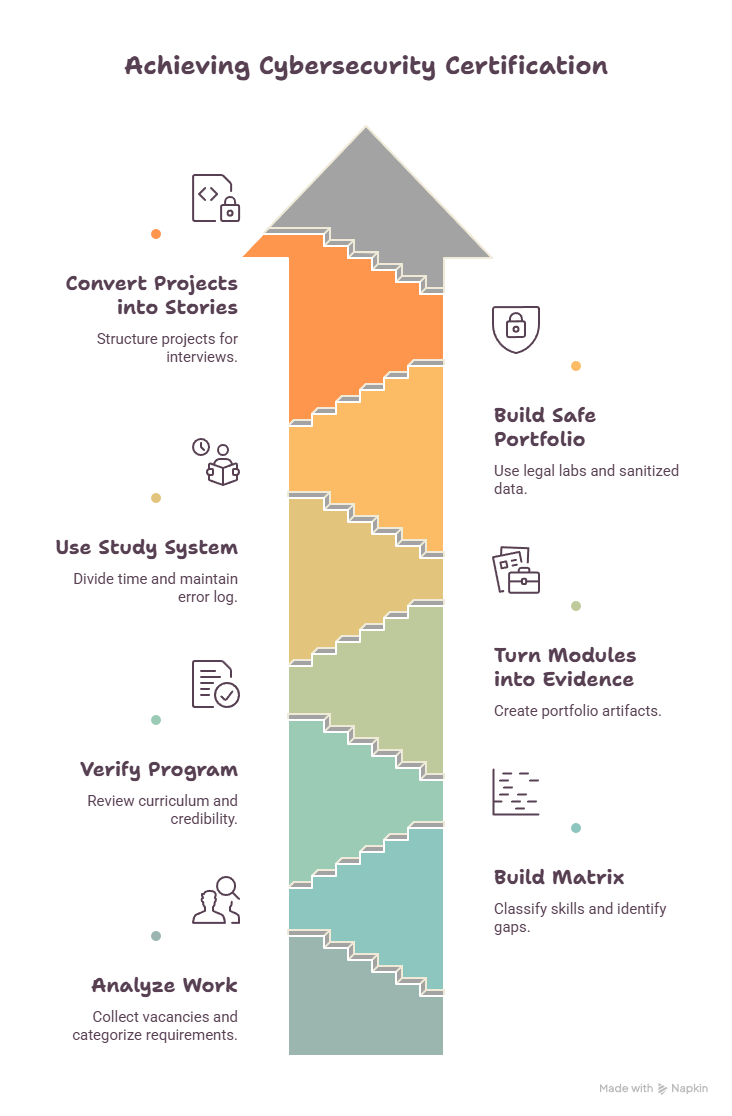
Step 1: Analyse the work before choosing the credential
Collect 20 to 30 vacancies that match your target role. Separate the requirements into technical skills, governance knowledge, tools, frameworks, communication responsibilities, experience expectations, and industry context. Use the cybersecurity job-market forecast, specialized role-demand analysis, remote-career outlook, and workforce shortage study.
Thailand’s Digital Economy Promotion Agency has introduced a Digital Skill Roadmap intended to develop workforce capability and prepare people for future industries. This reinforces the value of matching training with practical workforce needs.
Step 2: Build a capability-gap matrix
Classify each target skill under four levels:
Understand the concept
Perform with guidance
Perform independently
Explain, review, or lead the work
This method exposes false confidence. Someone may understand vulnerability management while lacking the ability to validate findings, rank remediation, assign ownership, and verify closure. Close specific gaps through the vulnerability assessment guide, incident responder roadmap, threat intelligence pathway, and security engineer roadmap.
Step 3: Verify the program before paying
Review curriculum depth, assessment design, practical exercises, delivery format, support, instructor or institutional credibility, renewal requirements, refund terms, and relevance to your target position. Examine the ACSMI certification program, international student structure, student testimonials, and global training-provider directory.
ACSMI states that its program is fully online and designed for international schedules. Its platform includes written lessons, video instruction, and additional learning formats accessible through internet-connected devices.
Step 4: Turn each module into evidence
A certification module should produce a portfolio artifact. Examples include:
A phishing investigation with a timeline and escalation decision
A cloud identity and access review
A vulnerability-remediation tracker
A PDPA-oriented data-security assessment
An incident-response playbook
An ISO/IEC 27001 gap analysis
A security metrics dashboard
An executive risk briefing
Support this work with the free cybersecurity course directory, cybersecurity book directory, YouTube learning guide, and industry podcast directory.
Step 5: Use a defensible study system
Divide each week among concept learning, guided practice, independent execution, documentation, and retrieval review. Maintain an error log recording the misunderstood concept, incorrect decision, correct principle, and a new scenario where the principle applies.
Repeated reading creates recognition. Closed-book summaries, timed scenarios, practical exercises, and explanation practice build retrieval. Reinforce your judgment through cybersecurity framework guidance, future threat analysis, AI-powered attack research, and future cybersecurity standards.
Step 6: Build a safe portfolio
Use legal labs, public datasets, fictional companies, sanitized scenarios, and environments you own. Never expose employer information, customer records, internal screenshots, private credentials, or findings from unauthorized systems.
A useful portfolio entry contains the problem, scope, assumptions, methodology, evidence, decision, recommendation, limitations, and verification method. Choose realistic technologies through the SIEM directory, vulnerability scanner guide, application-security directory, and endpoint-security provider comparison.
Step 7: Convert projects into interview stories
Use a structured sequence:
Situation → exposed asset → evidence → decision → action → result → lesson
Replace “I understand risk management” with an example showing how you identified an exposed process, estimated likelihood and impact, reviewed current controls, proposed treatment, assigned ownership, and defined verification. Prepare with the IT support transition guide, network administrator transition roadmap, analyst advancement guide, and cybersecurity consultant pathway.
5. How to Turn Certification Into Career and Salary Leverage
Your résumé should present one coherent professional direction. A SOC candidate needs evidence of detection, investigation, escalation, and response. A cloud-security candidate needs identity, configuration, logging, and architecture evidence. A GRC candidate needs risk, controls, policies, evidence, and remediation. Use the SOC manager pathway, penetration testing manager guide, compliance career roadmap, and security architect pathway.
For international or remote roles, make every project easy to evaluate. Use clear English where the target position requires it, define assumptions, explain business impact, identify limitations, and link findings to recognized frameworks. Research expectations through the global cybersecurity salary report, remote salary analysis, freelance cybersecurity report, and future job-market forecast.
For promotion, volunteer to own a bounded security problem. Examples include improving incident documentation, establishing vulnerability ownership, reviewing privileged access, creating a third-party security checklist, designing useful metrics, or organizing audit evidence. Document the baseline, risk, owner, target date, implementation, and measurable outcome. Develop the required leadership perspective through the security manager-to-director roadmap, IT manager transition guide, VP of security pathway, and CISO career roadmap.
For salary negotiation, connect the certification to increased scope and measurable value. Useful evidence includes faster incident triage, fewer unresolved vulnerabilities, stronger audit readiness, better cloud access governance, reduced manual reporting, improved recovery procedures, or clearer executive risk decisions. Prepare using the certification salary analysis, career-impact survey, salary progression research, and job-market salary forecast.
The strongest career cycle is continuous:
Learn → apply → document → request responsibility → measure → communicate → advance
Maintain that cycle through the cybersecurity research directory, global conference guide, industry-news directory, and future certification analysis.
6. FAQs
-
Its value increases when the curriculum matches a defined career target and produces evidence of practical capability. Professionals pursuing SOC, cloud, risk, compliance, audit, consulting, or management roles can use advanced training to close cross-domain gaps. Compare the ACSMI certification, certification ranking directory, career-impact research, and future certification forecast.
-
Yes. ACSMI describes the program as fully online and structured for international schedules, time zones, and working professionals. Learners can access the platform through an internet-connected computer, tablet, or mobile device. Review the international learner information, program overview, student testimonials, and training-provider directory.
-
ACSMI’s enrollment platform describes a flexible completion range of approximately eight weeks to six months, allowing learners to adjust their pace around work and other commitments. Study efficiency depends on previous experience, weekly consistency, lab depth, and the amount of portfolio work completed. Supplement the program through the free course directory, book directory, YouTube channel guide, and cybersecurity podcast directory.
-
ACSMI describes the program as suitable for college graduates, career changers, and IT professionals, including learners without previous cybersecurity experience. Beginners should allocate extra time to networking, operating systems, command-line work, identity, security principles, and risk terminology. Start with the IT support transition guide, SOC analyst roadmap, ethical-hacking pathway, and certification directory.
-
Career potential depends on your existing experience, industry access, language capability, technical interests, and willingness to pursue domestic or international work. Strong pathways include SOC operations, cloud security, application security, incident response, GRC, privacy, auditing, penetration testing, and security management. Compare the cloud security roadmap, incident responder guide, compliance analyst pathway, and red-team roadmap.
-
Certification strengthens knowledge and signaling, while hiring decisions also depend on experience, practical proof, communication, interview performance, specialization, and role fit. Build a portfolio that shows how you investigate evidence, identify risk, recommend controls, and communicate conclusions. Use the job-market analysis, workforce study, analyst advancement guide, and future-skills forecast.
