
The Ultimate Guide to Getting Advanced Cybersecurity & Management Certification in New Jersey: Everything You Need to Know in 2026-2027
New Jersey cybersecurity careers sit close to some of the most demanding risk environments in the country: finance, healthcare, pharmaceuticals, logistics, public-sector systems, higher education, insurance, cloud services, and enterprise technology. That makes advanced cybersecurity and management certification more than résumé decoration. It can become the proof that you understand security as a business responsibility.
This guide breaks down which certifications create real leverage, how New Jersey professionals should choose a path, and how to turn certification into stronger roles, higher trust, and better career mobility.

1. Why Advanced Cybersecurity & Management Certification Matters in New Jersey in 2026-2027
New Jersey professionals compete in a security market where basic technical ability rarely carries someone into senior responsibility by itself. Employers need people who can connect detection, compliance, identity, cloud, vendor risk, incident response, executive reporting, and team leadership. A candidate who can speak across those layers has stronger positioning for cybersecurity manager pathways, security analyst advancement, SOC manager growth, and CISO-track planning.
The painful part is that many professionals study hard and still choose the wrong credential. They pass an exam that looks impressive, then discover it does not support the next job they actually want. A Newark SOC analyst, a Jersey City compliance professional, an Edison cloud engineer, a Trenton public-sector security candidate, and a Princeton-area risk leader need different certification logic. That is why a smarter plan starts with role direction, then uses cybersecurity certification rankings, certification career impact research, salary growth certification analysis, and future cybersecurity skills as supporting evidence.
Advanced certification becomes especially valuable when it proves management range. CISSP can support architecture and senior security credibility. CISM can help with governance and program leadership. CISA can support audit and assurance. CRISC can strengthen risk ownership. CCSP can sharpen cloud-security positioning. OSCP can validate offensive depth. Security+, CySA+, PenTest+, and CASP+ can help earlier-career professionals build toward SOC analyst careers, ethical hacking roadmaps, cloud security engineering, and cybersecurity compliance officer tracks.
New Jersey also rewards sector fluency. A healthcare employer cares about patient-data exposure, ransomware readiness, access control, and audit evidence. A financial employer cares about fraud risk, resilience, vendor exposure, identity, and reporting. A logistics or port-adjacent employer cares about operational continuity, third-party systems, endpoint resilience, and incident response. A public-sector employer cares about policy, documentation, access discipline, and control maturity. That means your certification should connect with healthcare cybersecurity threat analysis, financial-sector cybersecurity incidents, critical infrastructure cybersecurity, and government cybersecurity providers.
Advanced Cybersecurity & Management Certification in New Jersey: 26-Credential Career Advancement Matrix
| Certification / Track | Best New Jersey Career Fit | Where It Creates Real Leverage | ACSMI Resource |
|---|---|---|---|
| CISSP | Senior security analyst, architect, manager | Strong for professionals who need broad credibility across architecture, operations, governance, and risk. | CISSP salary growth |
| CISM | Security manager, program manager, director track | Useful when the next move requires governance, program ownership, budget awareness, and executive reporting. | Cybersecurity manager path |
| CISA | Cybersecurity auditor, compliance analyst | Fits regulated employers that need control testing, audit readiness, and evidence discipline. | Cybersecurity auditor guide |
| CRISC | Risk analyst, GRC lead, security manager | Helps professionals translate cyber exposure into business risk, control ownership, and remediation priority. | Compliance trends report |
| CCSP | Cloud security engineer, cloud risk lead | Strong for hybrid-cloud, SaaS, identity, data protection, and shared-responsibility conversations. | Cloud security engineer |
| Security+ | Entry security analyst, IT-to-cybersecurity transition | Gives baseline credibility when paired with labs, projects, and clear role direction. | IT support to analyst |
| CySA+ | SOC analyst, detection analyst, incident triage | Useful for analysts proving they can investigate alerts, prioritize threats, and improve defensive workflow. | SOC analyst guide |
| CASP+ | Advanced practitioner, technical lead | Helps experienced professionals show senior technical depth before moving into architecture or leadership. | Analyst to engineer |
| PenTest+ | Junior penetration tester, assessment specialist | Works for candidates building offensive credibility before more demanding hands-on credentials. | Penetration testing tools |
| CEH | Ethical hacking, security testing, consulting | Useful when employers recognize the credential and the candidate can support it with practical work. | CEH career guide |
| OSCP | Penetration tester, red-team operator | Creates strong leverage for hands-on offensive roles where proof matters more than theory. | OSCP roadmap |
| GRC certificate path | Compliance analyst, risk coordinator | Best for professionals moving toward frameworks, policies, audit evidence, and risk registers. | Compliance analyst roadmap |
| NIST framework training | Public-sector, healthcare, enterprise risk roles | Helps candidates explain control maturity, risk governance, and program improvement clearly. | NIST framework adoption |
| ISO / COBIT training | Audit, governance, enterprise security | Supports professionals who need to discuss frameworks with leadership and auditors. | Cybersecurity frameworks |
| Incident response training | Incident responder, SOC lead | Builds credibility around containment, escalation, evidence handling, and post-incident improvement. | Incident responder roles |
| Threat intelligence training | Threat intelligence analyst, security researcher | Helps professionals explain attacker behavior, sector-specific risk, and defensive prioritization. | Threat intelligence roadmap |
| Cloud vendor security certificates | Cloud engineer, DevSecOps, cloud auditor | Useful for proving platform-specific security knowledge around identity, logging, and workload protection. | Cloud security tools |
| Application security training | AppSec analyst, secure SDLC lead | Strong for software, SaaS, fintech, and product teams that need security built into development. | Application security tools |
| Identity and access management path | IAM analyst, access governance lead | Creates leverage in environments fighting account takeover, privilege sprawl, and audit exceptions. | Access control models |
| PAM specialization | Identity security, infrastructure security | Useful for candidates working around privileged accounts, administrator access, and sensitive systems. | PAM solutions |
| EDR / endpoint security path | Endpoint security analyst, SOC engineer | Helps prove practical capability around endpoint hardening, detection, response, and telemetry. | EDR tools guide |
| SIEM / detection engineering path | Detection engineer, SOC lead | Builds credibility around alert quality, use-case design, log coverage, and measurable detection improvement. | SIEM solutions |
| DLP / data protection path | Data security analyst, privacy security lead | Fits employers protecting customer records, intellectual property, payment data, and regulated files. | DLP software |
| Security awareness training path | Security enablement, awareness manager | Useful for professionals reducing phishing risk, employee mistakes, and behavior-driven exposure. | Security awareness platforms |
| Cybersecurity program management | Program manager, security operations coordinator | Helps coordinate remediation, vendors, audits, tool rollouts, and cross-functional security initiatives. | Program manager guide |
| Executive security leadership path | Director, VP, CISO-track leader | Best for senior professionals who must connect cyber risk, budget, resilience, compliance, and trust. | VP cybersecurity leadership |
2. How to Choose the Right Advanced Cybersecurity Certification in New Jersey
The right certification should answer one career question: what responsibility are you trying to earn next? A professional trying to land a first cybersecurity role needs a different credential than someone trying to become a security manager, GRC lead, cloud security engineer, penetration tester, or director. This is where many candidates waste time. They chase a famous acronym before they know whether the credential supports junior analyst transitions, senior analyst advancement, cybersecurity manager development, or security leadership promotion.
If your goal is security operations leadership, CySA+, CASP+, CISSP, incident response training, and SIEM or EDR specialization can create a clear path. The strongest candidates prove they can reduce alert fatigue, improve escalation quality, create playbooks, and explain incidents without drowning leadership in technical noise. Pair your preparation with SOC analyst to SOC manager guidance, incident response career planning, state of ransomware analysis, and phishing prevention research.
If your goal is governance, risk, compliance, privacy, or audit, CISA, CRISC, CISM, NIST, ISO, COBIT, and privacy-oriented training will usually create stronger leverage than purely technical certificates. New Jersey has many environments where control evidence, risk documentation, access reviews, vendor oversight, and audit readiness matter. A certification becomes powerful when you can discuss real workflows: policy exceptions, control mapping, remediation owners, third-party reviews, and leadership dashboards. Strengthen that track with cybersecurity auditor guidance, future audit practice predictions, privacy regulation trends, and healthcare compliance reporting.
If your goal is technical specialization, choose a credential that sharpens the exact lane. Cloud candidates should focus on CCSP, cloud vendor security, identity, logging, workload protection, and configuration risk. Offensive candidates should consider PenTest+, CEH, OSCP, and a portfolio of reports. AppSec candidates should study secure SDLC, vulnerability classes, threat modeling, and testing tools. Build that choice through cloud security career guidance, OSCP penetration testing roadmap, ethical hacking transition advice, and application security tool analysis.
The smartest decision rule is simple: match the certification to the job posting, then match your projects to the certification. If job ads ask for risk management, choose a risk credential and create a risk register sample. If job ads ask for incident response, choose defensive training and write a mock incident report. If job ads ask for cloud security, choose a cloud path and document a cloud control review. That approach turns certification into proof instead of decoration.
3. The New Jersey Skill Stack Employers Actually Reward
A strong New Jersey cybersecurity career usually needs four layers: technical competence, risk language, documentation discipline, and stakeholder communication. Certification supports all four, but only when you study with role context. A person who memorizes exam domains may pass. A person who converts each domain into a workplace example becomes more promotable.
Technical competence starts with the security fundamentals that keep organizations alive: vulnerability management, endpoint protection, identity controls, email security, logging, network monitoring, cloud configuration, and incident response. These are the areas where mistakes create visible damage. Study vulnerability assessment techniques, top vulnerability scanners, email security solutions, and network monitoring security tools to understand how real environments are protected.
Risk language is what separates a senior candidate from a task executor. “We have outdated systems” sounds vague. “This unsupported asset increases ransomware exposure, weakens audit posture, and needs compensating controls until replacement” sounds like ownership. The same shift applies to cloud misconfiguration, excessive privilege, weak vendor controls, untested backups, and unmanaged endpoints. Build that vocabulary with cybersecurity compliance trends, NIST framework adoption, security audit best practices, and data breach mitigation strategies.
Documentation discipline matters because advanced roles live on evidence. A manager wants an incident timeline. An auditor wants access review proof. A director wants metrics. A customer wants assurance. A vendor review needs findings and owners. A tabletop exercise needs lessons learned. A certification gives you the language; your documents prove you can use it. Practice writing sanitized artifacts linked to cybersecurity incident response reporting, insider threat prevention, cloud environment threat analysis, and IoT security breach research.
Stakeholder communication is the promotion engine. New Jersey employers need security people who can talk with IT, legal, HR, finance, compliance, product, executives, and vendors without losing precision. That means you should translate every certification domain into business consequences. Identity becomes access risk. Logging becomes investigation readiness. Patching becomes exposure reduction. Vendor security becomes third-party accountability. Build this communication layer with cybersecurity workforce shortage research, future cybersecurity job market predictions, specialized cybersecurity role demand, and automation workforce analysis.
Quick Poll: What Is Your Biggest Certification Pressure Point in New Jersey?
Choose the outcome you are really chasing, because the right certification path changes when the career pressure changes.
4. How to Match Certification to New Jersey Industries and Career Tracks
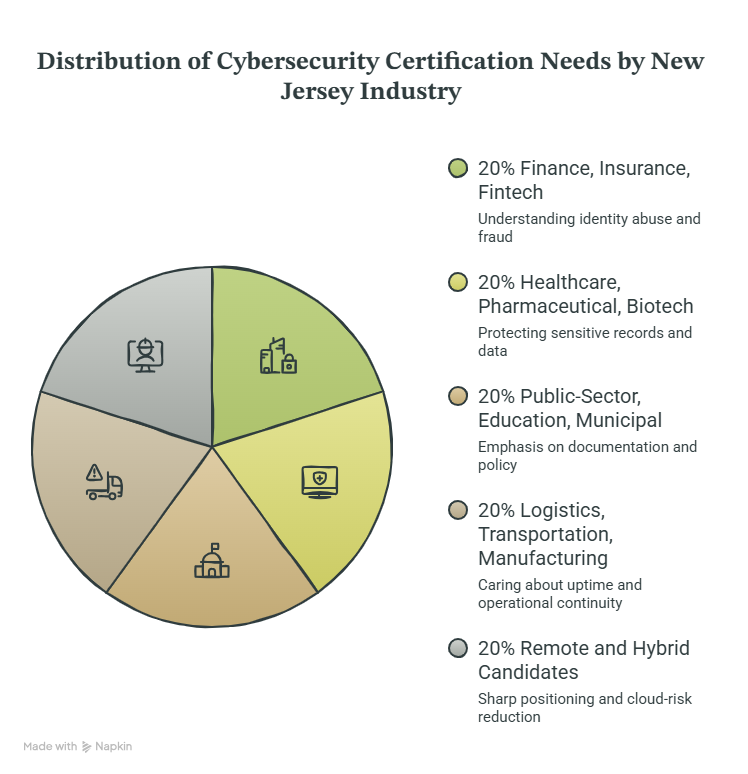
New Jersey’s cybersecurity market rewards people who understand sector pressure. A certification becomes more persuasive when it matches the problems your target employers actually face. A generic “cybersecurity certified” claim sounds thin. A focused claim such as “CISM-trained security manager with experience improving audit readiness and incident reporting for regulated environments” gives hiring managers a clearer reason to keep reading.
Finance, insurance, fintech, and payment-adjacent employers need security professionals who understand identity abuse, vendor risk, fraud-adjacent exposure, cloud control gaps, resilience, and executive reporting. CISSP, CISM, CRISC, CCSP, SIEM, IAM, and incident response training can fit this space well. Build your knowledge with financial cybersecurity firms, financial-sector cyber incident analysis, global cybersecurity salary benchmarks, and remote cybersecurity salary research.
Healthcare, pharmaceutical, biotech, and life-sciences employers need professionals who can protect sensitive records, research data, clinical workflows, vendor systems, and regulated processes. GRC, risk, cloud security, identity, incident response, and data protection credentials can create strong leverage here. Tie your certification plan to healthcare cybersecurity firms, healthcare compliance research, data loss prevention software, and future healthcare cybersecurity predictions.
Public-sector, education, and municipal environments place a premium on documentation, policy, access controls, procurement awareness, budget constraints, and practical resilience. CISA, CISM, CISSP, NIST, access control, incident response, and awareness training can be especially useful. Strengthen that path with education-sector cybersecurity solutions, government cybersecurity predictive analysis, security awareness platforms, and future education cybersecurity threats.
Logistics, transportation, manufacturing, and infrastructure-adjacent employers care about uptime, operational continuity, endpoint security, vendor access, network segmentation, and incident readiness. A candidate with CASP+, CISSP, incident response training, vulnerability management, EDR, SIEM, and industrial-security awareness can tell a stronger story here. Build the track through transportation cybersecurity firms, manufacturing security solutions, endpoint security effectiveness, and network monitoring tools.
Remote and hybrid candidates in New Jersey need an especially sharp positioning line because they compete beyond the local market. A strong remote profile should state the exact value: cloud-risk reduction, GRC implementation, SOC leadership, incident response, detection engineering, AppSec, or identity governance. Support that profile with remote cybersecurity career predictions, cybersecurity job market trends, future cloud security trends, and next-gen SIEM analysis.
5. Turning Certification Into Salary Growth, Promotions, and Senior Trust
Passing the exam is only the visible part of the move. The real career gain comes from translating the credential into stronger evidence. Before you announce the certification, build the story around it: what you can now lead, what risk you can reduce, what conversations you can handle, and what outcomes you can improve.
Start with your résumé. Replace task language with ownership language. “Monitored alerts” becomes “improved SOC escalation quality by documenting triage criteria and reducing low-value alerts.” “Helped with compliance” becomes “supported control evidence collection, exception tracking, and remediation follow-up.” “Worked on cloud security” becomes “reviewed cloud identity, logging, storage exposure, and misconfiguration risk.” That upgrade helps certification connect with entry-level to CISO salary progression, certification impact research, cybersecurity salary trends, and cybersecurity workforce demographics research.
Then build a small proof portfolio. For a GRC path, create a sample risk register, control matrix, audit evidence checklist, and policy exception memo. For a SOC path, create an incident timeline, triage decision tree, alert-quality dashboard, and post-incident review. For cloud security, create a shared-responsibility map, IAM review, logging checklist, and misconfiguration remediation plan. For offensive security, create a sanitized penetration test report and remediation summary. Link your portfolio thinking to penetration testing company reviews, red-team specialist careers, cloud security tools directory, and SIEM solution comparisons.
Use the certification internally as a trust-building tool. Ask to lead a tabletop exercise, improve an access review process, write a security exception template, mentor a junior analyst, map a control gap, update incident response documentation, or review vendor security questionnaires. Promotions usually come from visible ownership, not private studying. This is where advanced learners can connect with cybersecurity program management, security specialist to CISO planning, IT management to security leadership, and director of information security careers.
For salary leverage, avoid saying only “I earned a certification.” Say what changed. You can now lead risk conversations, improve audit readiness, design cloud controls, strengthen incident response, reduce alert waste, manage vendor risk, or support executive reporting. That is the difference between a credential and a compensation argument. Prepare with salary growth for certifications, freelance and consulting income data, cybersecurity gender pay gap analysis, and future cybersecurity job-market predictions.
6. FAQs About Advanced Cybersecurity & Management Certification in New Jersey
-
The best certification depends on your target role. CISSP is strong for broad senior security credibility, CISM works well for management, CISA fits audit, CRISC fits risk, CCSP fits cloud security, and OSCP fits hands-on offensive roles. New Jersey professionals should compare the credential against real job descriptions, then use cybersecurity certification directories, certification advancement research, future certification value predictions, and career advancement salary data.
-
Choose CISSP when your target role needs broad technical and security-domain credibility across architecture, operations, identity, risk, and software security. Choose CISM when your target role leans more toward governance, program leadership, security strategy, and business-risk communication. Many senior leaders eventually benefit from both. Start with the one that matches your next job posting and support it with cybersecurity manager pathways, security manager to director planning, VP of security guidance, and CISO roadmaps.
-
Advanced certification is worth it when it helps organize your experience into a stronger career story. Many experienced professionals have real skill but weak signaling. A respected credential can turn scattered tasks into recognizable expertise: risk management, cloud security, incident response, audit, governance, architecture, or leadership. It works best when paired with proof from security audits, incident response effectiveness, vulnerability assessment, and cybersecurity workforce shortage research.
-
For GRC roles, CISA, CRISC, CISM, NIST training, ISO/COBIT framework knowledge, and privacy-oriented education can be more valuable than purely technical credentials. Employers want people who can map controls, track remediation, prepare evidence, explain risk, and support audits. Build that track with cybersecurity compliance analyst guidance, cybersecurity auditor careers, future compliance predictions, and privacy regulation predictions.
-
A strong cloud security path can include CCSP, cloud vendor security certificates, identity training, logging and monitoring knowledge, secure configuration skills, and compliance awareness. The best cloud candidates can explain shared responsibility, privileged access, storage exposure, encryption, workload segmentation, incident response, and cost-aware control design. Strengthen your plan with cloud security engineer guidance, future cloud security trends, cloud security tools, and AI-driven cybersecurity tools.
-
Yes, certification can help when it is paired with practical proof. Security+, CySA+, hands-on labs, basic incident analysis, vulnerability management projects, and strong résumé language can support the move from IT support into cybersecurity. The transition works best when you show how your IT background connects to identity, endpoints, patching, troubleshooting, user risk, and infrastructure. Use IT support to cybersecurity analyst guidance, SOC analyst step-by-step planning, free cybersecurity courses, and cybersecurity bootcamp directories.
